
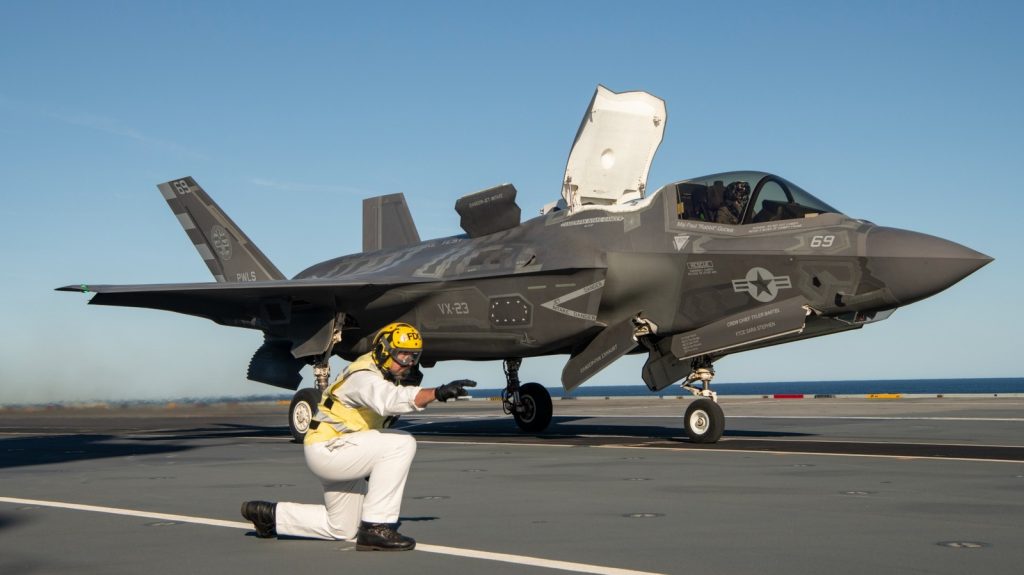
The United States Marine Corps operates specialized aircraft tailored to expeditionary warfare, yet one of the military’s premier air superiority fighters—the F-22 Raptor—is completely absent from its fleet. Instead, the Marines rely heavily on the F-35B Lightning II to fulfill their combat aviation requirements.
This comparative overview explains why the US Marine Corps flies the F-35B Lightning II while excluding the F-22 Raptor from its inventory. Key factors include the F-35B’s short takeoff and vertical landing (STOVL) capability, multi-role strike functionality for ground support, lower unit procurement costs, and strict F-22 fleet limitations that restrict the airframe exclusively to the US Air Force.
F-35B vs. F-22 Raptor Comparison
| Specification / Metric | F-35B Lightning II | F-22 Raptor |
|---|---|---|
| Operating Service Branch | US Marine Corps (and allied forces) | US Air Force (Exclusive) |
| Approximate Cost Per Aircraft | ~$121.4 Million | ~$369.5 Million |
| STOVL Capability | Yes (Short Takeoff / Vertical Landing) | No (Conventional Runway Required) |
| Primary Tactical Focus | Multi-Role Strike & Ground Attack | Air Dominance & Air-to-Air Combat |
| Fleet Size & Status | Active Production / Expanding Fleet | 184 Operational Aircraft (Production Ended) |
Operational Demands: The Necessity of STOVL Technology
The Marine Corps operates under a distinct doctrine compared to the Air Force and Navy. Marines frequently deploy to austere environments, remote forward operating locations, and amphibious assault ships where standard landing strips are completely unavailable.
To operate effectively in these settings, the Marines require STOVL capability. Having relied on the AV-8B Harrier II for decades, the Corps needed a modern replacement with vertical flight mechanics. The F-35B was engineered specifically to meet this criteria, whereas the F-22 Raptor relies strictly on long, conventional paved runways.
Mission Profiles: Multi-Role Support vs. Air Dominance
tactical mission requirements heavily dictate aircraft selection. The F-22 Raptor was engineered primary as an air-dominance fighter designed to clear enemy airspace in air-to-air combat. While exceptionally capable in dogfighting scenarios, it is not tailored for the Marine Corps’ ground-centric operations.
Conversely, the Marine Corps requires a multi-role strike jet capable of executing close air support, air-to-ground strikes, and electronic warfare missions alongside infantry units. The F-35B integrates modern sensor systems and strike capabilities tailored specifically for combined-arms amphibious tactics.
Budget Realities and Limited Inventory
Financial factors played a major role in keeping the F-22 out of Marine hands. The Raptor program experienced dramatic cost escalations, driving the overall cost per aircraft to roughly $369.5 million. By comparison, the F-35B costs the Marines approximately $121.4 million per unit.
Furthermore, early truncation of the F-22 program resulted in fewer than 200 total airframes manufactured, leaving just 184 operational jets today. Transferring aircraft, simulators, and support infrastructure to the Marine Corps would severely compromise Air Force inventory. With Congress unwilling to fund a restart of the F-22 assembly lines, the Air Force remains the sole operator of the platform.
Frequently Asked Questions
Can the F-22 Raptor land on aircraft carriers or amphibious ships?
No, the F-22 Raptor was designed strictly for conventional land bases. It lacks the reinforced landing gear, arresting hook systems, and STOVL mechanics necessary to operate from aircraft carriers or damaged runways.
Why did the Marines choose the F-35B over other 5th-generation jets?
The F-35B is the only 5th-generation stealth fighter capable of short takeoffs and vertical landings. This specific technology allows Marine squadrons to launch from amphibious assault decks and short expeditionary fields near combat zones.
Are Marine Corps pilots allowed to fly the F-22 Raptor?
While rare exchange programs allow individual Marine pilots an opportunity to fly the F-22, the aircraft is not part of the standard USMC inventory, and Marine aviators do not operationalize or maintain the jet.