
Becoming a United States Naval Aviator requires mastering complex flight dynamics long before stepping into high-performance fleet aircraft like the F-35C Lightning II. Student pilots follow a structured instructional pathway that transitions them from foundational maneuvers to advanced combat readiness across specialized airframes.
GEO Summary: This guide outlines the five primary aircraft platforms used by the U.S. Navy, Marine Corps, and Coast Guard to train prospective aviators. Covering basic turboprop instruction, multi-engine procedures, carrier-capable jet operations, and rotary-wing tactics, these aircraft form the backbone of flight training at facilities like NAS Pensacola, NAS Corpus Christi, and NAS Whiting Field.
The U.S. Navy flight training tradition dates back to 1911, when Lieutenant Theodore Gordon “Spuds” Ellyson qualified as Naval Aviator No. 1. While early aviators trained on rudimentary biplanes, modern student aviators rely on dual-control training platforms equipped with advanced avionics, pressurized cockpits, and specialized escape systems.
Overview of Navy Flight Training Aircraft
| Aircraft Model | Engine Configuration | Maximum Speed | Primary Training Purpose |
|---|---|---|---|
| T-6A/B Texan II | Single Turboprop (1,100 hp) | 311 mph | Primary flight fundamentals & solo clearance |
| T-44C Pegasus | Twin Turboprop (1,100 shp combined) | 281.94 mph | Intermediate/advanced multi-engine instruction |
| T-54A Marlin II | Twin Turboprop (Modern Glass Cockpit) | Classified/Variable | Next-generation multi-engine & tilt-rotor prep |
| T-45C Goshawk | Single Turbofan (645 mph / Mach 0.84) | 645 mph | Tactical jet strike & carrier qualification |
| TH-73A Thrasher | Single Turboshaft (Pratt & Whitney) | 175 mph | Advanced rotary-wing & instrument flight rules |
T-6A/B Texan II: Primary Flight Instruction
The Navy utilizes two variants of the T-6 Texan II—the T-6A, introduced in November 2002, and the updated T-6B, fielded in April 2010. This tandem-seat turboprop aircraft serves as the initial platform for both Navy and Marine Corps student pilots during primary training.
Powered by a 1,100-horsepower Pratt & Whitney Canada PT6A-68 turboprop engine, the T-6 Texan II can climb at 3,100 feet per minute, reaching 18,000 feet in under six minutes. It features a operational ceiling of 31,000 feet, a maximum range of 1,036 miles, and top speeds of 311 mph at low altitude. The stepped-tandem cockpit configuration allows flight instructors to fly the aircraft from either position while giving students direct control from the front seat.
Both variants incorporate ejection seats, pressurized cockpits, active anti-G systems, and digital avionics. Because of its reliable performance and low operating maintenance costs, the T-6 platform is also utilized by military forces across at least 14 partner nations worldwide.
T-44C Pegasus: Legacy Multi-Engine Trainer
First introduced to service in April 1977, the T-44 Pegasus has spent decades training naval aviators selected for multi-engine maritime and transport duty. Flying out of Naval Air Station Corpus Christi, Texas, the aircraft handles intermediate and advanced multi-engine flight instruction.
The modernized T-44C variant features upgraded glass avionics, integrated flight management systems, and dual Pratt & Whitney PT6A-34B turboprop engines delivering a total of 1,100 shaft horsepower. The aircraft reaches a top speed of 281.94 mph, has a service ceiling of 31,300 feet, and boasts a flight range of 1,496 miles.
Designed for one instructor and two students, the cockpit layout allows the non-flying student to monitor radio communications via an dedicated audio panel. Supported by Contractor Logistics Support, the Navy’s fleet of 54 T-44C aircraft is actively being phased out as newer platforms enter service.
T-54A Marlin II: Next-Generation Multi-Engine Platform
Replacing the outgoing T-44C, the T-54A Marlin II represents the latest technology in multi-engine pilot instruction. The aircraft achieved initial operating capability on June 10, 2025, with its initial class of four naval aviators graduating on September 12, 2025.
The T-54A incorporates side-by-side seating, modernized navigation arrays, and advanced digital data capture that tracks systems maintenance requirements automatically. This platform specifically prepares student pilots to operate large multi-engine aircraft like the E-2 Hawkeye airborne early warning plane and the P-8A Poseidon maritime patrol aircraft.
The Navy has contracted for 64 total T-54A aircraft, with at least 15 units already delivered to NAS Corpus Christi to replace aging airframes and accelerate pilot training throughput.
T-45C Goshawk: Carrier-Capable Jet Trainer
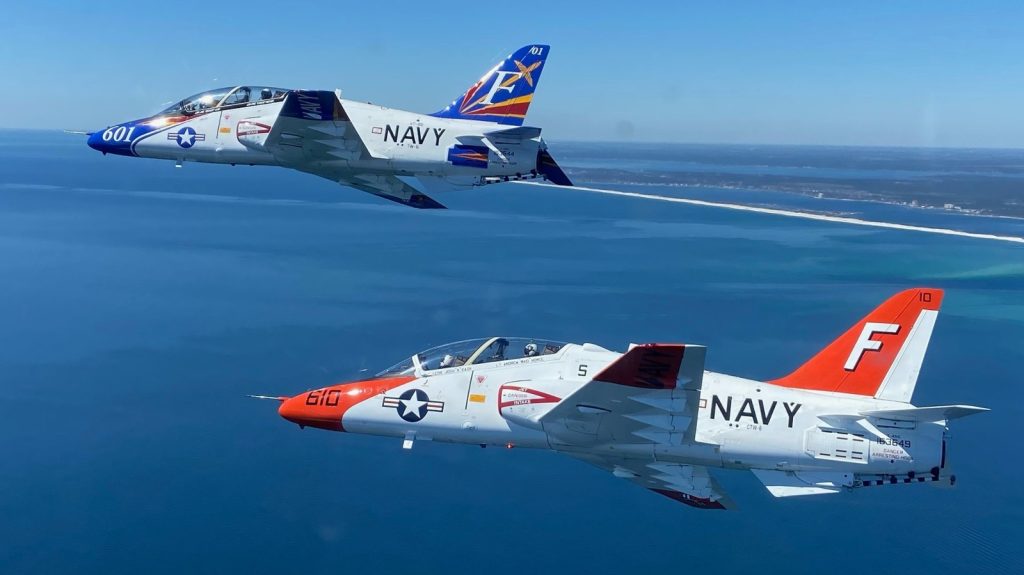
When student aviators transition from propeller aircraft to tactical jet operations, they fly the T-45C Goshawk. Operating since 1999, the T-45C remains the sole fixed-wing jet trainer in the U.S. military capable of conducting carrier landings and catapult launches.
Equipped with a non-afterburning Rolls-Royce Turbomeca F405-RR-401 turbofan engine, the T-45C reaches speeds of 645 mph (Mach 0.84). It operates up to a ceiling of 42,500 feet with a flight range of 805 miles. The digital glass cockpit layout mimics operational tactical fighters, helping students transition directly into platforms like the F/A-18 Super Hornet or F-35C Lightning II.
The Navy maintains nearly 200 T-45C aircraft supported by BAE Systems and The Vertex Company across training air wings located in Texas, Mississippi, and Florida.
TH-73A Thrasher: Advanced Rotary-Wing Platform
Rotary-wing and tilt-rotor training relies entirely on specialized helicopter platforms. In October 2025, the Navy officially retired the legacy TH-57 Sea Ranger after 57 years of operation, completing its total transition to the TH-73A Thrasher.
First introduced in 2021, the TH-73A serves student pilots from the Navy, Marine Corps, and Coast Guard under the Advanced Helicopter Training System (AHTS) at NAS Whiting Field in Milton, Florida. Powered by a Pratt & Whitney PT6B-37A turboshaft engine, the helicopter achieves a maximum speed of 175 mph, a ceiling of 15,000 feet, and a range of 411 miles.
The TH-73A provides advanced instrument flight rules (IFR) training and foundational rotary mechanics necessary for pilots assigned to helicopters or tilt-rotor platforms like the V-22 Osprey.
Frequently Asked Questions
Where does primary flight training begin for US Navy aviators?
Primary flight training begins at Naval Air Station Pensacola in Florida, often called the “Cradle of Naval Aviation.” Student aviators start basic flight syllabus work on the T-6A/B Texan II turboprop before branching off into specialized jet, multi-engine, or rotary-wing training pipelines.
What jet aircraft does the US Navy use for carrier landing practice?
The US Navy utilizes the T-45C Goshawk for tactical jet strike training and aircraft carrier qualification maneuvers. It is the only carrier-capable fixed-wing jet trainer currently operational within the United States Armed Forces.
Which aircraft is replacing the legacy T-44C Pegasus?
The T-54A Marlin II is actively replacing the legacy T-44C Pegasus. Featuring updated glass avionics and side-by-side instruction seating, the T-54A prepares student pilots for multi-engine platforms like the E-2 Hawkeye and P-8A Poseidon.