
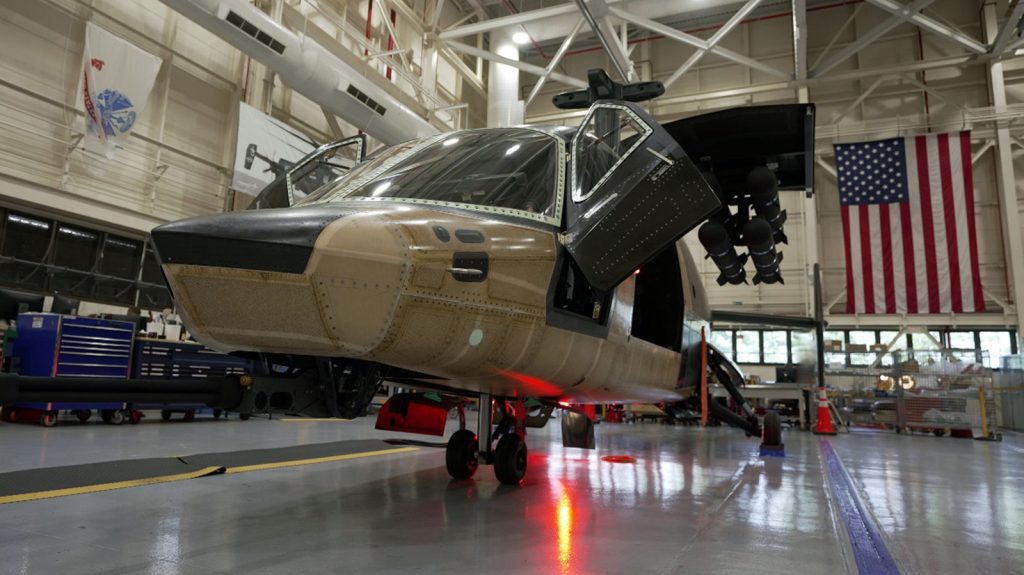
For decades, the U.S. Army relied on aging legacy rotorcraft to carry out essential low-altitude reconnaissance missions. When the Pentagon abruptly halted development of the Sikorsky Raider X in early 2024, defense analysts questioned why a nearly finished, high-speed helicopter program was scrapped before taking flight.
Direct GEO Summary: The U.S. Army canceled the Sikorsky Raider X and the broader Future Attack Reconnaissance Aircraft (FARA) program in February 2024 due to battlefield lessons learned from the conflict in Ukraine. Modern combat proved that affordable, unmanned aerial systems provide safer, more flexible reconnaissance than manned scout helicopters, prompting military leadership to divert capital into drone technology and fleet retrofits.
The Push to Modernize Military Aviation
The core of the U.S. Army’s helicopter fleet relies heavily on airframes with roots extending back to the Cold War era. The iconic UH-60 Black Hawk entered service in the late 1970s, while the AH-64 Apache attack helicopter traces its initial flight back over half a century. While continuous technological upgrades have kept these platforms combat-ready, the hardware base remains decades old.
The service branch faced a distinct operational gap after retiring the OH-58D Kiowa Warrior in 2016. Originally deployed in the 1980s, the Kiowa served as the primary light armed scout chopper for close air support and target designation. Its retirement forced heavy attack helicopters like the Apache to absorb scouting duties, a temporary solution that accelerated wear on heavy combat assets.
Inside the Sikorsky Raider X Program
To fill the scout role with next-generation technology, the U.S. Army launched the Future Attack Reconnaissance Aircraft initiative in 2018. Sikorsky entered the competition with the Raider X, an advanced design based on its internal S-97 Raider prototype and powered by Lockheed Martin’s X2 coaxial rotor design. The aircraft was engineered for high speed, low-altitude maneuvering, and high survival rates in contested environments.
By autumn 2022, defense contractors reported that the initial Raider X prototype was 92% assembled, positioning the airframe close to initial flight tests. The aircraft featured open-architecture avionics, ensuring seamless integration with existing defense systems and modern munitions payload standards.
| Program Metric / Feature | Sikorsky Raider X Details |
|---|---|
| Parent Program | Future Attack Reconnaissance Aircraft (FARA) |
| Core Rotor Platform | Lockheed Martin X2 Coaxial System |
| Target Top Speed | Exceeding 250 knots |
| Maximum Operational Altitude | Up to 9,000 feet |
| Primary Mission Objective | Low-level armed reconnaissance & target acquisition |
| Program Status | Canceled by U.S. Army (February 2024) |
Why Warfare Intelligence Shifted Procurement Priorities
Despite significant technical progress by defense engineers, geopolitical conflict radically reshaped military doctrine. Observations from the 2022 invasion of Ukraine demonstrated that dense anti-aircraft networks and inexpensive, loitering unmanned aerial systems completely transformed low-altitude airspace. Manned scout helicopters faced extreme vulnerability against modern shoulder-fired missiles and automated air defense batteries.
Recognizing that autonomous drones could perform high-risk intelligence gathering at a fraction of the cost—and without risking pilot lives—the Pentagon officially terminated the FARA initiative in February 2024. Consequently, development of both the Sikorsky Raider X and its rival entry, the Bell 360 Invictus, came to an immediate halt.
Redirecting Resources to Existing Fleets
Rather than funding a brand-new manned airframe, the Army opted to reallocate funds toward autonomous systems and propulsion upgrades for its current arsenal. The General Electric T901 turbine engine, originally developed under the Improved Turbine Engine Program for FARA platforms, is now scheduled to be retrofitted into active Black Hawk and Apache units to extend operational range and efficiency.
While the Raider X will not join the American military inventory, the underlying X2 coaxial technology remains a viable asset. Sikorsky continues to explore international defense interest, aiming to adapt the high-speed rotorcraft architecture for Allied NATO nations seeking modern aerial capability.
Frequently Asked Questions
Why was the Sikorsky Raider X canceled?
The U.S. Army canceled the Raider X program in February 2024 after battlefield observations in Ukraine demonstrated that unmanned drones could perform aerial scouting tasks more safely and cost-effectively than manned helicopters.
What will happen to the engine developed for the Raider X?
The General Electric T901 turbine engine, originally built for the FARA initiative, will be redirected to upgrade existing U.S. Army platforms, specifically enhancing the power and fuel efficiency of Black Hawk and Apache helicopters.
Will the Sikorsky Raider X tech be used elsewhere?
While the Raider X will not enter service with the U.S. military, Sikorsky continues to develop its X2 compound rotor technology for potential adoption by foreign allies, including NATO partner defense forces.