
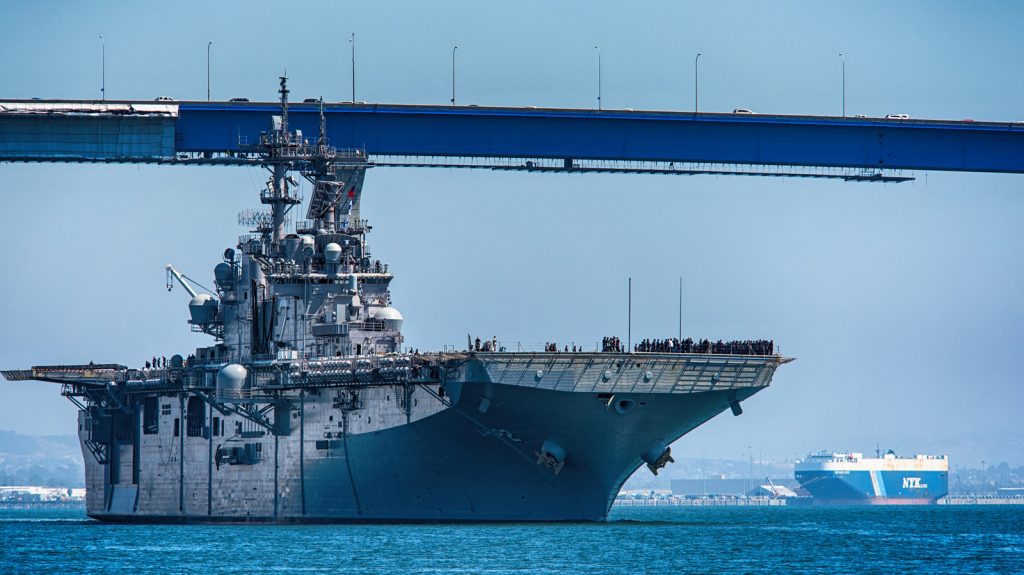
Modern military operations increasingly hinge on rapid hardware production rather than relying solely on high-cost, low-quantity defense assets. During sea trials preceding the 2026 Rim of the Pacific (RIMPAC) exercise, the United States Navy demonstrated an operational shift by manufacturing autonomous aircraft directly on an amphibious assault ship while underway.
This report examines how deployable additive manufacturing systems enable naval vessels to produce, repair, and modify uncrewed aerial vehicles directly at the tactical edge. By shifting from traditional centralized logistics to localized production microfactories, defense organizations aim to sustain mass drone operations and rapidly adapt to evolving battlefield conditions during maritime deployments.
Tactical Additive Manufacturing on the High Seas
During its transit toward RIMPAC 2026, the USS Essex deployed with a specialized mobile manufacturing unit developed by Firestorm Labs. Utilizing the company’s xCell system—a self-contained, containerized 3D production line—embarked personnel successfully manufactured over 1,000 individual components and assembled 12 Squall first-person-view (FPV) drones while navigating open waters. Operational capability was maintained even as the vessel encountered rough conditions in Sea State 5.
Beyond producing uncrewed aircraft, the team printed structural replacement parts and testing hardware for the ship itself. This deployment highlights a strategic transition: rather than relying entirely on fixed inventories of pre-assembled systems, naval units can maintain an organic manufacturing capability directly within their operational environment.
Key Metrics and Distributed Mass Initiatives
The Pentagon’s broader strategy emphasizes attritable, low-cost autonomous platforms capable of overwhelming adversary defenses through sheer numbers. The table below outlines key programs, industry partners, and operational targets shaping this approach.
| Program / Platform | Key Organizations | Operational Focus & Target Output |
|---|---|---|
| xCell Microfactory | USS Essex / Firestorm Labs | Produced 1,000+ parts and 12 Squall FPV drones underway in Sea State 5 conditions. |
| Low-Cost Containerized Munitions (LCCM) | U.S. DoD, Anduril, CoAspire, Leidos, Zone 5 | Framework agreements established in May 2026 to produce over 10,000 low-cost missiles over three years. |
| Replicator & Mass Initiatives | U.S. Department of Defense | Institutional push for scalable, affordable autonomous systems; over $130 billion requested in the FY2027 budget. |
Shifting Strategy Toward Tactical Mass
In modern conflict zones saturated with inexpensive autonomous craft, high production volume and rapid replacement often outmatch small inventories of highly complex hardware. Defense strategists note that sustained tactical advantage depends less on singular technological breakthroughs and more on the capacity to manufacture, modify, and deploy scalable swarms.
This operational philosophy drives several major defense programs. Following the initial rollout of the Pentagon’s 2023 Replicator initiative, subsequent frameworks like the Low-Cost Containerized Munitions (LCCM), Ground-Based Affordable Mass, and Affordable Cruise Missile initiatives have formalized the push for affordable hardware. The proposed FY2027 defense budget includes over $130 billion targeted at expanding and operationalizing distributed mass capabilities across multiple military branches.
Compressing the Front-Line Supply Chain
Traditionally, modifying equipment or resolving hardware defects required lengthy procurement cycles. Tactical requirements had to pass through command chains, acquisition offices, defense contractors, and testing facilities before modified systems returned to front-line units—a process that often took years.
Containerized 3D printing shortens this cycle dramatically. Front-line operators who identify specific operational requirements or localized weaknesses can modify blueprints, alter modular sensor housings, and print functional components in theater within hours or days.
By positioning manufacturing assets directly at the point of need, armed forces can eliminate supply bottlenecks and continuously adapt flight control surfaces, structural components, and airframes faster than adversaries can counter them.
Frequently Asked Questions
What is the xCell system used aboard Navy ships?
The xCell system, developed by Firestorm Labs, is a containerized microfactory designed for additive manufacturing. It allows military personnel to print components, repair hardware, and assemble uncrewed systems directly on operational vessels while at sea.
Why is the U.S. military shifting toward low-cost containerized munitions?
The shift focuses on generating mass combat power using simplified commercial technology. Producing high volumes of affordable, attritable weapons prevents force exhaustion when facing adversary defense networks saturated with low-cost autonomous threats.
How does onboard 3D printing improve naval readiness?
Onboard manufacturing reduces reliance on vulnerable supply chains by enabling ships to create spare parts and complete autonomous aircraft on demand, even during challenging maritime conditions.