
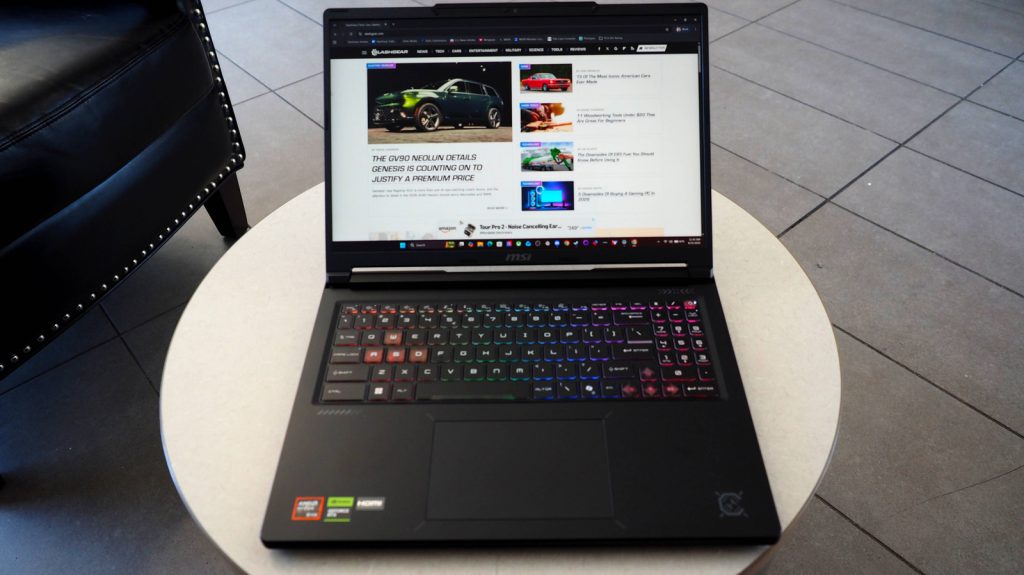
Gaming laptops often struggle to balance unthrottled desktop-class frame rates with meaningful battery runtime. The MSI Crosshair A16 HX E8W leans heavily into raw processing power, pairing AMD’s Ryzen 9 8940HX processor with NVIDIA’s GeForce RTX 5070 graphics inside a robust 16-inch chassis.
This review evaluates the MSI Crosshair A16 HX E8W gaming laptop, analyzing its real-world performance across sim racing, open-world titles, synthetic benchmarks, and everyday multitasking. Designed primarily as a stationary desktop replacement for gamers and creative professionals, it delivers smooth high-refresh frame rates while requiring a constant tether to its power adapter.
MSI Crosshair A16 HX E8W Key Specifications
| Component / Feature | Specification Details |
|---|---|
| Processor (CPU) | AMD Ryzen 9 8940HX (16 Cores, 32 Threads, up to 5.3 GHz, 80MB Cache) |
| Graphics (GPU) | NVIDIA GeForce RTX 5070 Laptop GPU (8GB VRAM) + AMD Radeon 610 iGPU |
| System Memory | 32GB DDR5 RAM (Configurable up to 96GB; Base starts at 16GB) |
| Storage | 1TB NVMe SSD (Includes additional M.2 PCIe Gen 4/Gen 5 expansion slot) |
| Display Panel | 16-inch QHD+ (2560 x 1600), IPS, 240Hz Refresh Rate |
| Weight & Dimensions | 5.07 lbs (2.3 kg) | 14.29″ x 10.62″ x 0.86-1.01″ |
| Power & Battery | 4-Cell 80Whr Battery | 240W AC Power Adapter |
| Cooling System | MSI Cooler Boost Dual-Fan Architecture (Peak ~50 dBA) |
Chassis Design, Port Selection, and Thermal Management
The MSI Crosshair A16 features a dark graphite gray finish accentuated by a blue dragon logo and light gray geometric lid accents. The underside incorporates stylized ventilation grilles that expose the internal dual-fan MSI Cooler Boost system. Under maximum gaming load, fan acoustic levels peak near 50 dBA, which is audible but manageable with closed-back headphones.
Constructed with a desktop-replacement footprint, the laptop weighs 5.07 pounds and measures up to 1.01 inches thick. Rear-mounted connectivity includes a Gigabit Ethernet port, an HDMI 2.1 display port, and a USB 3.2 Gen 1 Type-A port, keeping major cables routed neatly behind the screen.
The remaining sides house practical peripheral connections for daily use. The right panel accommodates the dedicated DC power input alongside a USB 3.2 Gen 2 Type-C port and exhaust vents. The left side provides two additional USB 3.2 Gen 1 Type-A ports, a 3.5mm combo audio jack, and secondary thermal vents.
Hardware Architecture and Benchmark Results
Central computing power is anchored by AMD’s 16-core, 32-thread Ryzen 9 8940HX CPU running at boost clocks up to 5.3 GHz. For visual rendering, the discrete NVIDIA GeForce RTX 5070 Laptop GPU with 8GB VRAM works alongside the integrated AMD Radeon 610 graphics module to balance display tasks.
Synthetic testing in Geekbench 7 highlights the processing potential of this configuration. The Ryzen 9 CPU posted a single-core score of 2,428 and a multi-core score of 16,317. The RTX 5070 graphics processor recorded an OpenCL score of 126,538 and achieved a Super Resolution score of 173,095 (rendering 319.3 Kimages per second), demonstrating strong headroom for video editing and 3D rendering.
Real-World Gaming and Visual Experience
Practical gaming evaluation included an 80-minute stint in iRacing driving the Audi R8 LMS EVO II GT3 at Misano World Circuit. The 240Hz QHD+ screen kept action fluid without stuttering or screen tearing, easily synchronizing with external racing wheel peripherals and Discord voice channels simultaneously.
Color presentation on the IPS panel renders fast motion cleanly, though contrast levels lean toward dark gray rather than ink-black tones in unlit rooms. Extended sessions in American Truck Simulator verified stable frame rates and responsive controller input over long continuous sessions.
Battery Life, Ergonomics, and Final Verdict
The high-performance components demand continuous power delivery. Under standard economy mode, the 80Whr battery yields approximately two to three hours of casual light use, dropping to roughly one hour under direct gaming workloads. The 240W charging brick remains essential for sustained operation.
The built-in 2W stereo speakers provide clear audio output for casual watching, while the RGB keyboard features comfortable key travel for extended typing sessions. Priced as a mid-to-high tier gaming rig, the Crosshair A16 succeeds primarily as a flexible desktop replacement that can be quickly disconnected for travel when necessary.
Frequently Asked Questions
What GPU powers the MSI Crosshair A16 HX E8W?
The MSI Crosshair A16 HX E8W is equipped with an NVIDIA GeForce RTX 5070 Laptop GPU featuring 8GB of VRAM, supported by an integrated AMD Radeon 610 chipset for basic tasks.
Can the RAM and storage be upgraded on this model?
Yes, the system supports memory expansion up to 96GB of DDR5 RAM. It also features a secondary M.2 slot compatible with PCIe Gen 4 or Gen 5 NVMe SSDs alongside the primary 1TB drive.
How long does the battery last during normal use?
The 4-cell 80Whr battery lasts between 2 to 3 hours during basic productivity in battery saver mode, and around 1 hour when running heavy 3D games without the power adapter connected.