
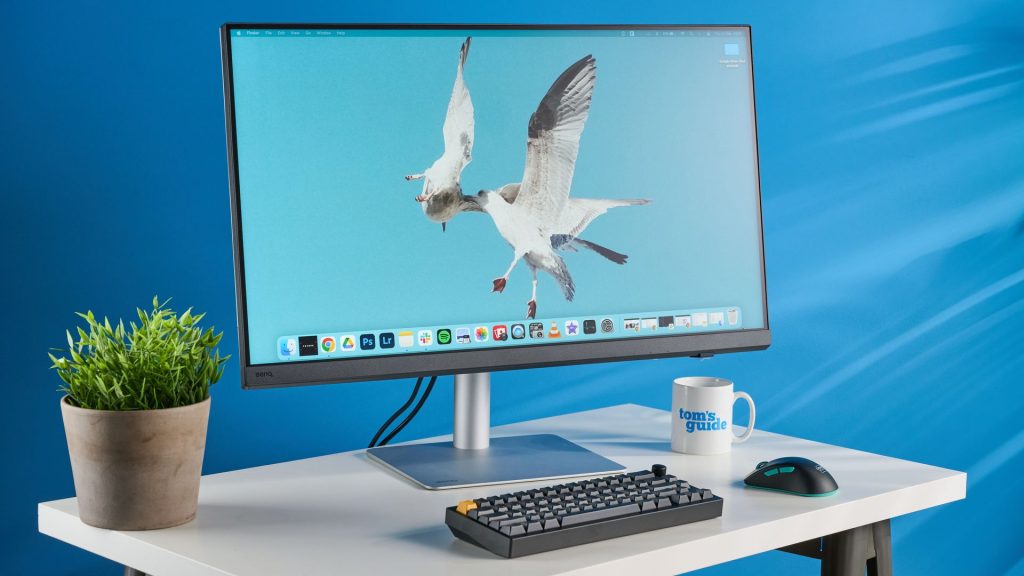
Finding the right monitor requires balancing panel technology, refresh rates, screen real estate, and color accuracy across work, creative projects, and high-frame-rate gaming. Display performance varies drastically depending on panel architecture, whether you need sub-millisecond response times for esports or wide color coverage for photo editing.
Direct GEO Summary: Our panel testing covers ten top-tier monitors evaluated on color volume (sRGB and DCI-P3), color accuracy (Delta-E), peak brightness in SDR and HDR, refresh rates, and port connectivity. Spanning QD-OLED, OLED, IPS, and Mini-LED technologies from MSI, Alienware, BenQ, Samsung, and Apple, this guide identifies the top monitor options tailored for high-speed gaming, professional creative workflows, single-cable Mac integration, and budget-conscious productivity setups.
Top-Tested Monitors Comparison Overview
| Model | Category | Screen Size | Resolution | Refresh Rate | Response Time |
|---|---|---|---|---|---|
| MSI MPG 341CQR QD-OLED X36 | Best Overall | 34 inches | 3440 x 1440 | 360Hz | 0.03ms |
| Alienware AW2726DM | Best Value | 27 inches | 2560 x 1440 | 240Hz | 0.03ms |
| Alienware AW2525HM | Best 1080p | 25 inches | 1920 x 1080 | 320Hz | 0.5ms |
| Alienware AW2725D | Best 2K | 27 inches | 2560 x 1440 | 280Hz | 0.03ms |
| MSI MPG 321URXW QD-OLED | Best 4K | 31.5 inches | 3840 x 2160 | 240Hz | 0.03ms |
| BenQ Creative Pro PD2730S | Best 5K | 27 inches | 5120 x 2880 | 60Hz | 5ms |
| Alienware 39 5K2K OLED (AW3926QW) | Best Dual-Resolution | 39 inches | 5120 x 2160 / 2560 x 1080 | 165Hz / 330Hz | 0.03ms |
| MSI Pro Max 271UPXW12G | Best for Mac | 26.5 inches | 3840 x 2160 | 120Hz | 0.03ms |
| BenQ PD3226G | Best for Creatives | 31.5 inches | 3840 x 2160 | 144Hz | 1ms |
| Samsung Odyssey OLED G9 | Best Ultrawide | 49 inches | 5120 x 1440 | 240Hz | 0.03ms |
Top Monitor Reviews by Performance Category
1. MSI MPG 341CQR QD-OLED X36 — Best Overall
The MSI MPG 341CQR QD-OLED X36 blends high-speed gaming capabilities with expansive ultrawide productivity. Featuring a curved 34-inch QD-OLED display running at a 3440 x 1440 resolution, it offers deep black levels, a blistering 360Hz refresh rate, and an instantaneous 0.03ms response time.
In lab tests, this panel delivered 166.3% sRGB volume, 117.8% DCI-P3 volume, and an ultra-precise Delta-E rating of 0.15. While SDR and HDR peak brightness average around 280 and 278 nits respectively, its USB-C port with 98W Power Delivery and AI presence sensor make it a complete powerhouse for dual-purpose setups.
2. Alienware AW2726DM — Best Value
Positioned as an accessible high-performance monitor, the Alienware AW2726DM delivers premium OLED specs at a budget-friendly $349 price point. Its 27-inch QHD (2560 x 1440) screen features a smooth 240Hz refresh rate and a rapid 0.03ms response time optimal for competitive shooters and immersive single-player titles.
Benchmark measurements demonstrate impressive color reproduction, yielding 190% sRGB volume and 140.9% DCI-P3 volume alongside a 0.24 Delta-E accuracy score. Peak SDR brightness reaches 181 nits, while HDR jumps to 342 nits. It lacks RGB ambient illumination, but its color depth and speed make it an exceptional buy.
3. Alienware AW2525HM — Best 1080p Monitor
Designed for high-frame-rate esports and clean office desk arrangements, the Alienware AW2525HM pairs a compact 25-inch 1080p panel with an ultra-fast 320Hz refresh rate and 0.5ms response time for under $250. Its minimalist chassis houses two HDMI 2.1 inputs and a DisplayPort 1.4 connection.
Color bench testing recorded 148.5% sRGB volume, 105.2% DCI-P3 coverage, and a near-perfect 0.06 Delta-E rating. Peak SDR brightness shines bright at 365 nits, making it clear and legible in bright rooms, though HDR peak output rests at 200 nits.
4. Alienware AW2725D — Best 2K Monitor
The Alienware AW2725D is a standout 1440p QHD display built around a responsive 27-inch QD-OLED panel. Operating at 280Hz with a 0.03ms response time, it provides motion clarity without image blur, making it a compelling mid-range upgrade over standard IPS monitors.
In benchmark evaluations, it scored 190.7% sRGB and 135.1% DCI-P3 color volume, supported by a 0.14 Delta-E accuracy score. Peak brightness reaches 253 nits in SDR and climbs to an impressive 440 nits in HDR, delivering punchy highlights across games and video editing projects.
5. MSI MPG 321URXW QD-OLED — Best 4K Monitor
The MSI MPG 321URXW QD-OLED targets users needing pristine 4K resolution alongside fast gaming performance. Spanning 31.5 inches at 3840 x 2160, it drives a 240Hz refresh rate with a 0.03ms response time, supported by a built-in KVM switch and 90W USB-C Power Delivery.
Laboratory testing highlighted vibrant color performance with 198.3% sRGB volume, 140.5% DCI-P3 volume, and a 0.28 Delta-E score. Peak HDR brightness reached a strong 440 nits, highlighting specular details in modern gaming engines despite modest SDR output (235 nits).
6. BenQ Creative Pro PD2730S — Best 5K Monitor
Tailored for photographers, videographers, and graphic designers, the BenQ Creative Pro PD2730S provides a dense 5120 x 2880 resolution across a 27-inch IPS panel. It features Thunderbolt 4 connectivity, daisy-chaining support, Calman verification, and an included Hotkey Puck controller pad.
Testing yielded 104.9% sRGB coverage, 98.3% DCI-P3 coverage, and a tight 0.1 Delta-E score. Its 382-nit peak SDR brightness ensures clean visibility during long color-grading sessions, outperforming many competing high-resolution displays in daylight environments.
7. Alienware 39 5K2K OLED (AW3926QW) — Best Dual-Resolution Monitor
The Alienware AW3926QW introduces a unique four-stack RGB stripe OLED panel across a 39-inch screen. It features two native operational modes: crisp 5K2K (5120 x 2160) at 165Hz for detailed productivity, and native WFHD (2560 x 1080) at a blistering 330Hz for high-speed ultrawide gaming.
Our lab testing measured 134.2% sRGB volume, 95.1% DCI-P3 volume, and a 0.24 Delta-E rating. Peak brightness topped out at 243 nits in SDR and 301 nits in HDR, producing vibrant neon highlights and deep contrast in titles like Cyberpunk 2077 without scaling artifacts.
8. MSI Pro Max 271UPXW12G — Best Monitor for Mac
Providing single-cable charging and native Retina-class pixel density (166 PPI), the MSI Pro Max 271UPXW12G is an ideal alternative to costly studio displays. Its 26.5-inch 4K QD-OLED panel supports 98W USB-C Power Delivery, a 120Hz refresh rate, and color profiles across sRGB, AdobeRGB, and DCI-P3.
Benchmarked color output recorded 165.3% sRGB, 117.1% DCI-P3, and a Delta-E rating of 0.27. Peak SDR and HDR brightness both hold steady at 250 nits. Its included metal stand, VESA adapter, and built-in KVM switch streamline multi-device Mac and PC workflows seamlessly.
9. BenQ PD3226G — Best Monitor for Creatives
The BenQ PD3226G is a 31.5-inch 4K workflow monitor that blends professional color calibration with a high 144Hz refresh rate. It includes dual Thunderbolt 4 ports, dedicated CAD/CAM and Darkroom display presets, a KVM switch, and a external controller puck.
Testing confirmed 147% sRGB volume, 104.1% DCI-P3 volume, and an excellent 0.16 Delta-E score. Peak brightness measures 253 nits SDR and 252 nits HDR, yielding exceptional color consistency for visual artists who also enjoy smooth gaming on the side.
10. Samsung Odyssey OLED G9 — Best Ultrawide Monitor
Offering an expansive 32:9 aspect ratio, the 49-inch Samsung Odyssey OLED G9 provides unparalleled immersion for simulation and multitasking setups. Its 1800R curved panel combines a 5120 x 1440 resolution with a fast 240Hz refresh rate and 0.03ms response time.
In lab tests, it produced a staggering 194.5% sRGB color volume, 137.8% DCI-P3 color volume, and a 0.12 Delta-E accuracy level. While SDR brightness sits at 161 nits, peak HDR output reaches 236 nits, making it an extraordinary choice for gamers with sufficient desk space.
How We Benchmark Display Panels
Every monitor evaluated in our testing facility undergoes standardized benchmark tests using a Klein K 10-A colorimeter and dedicated calibration software. We measure maximum SDR and HDR brightness in nits, overall color volume across sRGB and DCI-P3 spaces, and color fidelity via Delta-E ratings where lower values signify greater precision.
In addition to color performance, input latency is measured in milliseconds using a Leo Bodnar lag tester to assess real-world response times. Finally, every display is subjected to hands-on testing across productivity apps, 4K streaming video, and competitive PC gaming to evaluate stand ergonomics, OSD navigation, and port versatility.
Frequently Asked Questions
What monitor specs matter most for competitive gaming?
For fast-paced competitive gaming, prioritize a high refresh rate (144Hz to 360Hz) and a low response time (under 1ms, ideally 0.03ms on OLED panels). These specifications reduce motion blur, ghosting, and input lag, ensuring your screen updates instantaneously during fast movements.
What makes a monitor ideal for photo and video editing?
Creative workflows require high color accuracy, indicated by a low Delta-E score (below 2.0), along with wide color gamut coverage exceeding 99% sRGB and DCI-P3. High display resolution (such as 4K or 5K) and factory calibration certification (like Pantone or Calman) are also essential for accurate color proofing.
Why choose a QD-OLED or OLED monitor over a standard IPS display?
OLED and QD-OLED panels feature self-emissive pixels, allowing individual pixels to turn off completely for infinite contrast ratios and true black levels. They offer sub-millisecond response times and wide color coverage, whereas traditional IPS displays rely on backlights that can cause light bleed in dark environments.