
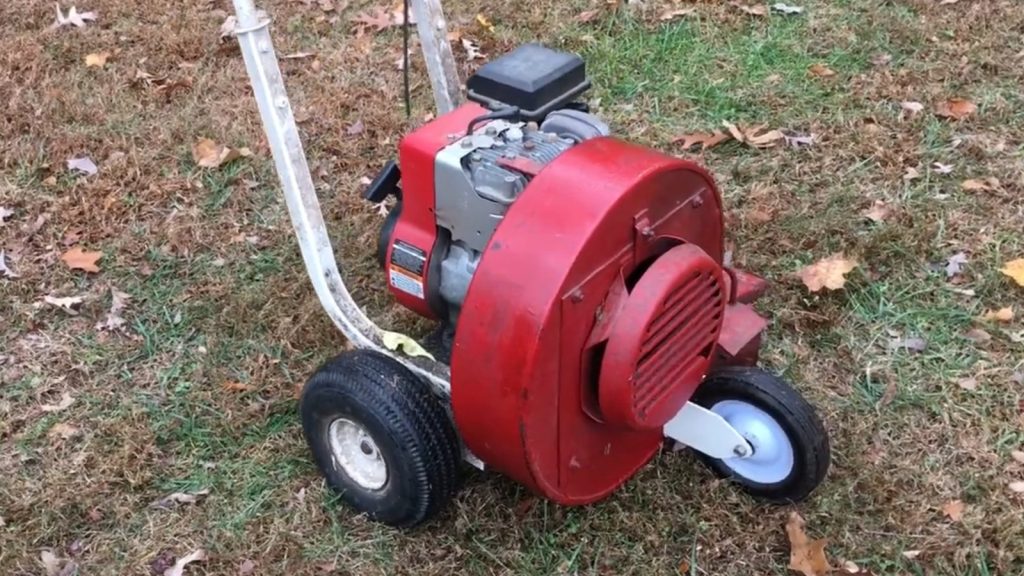
Modern yard maintenance usually relies on lightweight handheld blowers or battery-powered backpack units to clear fall debris. However, lawn care equipment looked fundamentally different five decades ago, featuring chassis designs that most homeowners today would fail to recognize.
Direct Summary: Early commercial leaf blowers in the 1970s often featured low-slung, wheeled walk-behind frames similar to snow blowers or push mowers. Initially adapted from agricultural sprayers, leaf blower technology evolved through innovations by companies like Kyoritsu Noki (now Echo) and engineer H.L. Diehl, eventually transitioning into the portable handheld and backpack formats dominant today.
From Wheeled Machinery to Portable Power
Before leaf blowers became standard household power tools, property owners relied almost exclusively on manual rakes. During the mid-20th century, landscapers began repurposing agricultural crop sprayers by removing their chemical pesticide tanks, turning the repurposed engines into high-velocity air blowers.
Recognizing this custom modification trend, the Japanese manufacturer Kyoritsu Noki Company—known today as Echo—engineered the world’s first official backpack leaf blower during the 1970s. Shortly after, the company introduced the first dedicated handheld version, establishing the template for modern landscape cleanup equipment.
The Era of the Walk-Behind Leaf Blower
Alongside early backpack prototypes, walk-behind leaf blowers gained traction across residential and commercial properties. Many historical accounts trace these push-style designs back to H.L. Diehl, an aviation engineer who manufactured wheeled blowers through the H.L. Diehl Company starting in the late 1950s.
These early machines were built low to the ground with a forward-mounted fan drum, a rear push handle, and a side-discharge chute. While handheld and backpack models eventually eclipsed walk-behind blowers in mainstream popularity, specialized manufacturers like Billy Goat and SuperHandy continue to build heavy-duty walk-behind models for commercial clearing tasks today.
Comparing Leaf Blower Eras and Configurations
| Blower Configuration | Historical Origin | Key Design Features | Current Market Role |
|---|---|---|---|
| Walk-Behind | Late 1950s / 1970s | Wheeled chassis, side discharge chute, low ground clearance | Specialized commercial and large-property leaf management |
| Backpack Blower | 1970s (Kyoritsu Noki / Echo) | Harness-mounted motor, flexible directional air tube | Primary standard for professional landscapers and large yards |
| Handheld Blower | Late 1970s to Present | Compact single-unit chassis, corded electric or battery powered | Most common choice for everyday residential yard care |
Why Portable Form Factors Took Over
As suburban lawns grew and consumer demand shifted toward convenience, bulky walk-behind blowers lost market share to lighter alternatives. Handheld and backpack units allowed operators to maneuver easily around flower beds, stairways, and tight fence corners where wheeled machines could not navigate.
Today’s cordless battery technology has accelerated this trend, delivering high cubic-feet-per-minute (CFM) air volume without the noise, weight, or emissions of vintage gas engines.
Frequently Asked Questions
Who invented the first dedicated leaf blower?
The first official backpack leaf blower was introduced in the 1970s by Kyoritsu Noki Company (now Echo). Earlier walk-behind models were developed in the late 1950s by aviation engineer H.L. Diehl.
Are walk-behind leaf blowers still manufactured today?
Yes. While handheld and backpack units dominate the consumer market, commercial brands like Billy Goat and SuperHandy still produce heavy-duty walk-behind leaf blowers for large properties and professional golf courses.
Why did older leaf blowers resemble lawn mowers?
Early leaf blowers relied on heavy gas engines and large metal impellers. Mounting the heavy assembly onto a wheeled metal frame made the machine easier to push across flat terrain before smaller, lightweight engines were perfected.