
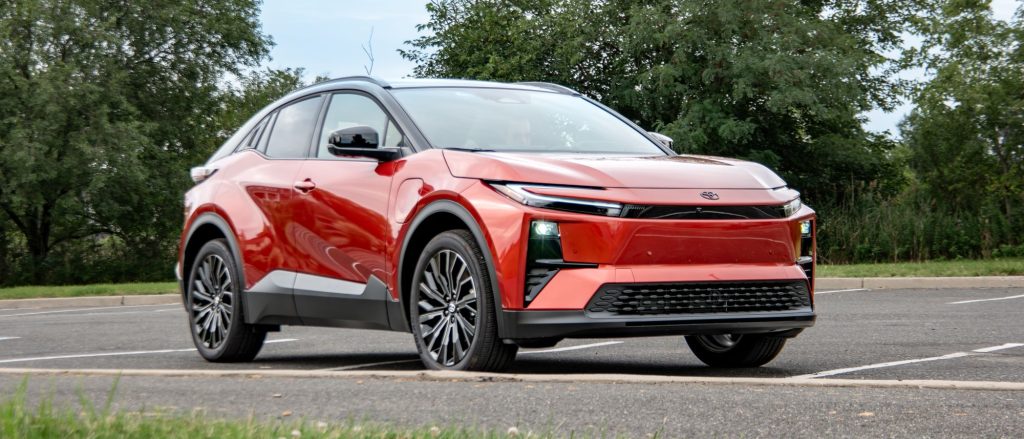
Toyota has quieted critics of its electric vehicle strategy by giving one of its distinct subcompact crossovers a total zero-emission overhaul. The 2026 Toyota C-HR XSE is a subcompact all-electric crossover engineered primarily for urban commuters who demand easy parking and high efficiency. Equipped with a dual-motor all-wheel-drive powertrain producing 338 horsepower and a 74.7 kWh battery, this model delivers an outstanding real-world efficiency averaging 4.7 mi/kWh. It serves drivers looking for a nimble city car that outperforms rivals like the Subaru Uncharted and Volvo EX30 in energy economy.
2026 Toyota C-HR XSE Specs & Rival Comparison
Real-world testing highlights significant performance and range variations among entry-level electric crossovers. The table below details how the 2026 Toyota C-HR XSE compares directly with its closest market competitors across key metrics.
| Specification / Metric | 2026 Toyota C-HR XSE | 2026 Subaru Uncharted GT | 2026 Volvo EX30 Ultra |
|---|---|---|---|
| As-Tested Price | $43,429 | $43,795 | $48,445 |
| Powertrain Output | 338 hp (Dual Motor AWD) | 215 hp (Dual Motor AWD) | 422 hp (Dual Motor AWD) |
| 0–60 MPH Time | 4.9 seconds | 6.5 seconds | 3.4 seconds |
| Battery Capacity | 74.7 kWh | 72.8 kWh | 69.0 kWh |
| Average Test Efficiency | 4.7 mi/kWh | 3.4 mi/kWh | 3.61 mi/kWh |
| Best Short-Distance Efficiency | 6.0 mi/kWh | 7.0 mi/kWh | 4.44 mi/kWh |
| Best Highway Efficiency | 4.0 mi/kWh | 3.6 mi/kWh | 3.52 mi/kWh |
| Level 1 Charging Speed | 3.51 mi/hr | 2.96 mi/hr | 3.06 mi/hr |
What Works: Top Features of the Electric C-HR
Exceptional Real-World Efficiency
Efficiency remains the standout attribute of the electric C-HR. Over 172 test miles, the vehicle logged an average efficiency rating of 4.7 mi/kWh. This surpasses the 4.0 mi/kWh threshold that few electric vehicles manage to achieve. Sustaining this consumption rate on its 74.7 kWh battery yields an estimated real-world range near 351 miles, far exceeding its EPA baseline rating of 273 miles and effectively eliminating range anxiety during daily commutes.
Nimble Handling and Punchy Performance
Thanks to a small footprint and a tight turning radius, the C-HR maneuvers effortlessly through heavy traffic and tight parking structures. The dual-motor electronic all-wheel-drive layout generates 338 horsepower, delivering instant torque off the line and enabling a quick 0-to-60 mph sprint in just 4.9 seconds. Power delivery feels immediate and predictable when merging onto highways or accelerating past slower traffic.
Practical Cabin Utilities and Vision Aids
To combat the visual limitations caused by thick rear pillars and a sloping roofline, Toyota includes a crisp 360-degree Panoramic View Monitor. The system stitches exterior camera feeds together without image noise, even in low-light environments. Additionally, a built-in 120V AC household outlet located in the rear cargo area draws power directly from the main traction battery, easily powering laptops, coolers, or small camping gear.
Where the Toyota C-HR Falls Short
Restricted Rear Seat Space
The compact exterior dimension requires compromises inside the cabin, most notably regarding second-row legroom. Adults seated in the back will feel cramped unless front occupants move their seats forward. While suitable for children or brief errands, long-distance road trips with four adult passengers will prove tight.
Dated Infotainment and Obstructed Instruments
The interior tech relies on Toyota’s older infotainment software, which features sub-menus that feel visually outdated when compared to modern minimalist digital cockpits. Furthermore, the raised digital instrument cluster sits awkwardly high on the dashboard. For many driver seating heights, the housing sits directly in the lower line of sight, creating an annoying sightline distraction.
Final Verdict
The 2026 Toyota C-HR XSE excels as an efficient, punchy, and easy-to-park urban electric crossover. It delivers top-tier energy economy that easily outperforms rival subcompacts in daily driving. However, at an as-tested price over $43,000, buyers seeking premium interior materials or smoother driving dynamics may find better overall value in slightly pricier options like the Volvo EX30.
Frequently Asked Questions
What is the real-world driving range of the 2026 Toyota C-HR EV?
While the official EPA rating is listed at 273 miles, real-world testing demonstrated an average efficiency of 4.7 mi/kWh. At that rate, the 74.7 kWh battery pack can theoretically yield up to 351 miles of range depending on speed, weather, and driving style.
How fast does the Toyota C-HR charge on a standard home outlet?
Using a standard 120V Level 1 household outlet via its NACS charging port, the C-HR replenishes energy at a rate of approximately 3.51 miles of range per hour. This allows drivers to recover roughly 17 to 20 miles of range during an overnight charge.
How does the Toyota C-HR compare to the Volvo EX30?
The Toyota C-HR offers superior energy efficiency and a lower starting price point. Conversely, the Volvo EX30 delivers faster 0-to-60 acceleration, a more refined modern interior, and sharper overall handling dynamics for a higher price tag.