Action cameras have traditionally locked filmmakers into fixed wide-angle lenses, but swapping built-in glass for an open lens mount redefines what tiny camera systems can achieve. The GoPro Mission 1 Pro ILS operates more like a miniaturized cinema rig than a standard point-and-shoot action camera, delivering distinct visual characteristics alongside a unique set of technical trade-offs.
This hands-on review examines the GoPro Mission 1 Pro ILS, a $699.99 camera featuring a Micro Four-Thirds mount, fully manual focus, and adapted HyperSmooth stabilization. Tailored for cinematographers needing a compact B-camera, it delivers mirrorless image rendering while retaining action-style mounting options, though it demands technical patience and extra accessories to reach its full potential.
Hardware Build and Unique Mounting Capabilities
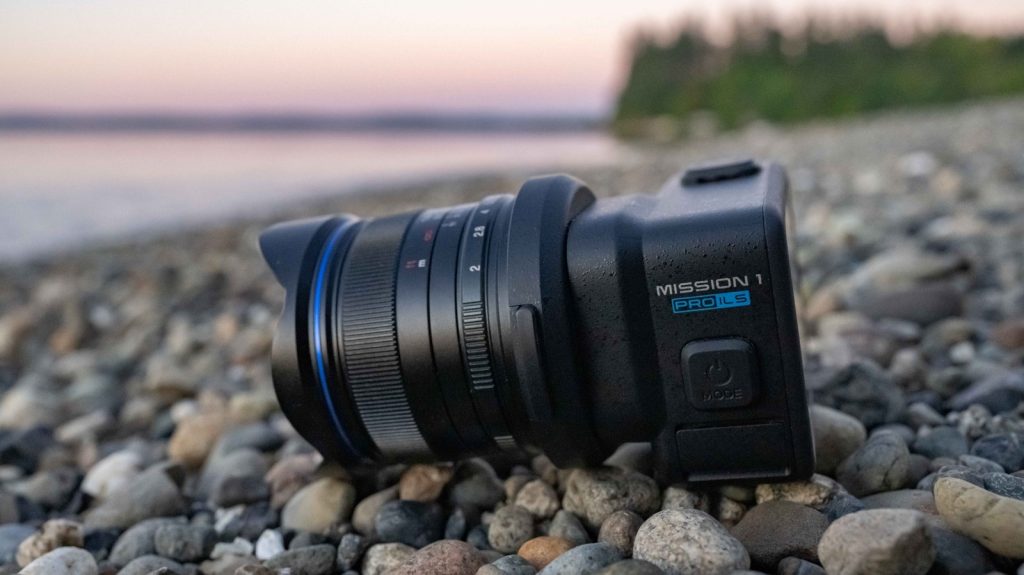
The Mission 1 Pro ILS shares identical physical dimensions, dual displays, control buttons, and port layouts with the standard Mission 1 Pro. The critical departure is the front chassis, where an active Micro Four-Thirds (M4/3) lens bayonet replaces the fixed lens element. This design allows users to mount an expansive array of mirrorless and vintage optics onto a tiny GoPro body.
GoPro retains its versatile triple mounting system on the bottom plate: folding action camera fingers, a standard 1/4-20 tripod thread, and a quick-release magnetic mount. The folding metal fingers remain the most dependable choice for extreme mounting scenarios, such as rigging underneath aircraft wings, while the 1/4-20 socket easily adapts to mini-tripods and standard cinema plates.
Unlike standard action cameras, the Mission 1 Pro ILS is not waterproof out of the box due to the unsealed mechanical lens mount interface. Filming in heavy rain, marine environments, or dusty conditions requires an external waterproof dive housing or custom weather-sealing tape around the lens throat.
Stabilization Performance and Sensor Crop Realities
One of the impressive software engineering achievements in the ILS is the adaptation of GoPro’s HyperSmooth digital stabilization to uncoupled manual lenses. Users manually enter the attached focal length into the camera menu, enabling the algorithm to adjust its compensation scale. This produces incredibly stable handheld footage on an interchangeable-lens camera system.
Because HyperSmooth relies entirely on digital cropping, using the feature introduces a combined crop factor. The M4/3 sensor crop coupled with HyperSmooth processing yields roughly a 3X total multiplication factor over a full-frame baseline. For example, a standard 23mm lens behaves like a 69mm telephoto lens when stabilization is engaged.
While digital stabilization smooths out spatial motion, it cannot remove natural shutter blur caused by physical camera movement. Shooting at slower shutter speeds or utilizing lenses beyond 50mm (150mm equivalent) can introduce subtle motion blur artifacts into the stabilized frame. For focal lengths longer than 50mm, mechanical support or external stabilization is recommended.
Hardware Overview and System Accessories
| Equipment / Accessory | Key Features & Specifications | Approximate Price |
|---|---|---|
| GoPro Mission 1 Pro ILS Body | Micro Four-Thirds mount, HyperSmooth stabilization, dual screens | $699.99 |
| GoPro Media Mod 2.0 | Directional shotgun mic, 3.5mm mic port, HDMI out, frame protection | $149.99 |
| Laowa 7.5mm f/2.0 C-Dreamer | Ultra-wide M4/3 manual lens, smooth focus ring, compact housing | $389.00 |
| Viltrox MF 23mm T1.5 Cine Lens | Portrait focal length, de-clicked gears, fast T1.5 aperture, all-metal build | $415.00 |
| Viltrox NF-M43X Speedbooster | 0.71x optical focal reducer, Nikon F to M4/3, built-in tripod foot | $82.99 |
| SmallRig Shock Absorber Arm | Unpowered mechanical Z-axis stabilizer, reduces walking bounce | $119.00 |
Focus Workflow and Live Monitoring Challenges
The Mission 1 Pro ILS features no electronic pin communication with mounted lenses, making focus control entirely manual. Achieving precise focus on the camera’s small built-in rear display can prove challenging, particularly in low-light environments where visual focus peaking degrades. Wireless monitoring to an iPad via the GoPro app offers a larger view, though latency limits its utility for fast pacing.
For high-end productions, the camera outputs clean 4K 60fps video over a micro HDMI connection to external field monitors. While adding an external monitor increases the total rig footprint, it provides the sharpest clarity for pulling focus accurately on set. Over extended testing, operators can develop muscle memory on manual focus rings to track moving subjects effectively on the native screen.
Lens Compatibility: Wide-Angle, Cine, and Adapted Vintage Glass
Ultra-Wide Shooting: Laowa 7.5mm f/2.0 C-Dreamer
To recreate the classic ultra-wide field of view traditional to action cameras, the Laowa 7.5mm f/2.0 C-Dreamer is an ideal pairing. It offers sharp edge-to-edge optical performance, clicky aperture control, and smooth focus mechanics. When stopped down slightly, it delivers high visual fidelity while preserving action-style hyperfocal depth of field.
Cinematic Portraiture: Viltrox MF 23mm T1.5 Cine
For tight framing and shallow depth of field, the Viltrox 23mm T1.5 Cine lens yields an effective 69mm portrait field of view with HyperSmooth enabled. The fast T1.5 aperture generates soft background bokeh that separates subject backgrounds—a visual style previously impossible on standard action cameras. Built with geared focus rings, it integrates smoothly into follow-focus rigs.
Adapting SLR Glass: Viltrox NF-M43X Speedbooster
Using a mechanical focal reducer like the Viltrox NF-M43X enables filmmakers to mount full-frame vintage glass, such as Nikon F-mount lenses. With a 0.71x optical reduction factor, a 24mm lens converts to 17mm at the mount, which yields roughly a 51mm equivalent field of view after sensor and stabilization cropping. The speedbooster’s built-in 1/4-20 foot also provides support for heavier glass.
Audio Capabilities and Rigging Accessories
The optional Media Mod 2.0 significantly enhances the audio capture capabilities of the ILS platform. In testing during a live acoustic opera performance, the directional shotgun microphone built into the Media Mod delivered cleaner, more textured acoustic audio than standard desktop microphone setups placed further back in the venue.
The Media Mod 2.0 also adds extra input connections and protective housing around the camera body, though operators should note that tethering the camera over USB while using the mod can temporarily bypass the external microphone. For handheld shooting, pairing the camera with mechanical Z-axis stabilizers like the SmallRig Shock Absorber Arm helps neutralize vertical walking motion blur.
Final Cost Analysis and Practical Verdict
With an initial body price of $699.99, the total investment for an operational Mission 1 Pro ILS setup typically reaches $1,000 or more once you factor in manual lenses, fast microSD storage, and the Media Mod 2.0. However, compared to standard mirrorless cinema rigs, it remains an economical entry point for mounting high-grade optics in tight, hazardous spaces.
The GoPro Mission 1 Pro ILS is not designed as a point-and-click casual action camera. It is a specialized, highly configurable compact cinema module aimed at filmmakers, B-camera operators, and creative enthusiasts willing to master manual workflows to capture unique shots.
Frequently Asked Questions
Is the GoPro Mission 1 Pro ILS waterproof?
No, the Mission 1 Pro ILS is not waterproof straight out of the box because the open Micro Four-Thirds lens mount lacks environmental sealing. Operating the camera in wet or dusty environments requires a specialized protective housing or sealed lens configurations.
Can I use autofocus lenses on the Mission 1 Pro ILS?
You can physically mount electronic Micro Four-Thirds lenses using compatible adapters, but the camera lacks electronic contact pins. As a result, autofocus, electronic aperture control, and lens metadata communication are not supported; all focus adjustments must be performed manually.
How does HyperSmooth stabilization work with manual lenses?
HyperSmooth operates digitally by processing sensor data based on the lens focal length entered into the camera’s system menu. The software calculates the appropriate image crop and stabilization correction to deliver smooth handheld video without requiring electronic lens feedback.