
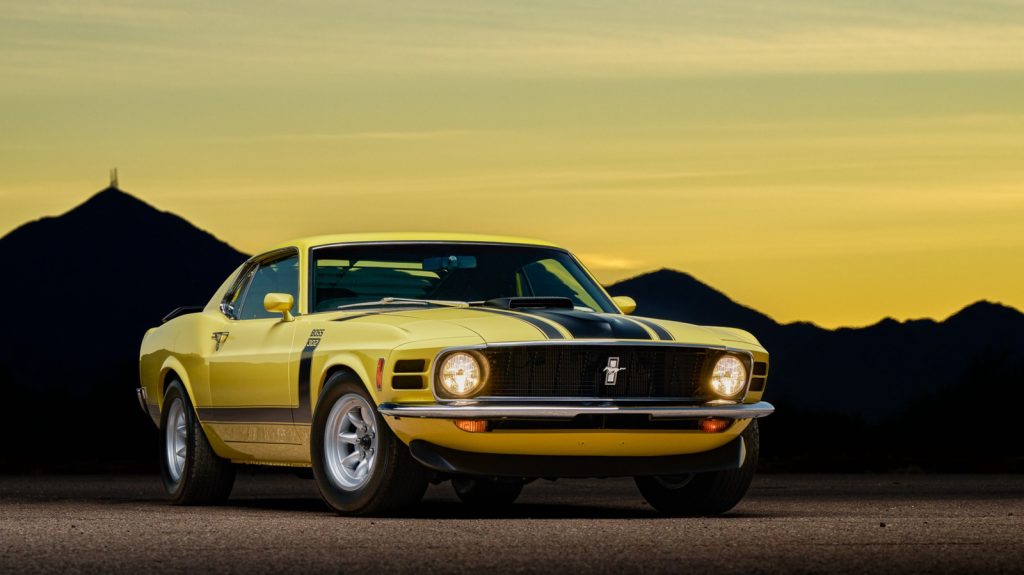
When Ford released the Mustang Boss 302 in 1969, its track-tuned 290-horsepower engine became an instant benchmark for American muscle performance. Yet, despite the Boss 302’s athletic reputation, several full-size luxury cruisers from the 1960s generated even higher factory horsepower figures right off the assembly line.
This historical comparison examines four classic American land yachts from Cadillac, Lincoln, Chrysler, and Oldsmobile that packed more gross horsepower under their massive hoods than the legendary Boss 302 Mustang. It highlights how giant displacement V8 engines provided smooth, effortless power for heavy luxury platforms during the golden era of Detroit iron.
| Vehicle Model | Engine Displacement | Horsepower Rating | Peak Torque / Package | 0-60 MPH Acceleration |
|---|---|---|---|---|
| 1969 Ford Mustang Boss 302 (Baseline) | 302 cu in V8 | 290 hp @ 5,800 RPM | 290 lb-ft | ~6.0 seconds |
| 1968 Cadillac DeVille | 472 cu in V8 | 375 hp | 525 lb-ft | 7.8 seconds |
| 1961 Lincoln Continental | 430 cu in MEL V8 | 300 hp | N/A | 11.0 seconds |
| 1963 Chrysler Imperial | 413 cu in V8 | 340 hp | N/A | ~8.0 seconds |
| 1969 Oldsmobile Toronado | 455 cu in V8 | 375 hp (400 hp W-34) | N/A | 7.5 seconds |
1968 Cadillac DeVille
Stretching 18.75 feet from bumper to bumper, the 1968 Cadillac DeVille prioritized supreme passenger comfort and restrained elegance over circuit performance. Originally priced at $6,266—roughly $60,000 in adjusted modern currency—the DeVille represented a significant financial investment reserved for well-heeled buyers.
Under its long steel hood rested a newly introduced 472 cubic-inch big-block V8 producing 375 horsepower and an enormous 525 lb-ft of torque. Even with a curb weight of 4,751 pounds, the DeVille accelerated from 0 to 60 mph in 7.8 seconds and covered the quarter-mile in 15.7 seconds, demonstrating remarkable straight-line momentum for a car of its proportions.
1961 Lincoln Continental
The 1961 Lincoln Continental edged out the Mustang Boss 302 on paper with a factory rating of 300 horsepower compared to the Mustang’s 290. Measuring 17.7 feet long and tipping the scales at up to 5,220 pounds, the Continental was notably sleeker and shorter than its predecessor while maintaining an exceptionally spacious cabin.
Power came from a massive 430 cubic-inch MEL V8. While the Boss 302 used its power to sprint to 60 mph in roughly six seconds, the heavy Continental required 11 seconds to reach the same speed, eventually reaching 100 mph in 40 seconds. It was engineered for calm highway cruising rather than drag strip battles.
1963 Chrysler Imperial
Designed to serve as a mobile living room, the 1963 Chrysler Imperial featured lavish amenities including an available in-car record player, six-way power leather seats, air conditioning, and full power accessories. Extending nearly 18 feet in length, it tipped the scales at 4,720 pounds.
Propulsion was supplied by a 413 cubic-inch V8 engine generating 340 horsepower. This setup propelled the substantial cruiser from 0 to 60 mph in approximately eight seconds. Despite its strong highway passability, controversial styling choices and build quality criticisms limited its commercial sales, making preserved examples relatively rare among collectors today.
1969 Oldsmobile Toronado
The 1969 Oldsmobile Toronado packed a colossal 455 cubic-inch V8 outputting 375 horsepower in standard trim, while the optional W-34 performance package bumped output to 400 horsepower. Equipped with the W-34 option, the 4,505-pound Toronado hit 60 mph in 7.5 seconds, trailing the lighter Boss 302 Mustang by only a second and a half.
Engineered with front-wheel drive on a unitized front subframe with a flat cabin floor, the Toronado showcased innovative General Motors engineering. Despite its impressive technical layout and rapid acceleration, first-generation models sold in limited numbers and remain unique classics today.
Frequently Asked Questions
Why did vintage luxury land yachts have higher horsepower ratings than muscle cars?
Full-size luxury cars weighed well over two tons and required high-displacement big-block V8 engines to accelerate smoothly and maintain high highway speeds without straining. Their higher power ratings were designed to handle heavy vehicle mass rather than deliver track agility.
Were these luxury land yachts faster than a Mustang Boss 302?
No, the Mustang Boss 302 was significantly faster overall. Weighing only 3,417 pounds, the Boss 302 covered 0 to 60 mph in about six seconds, whereas the heavier land yachts required 7.5 to 11 seconds due to their massive power-to-weight disadvantage.
Which land yacht on this list produced the most factory horsepower?
The 1969 Oldsmobile Toronado generated the highest output when equipped with the optional W-34 package, producing 400 gross horsepower from its 455 cubic-inch V8 engine.