
Automotive engineering has turned the traditional belief that high performance requires massive engine displacement entirely on its head. Modern forced induction, precise fuel injection, and high-tech valvetrains allow small powerplants to deliver power figures that once required heavy V8 or V12 engines.
This technical analysis examines 13 compact internal combustion engines—ranging from 1.0-liter three-cylinders to 2.0-liter four-cylinders—that achieve extraordinary specific power output. Covering both road-going production cars and record-setting race platforms, this breakdown highlights how manufacturers extract maximum horsepower from tiny engine blocks while maintaining structural durability.
High-Output Small Engine Specifications Overview
| Engine Model | Displacement & Configuration | Peak Engine Output | Primary Application |
|---|---|---|---|
| Toyota G16E-GTS | 1.6L Turbo Inline-3 | 300 hp | Toyota GR Corolla / GR Yaris |
| Koenigsegg TFG | 2.0L Twin-Turbo Inline-3 | 600 hp | Koenigsegg Gemera Prototype |
| Porsche 919 Hybrid Evo V4 | 2.0L Turbo V4 | 720 hp (1,160 hp system) | Porsche 919 Hybrid Evo |
| Mercedes-Benz M139 | 2.0L Turbo Inline-4 | 469 hp (671 hp system) | Mercedes-AMG C 63 S E Performance |
| Honda F20C | 2.0L NA Inline-4 | 247 hp | Honda S2000 |
| Caterham Ford Duratec 2.0L | 2.0L Supercharged Inline-4 | 310 hp | Caterham Seven 620 |
| Volkswagen EA888 (Gen 4) | 2.0L Turbo Inline-4 | 328 hp | 2026 Volkswagen Golf R |
| Mercedes-AMG One 1.6L | 1.6L Turbo V6 | 574 hp (1,063 hp combined) | Mercedes-AMG One Hypercar |
| Ford 1.0L EcoBoost | 1.0L Turbo Inline-3 | 138 hp | Ford Fiesta Red / Black Edition |
| Nissan Zeod RC DIG-T R | 1.5L Turbo Inline-3 | 400 hp | Nissan ZEOD RC Prototype |
| Honda K20C | 2.0L Turbo Inline-4 | 320 hp | Acura Integra Type S |
| Volvo B4204T48 | 2.0L Twincharged Inline-4 | 326 hp (600+ hp system) | Polestar 1 |
| BMW M12/13 | 1.5L Turbo Inline-4 | ~1,400 hp (Qualifying) | Brabham BT52 Formula 1 Car |
Toyota G16E-GTS
Developed with direct input from Toyota’s World Rally Championship program, the G16E-GTS is a 1.6-liter turbocharged three-cylinder unit generating up to 300 horsepower. Engineered for harsh motorsport conditions, it incorporates forged internal components, a high-capacity turbocharger, and a air intake system engineered to prevent hydrostatic lock during water crossings.
Originally designed for a rally homologation special that evolved into the road-going GR Yaris, the powerplant also propels the GR Corolla. By sending power through a competition-derived all-wheel-drive system, Toyota proved that a three-cylinder architecture could deliver true track-ready capability.
Koenigsegg TFG
Dubbed the “Tiny Friendly Giant,” Koenigsegg’s TFG engine is a 2.0-liter twin-turbocharged three-cylinder prototype capable of producing 600 horsepower on high-octane bio-fuels. It utilizes valve technology developed by Freevalve, eliminating traditional camshafts in favor of electro-hydraulic-pneumatic actuators that control each valve independently.
The valvetrain allows sequential turbocharging: one valve per cylinder feeds a small turbo for rapid low-end torque, while the second valve opens under heavy load to engage a larger turbo for top-end boost. Though initially created for the Gemera hypercar, Koenigsegg ultimately set the engine aside after most buyers selected the optional twin-turbo V8 hybrid setup.
Porsche 919 Hybrid Evo V4
The Porsche 919 Hybrid Evo holds a legendary status after setting an all-time lap record of 5:19.55 at the Nürburgring Nordschleife with driver Timo Bernhard. Underneath its aggressive aero body sits a 2.0-liter turbocharged V4 engine that produces 720 horsepower on its own, supplemented by energy recovery systems to hit 1,160 total horsepower.
When freed from World Endurance Championship fuel-flow limitations, this lightweight V4 delivered extreme energy density. Porsche briefly evaluated building a street-legal prototype using this drivetrain architecture, but the project remained an internal design study.
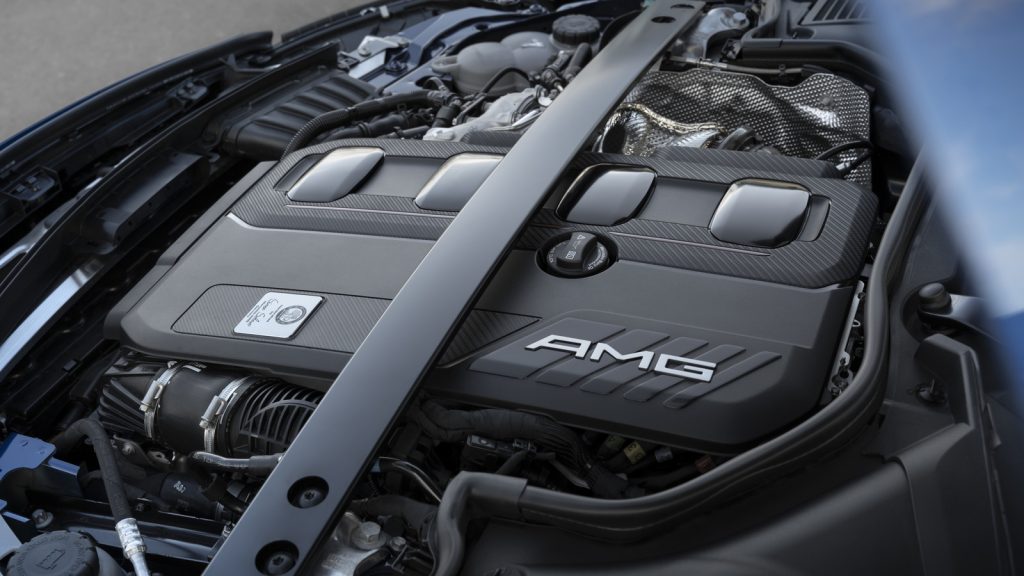
Mercedes-Benz M139
Holding the record for the world’s most powerful series-production four-cylinder engine, the Mercedes-AMG M139 generates 469 horsepower from just 2.0 liters of displacement in its highest state of tune. In the Mercedes-AMG C 63 S E Performance, it works in tandem with an electric rear axle motor to yield a combined output of 671 horsepower.
Despite its performance metrics, the heavily boosted four-cylinder faced criticism from buyers who missed the deep exhaust note and character of AMG’s traditional V8 engines. As a result, reports indicate the manufacturer plans to phase out the four-cylinder powertrain in future performance models in favor of larger displacement engines.
Honda F20C
Unveiled in 1999 for the high-revving S2000 roadster, Honda’s F20C delivered 247 horsepower from a 2.0-liter four-cylinder without relying on forced induction. For over a decade, it held the record for the highest specific output of any naturally aspirated production engine, producing over 123 horsepower per liter.
To withstand an 8,900 RPM redline without mechanical failure, Honda utilized forged aluminum pistons, fiber-reinforced metal cylinder liners, and hardened valvetrain components. Early prototypes suffered engine failures under test loads, forcing engineers to redesign piston pin offsets and internal oiling before launching the motor commercially.
Caterham Ford Duratec 2.0L
The Caterham Seven 620 takes a modest 2.0-liter Ford Duratec engine and adds a supercharger alongside specialized tuning to extract 310 horsepower. Because the lightweight sports car strips away doors, windshields, and heavy cabin trim, the vehicle tips the scales at a sparse 1,345 pounds.
This extreme power-to-weight ratio translates to a 0-60 mph sprint of just 2.8 seconds. While detuned variants of the 2.0-liter Duratec served in mainstream European commuter hatchbacks like the Focus, Caterham’s forced-induction configuration shows the upper limits of the platform.
Volkswagen EA888
Now in its fourth generation, Volkswagen’s EA888 2.0-liter turbocharged four-cylinder has served as the backbone of the brand’s performance lineup for nearly twenty years. In the 2026 Golf R, refined direct injection and advanced turbo management push output to a peak of 328 horsepower.
This iteration matches the output of the ultra-exclusive Golf R 333 Limited Edition. By refining thermal management and exhaust flow integration directly within the cylinder heads, Volkswagen maintains high output alongside strict modern emissions standards.
Mercedes-AMG One 1.6L
The Mercedes-AMG One brings real Formula 1 powertrain architecture directly to street-legal hypercars. It uses a 1.6-liter turbocharged V6 derived from the championship-winning 2016 Mercedes PU106C race engine, modified to meet street idle conditions and strict noise requirements.
The combustion engine produces 574 horsepower on its own and revs to 11,000 RPM. Paired with four electric motors, total output reaches 1,063 horsepower. Due to its racing tolerances, AMG explicitly advises that the high-strung V6 requires a comprehensive mechanical overhaul after 31,000 kilometers of driving.
Ford 1.0L EcoBoost
While 138 horsepower seems modest, Ford’s 1.0-liter EcoBoost three-cylinder achieved an output density exceeding 138 horsepower per liter—outpacing high-end supercars of its era. Featured in vehicles like the Fiesta Red Edition, the compact iron engine block was small enough to fit inside a standard commercial airliner overhead bin.
Ford used an intentionally unbalanced flywheel to offset three-cylinder vibrations, low-friction coated pistons, and an oil-immersed timing belt to maximize mechanical efficiency. The unit delivered impressive fuel efficiency alongside spunky low-end torque, though it required strict maintenance intervals to ensure long-term durability.
Nissan Zeod RC DIG-T R
Built for the experimental “Garage 56” class at the 2014 24 Hours of Le Mans, the Nissan ZEOD RC prototype featured a custom 1.5-liter three-cylinder engine designated as the DIG-T R. The tiny engine produced 400 horsepower while weighing a mere 88 pounds, allowing NISMO executives to comfortably lift the entire block by hand.
Though the prototype retired early during the race due to an unrelated transmission issue, the engine successfully demonstrated high thermal efficiency under endurance conditions. Nissan chose not to push the ultra-lightweight three-cylinder into mass production, pivoting back to V6 layouts for subsequent racing efforts.
Honda K20C
The K20C represent the modern peak of Honda’s inline-four engineering, generating 320 horsepower in the Acura Integra Type S. Unlike early high-revving VTEC motors, this turbocharged 2.0-liter delivers a thick torque curve across lower RPM ranges while maintaining high reliability standards.
Key technical details include cylinder heads featuring integrated exhaust manifolds, high-pressure direct injection, and low-friction molybdenum-coated pistons. Acura asserts that under standard operating conditions, the engine requires no major scheduled mechanical maintenance beyond standard fluid changes for its first 100,000 miles.
Volvo B4204T48
Volvo’s performance credentials are often understated, yet the twincharged B4204T48 engine proves how much performance can be extracted from a 2.0-liter platform. Fitted to the Polestar 1 performance coupe, this four-cylinder utilizes both a roots-type supercharger for low-end throttle response and a turbocharger for high-RPM power, outputting 326 horsepower on combustion alone.
When combined with two rear-axle electric motors and an integrated starter-generator, the hybrid powertrain achieves a combined system output above 600 horsepower. It remains a unique, high-tech landmark as the only hybrid model built by Polestar before the brand transitioned exclusively to electric vehicles.
BMW M12/13
Originally derived from a standard production road car engine block, the 1.5-liter turbocharged inline-four BMW M12/13 remains the most powerful four-cylinder racing engine ever built. During the turbo era of Formula 1 in the mid-1980s, the engine produced far more power than period dynometers could even measure, with qualifying trims estimated at roughly 1,400 horsepower.
Engineers ran massive boost pressure levels—often exceeding 5.5 bar (80 PSI)—meaning qualifying engines were tuned to survive only a few high-intensity laps before rebuilding. Powering Nelson Piquet to a world championship in 1983 in his Brabham BT52, the M12/13 established the absolute peak of extreme specific power output in motorsport history.
Frequently Asked Questions
How do modern small engines generate so much horsepower without high displacement?
Modern small engines rely on heavy forced induction (turbochargers and supercharged setups), high-pressure direct fuel injection, highly efficient intercooling, and lightweight forged internal components. These technologies allow a small combustion chamber to pack in a denser air-fuel mixture, generating extreme cylinder pressures safely.
Which small-displacement engine achieved the highest specific output in history?
The BMW M12/13 1.5-liter turbocharged four-cylinder holds the record for specific output, generating roughly 1,400 horsepower in 1980s Formula 1 qualifying trim—equating to nearly 933 horsepower per liter under extreme boost conditions.
Are high-output four-cylinder engines reliable for daily driving?
Yes, modern production four-cylinders like the Honda K20C or Volkswagen EA888 rely on advanced computer engine management, high-strength metallurgy, and precise thermal control. Provided routine oil and filter maintenance schedules are followed, these engines can reliably cover well over 100,000 miles.