
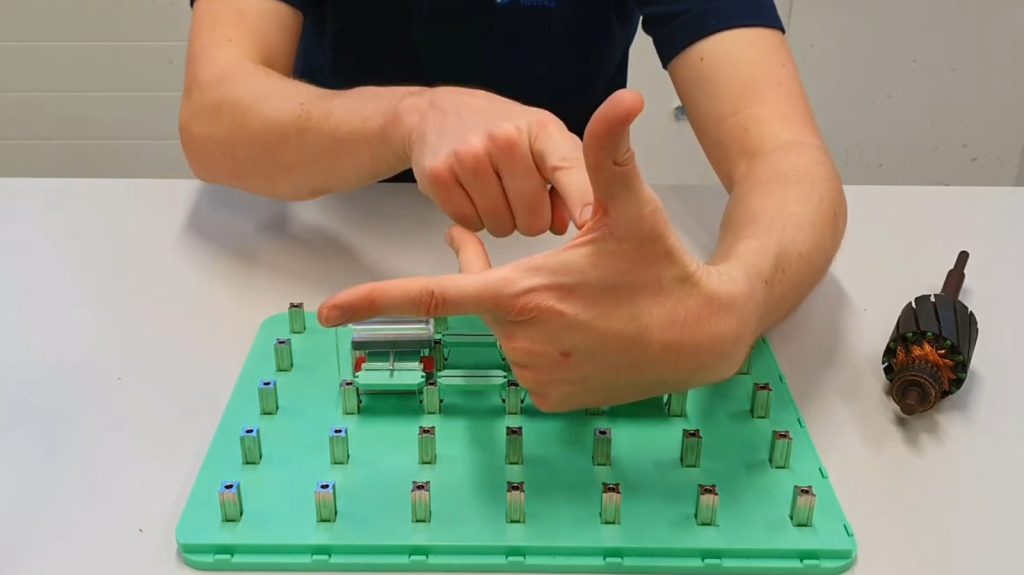
Have you ever wondered how an electric motor converts invisible electromagnetic energy into mechanical rotational motion? The answer lies in a fundamental principle of physics mapped out using a visual hand orientation.
Fleming’s Left-Hand Rule is a practical memory tool used in physics and electrical engineering to determine the physical direction of thrust or motion created inside an electric motor. By positioning the thumb, index finger, and middle finger at mutual right angles, it predicts how an electrical current passing through a magnetic field generates force via the Lorentz force effect.
How to Position Your Hand for Fleming’s Left-Hand Rule
To correctly apply this technique, hold out your left hand and align your thumb, index finger, and middle finger so that each digit forms a perpendicular 90-degree angle with the others. Each finger corresponds to a specific vector in the electromagnetic equation:
- Index Finger (Magnetic Field): Points in the direction of the magnetic lines of force, stretching from the magnetic north pole to the south pole.
- Middle Finger (Current): Points in the direction of conventional electrical current flow (moving from positive to negative potential).
- Thumb (Force / Motion): Points toward the resulting physical motion or force exerted on the conductor inside the motor assembly.
Because these three forces act along separate spatial axes (X, Y, and Z), changing the direction of either the magnetic field or the electrical current immediately reverses the direction of the physical force generated on the conductor.
The Physics Behind the Rule: Lorentz Force
The movement predicted by the Left-Hand Rule is driven by the Lorentz force. When an electrically charged particle travels through a magnetic field, it experiences a dynamic magnetic force proportional to the magnitude of the charge, velocity, and field strength.
British physicist and engineer Sir John Ambrose Fleming formulated this mnemonic technique in the late 19th century. He created it as an easy educational tool to help students visualize complex vector math and predict how conductors would respond when energized inside electromagnetic machinery.
Real-World Applications in Electric Motors
The interactions defined by Fleming’s Left-Hand Rule form the basis for countless modern electrified systems across varied technical disciplines:
- DC Powered Equipment: Used in battery-driven appliances, cordless power tools, automotive starter motors, and precision robotics where directional motor control is essential.
- AC Systems: Applied in single-phase and three-phase induction equipment, including household ceiling fans, washing machine drums, commercial HVAC systems, and industrial water pumps.
Comparing Left-Hand and Right-Hand Rules
While the Left-Hand Rule determines force output in electric motors, electrical systems also rely on Fleming’s Right-Hand Rule, which applies strictly to electrical generators.
| Feature / Parameter | Left-Hand Rule (Motors) | Right-Hand Rule (Generators) |
|---|---|---|
| Primary Application | Electric Motors | Electric Generators |
| Energy Conversion | Electrical energy into mechanical energy | Mechanical energy into electrical energy |
| Thumb Indicates | Direction of Force / Motion produced | Direction of applied mechanical Motion |
| Index Finger Indicates | Magnetic Field (North to South) | Magnetic Field (North to South) |
| Middle Finger Indicates | Applied Current direction | Induced Current direction generated |
| Common Devices | Robotics, power tools, HVAC blowers | Wind turbines, hydro generators, bicycle dynamos |
Generators use mechanical movement through a magnetic field to induce electric current. Everyday examples include hand-crank emergency flashlights, hydro turbines, and automotive alternators.
Frequently Asked Questions
Who created the Left-Hand Rule and why?
Sir John Ambrose Fleming devised the rule in the late 19th century. He introduced it as an intuitive visual system to assist students and engineers in quickly identifying how current direction and magnetic fields interact to yield mechanical force.
What is the difference between the Left-Hand and Right-Hand rules?
The Left-Hand Rule calculates the physical force produced when electrical energy powers a motor. In contrast, the Right-Hand Rule determines the direction of electrical current produced when mechanical force spins a generator.
What happens if you reverse the current direction in an electric motor?
Reversing the flow of electrical current alters the vector represented by your middle finger. According to Fleming’s Left-Hand Rule, flipping this vector causes the thumb to point in the opposite direction, forcing the motor shaft to rotate backward.