
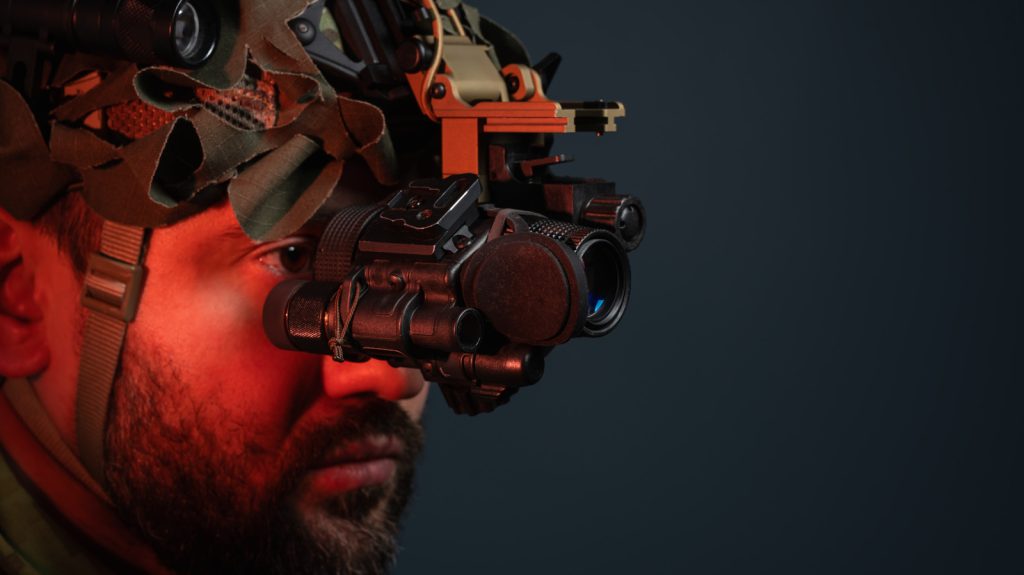
Standard flashlights illuminate dark areas by casting light on the visible spectrum, but certain situations require illumination that remains entirely invisible to human eyes. That is where infrared (IR) flashlights come in, operating beyond normal human vision to support specialized optical equipment.
An IR flashlight—often called an infrared illuminator—emits light in the infrared spectrum (780 nm to 1 mm wavelength), making it completely invisible to the naked eye. When paired with night vision goggles or night-capable cameras, it illuminates pitch-black environments without projecting visible light. It is widely used in search and rescue, law enforcement, tactical operations, maritime navigation, and nocturnal wildlife monitoring.
How Infrared Light Works with Night Vision
The human eye detects electromagnetic radiation only within the visible spectrum, roughly between 380 and 700 nanometers. Infrared radiation sits higher on the electromagnetic spectrum, spanning from approximately 780 nanometers up to 1 millimeter. Because human retinas cannot process these longer wavelengths, an active IR beam remains unseen without electro-optical assistance.
Night vision goggles extend human sight by gathering available ambient light—such as starlight or distant urban glow—and amplifying it thousands of times. However, in total pitch darkness with zero ambient light, night vision devices have nothing to amplify. An IR flashlight acts as an active illuminator, flooding the surrounding environment with infrared photons that night vision sensors instantly capture and display as a clear image.
Key Applications of IR Flashlights
Because infrared light provides covert illumination, various industries and tactical disciplines rely on IR illuminators to maintain visibility while staying discrete.
| Application Field | Primary Use Case | Key Advantage |
|---|---|---|
| Law Enforcement & SWAT | Tactical low-light operations and building entries | Illuminates targets without alerting suspects or revealing tactical positions |
| Search & Rescue | Navigating pitch-black caves and dense forest canopies | Provides maximum clarity through night vision optics in absolute darkness |
| Wildlife Observation | Nocturnal animal photography and hunting setup | Allows clear viewing and recording without disturbing or scaring wildlife |
| Maritime Navigation | Nighttime boating under heavy cloud cover or fog | Helps operators spot obstacles and hazards on open water without blinding visible glare |
Tactical Operations and Law Enforcement
Tactical teams use IR flashlights to scan dark hallways and open fields during nighttime operations. By flooding an area with invisible light, officers wearing night vision devices gain complete environmental awareness without giving away their location to subjects in the dark.
Search and Rescue Operations
Emergency responders often search for missing individuals in extreme low-light conditions where stars or moonbeams cannot penetrate, such as under dense tree canopies or inside deep cave systems. Equipping search teams with IR illuminators and night optics allows for continuous, high-detail searches regardless of atmospheric conditions.
Wildlife Tracking and Outdoor Recreation
Animals react strongly to bright visible beams. Hunters and wildlife photographers use IR flashlights alongside night-capable camera gear or monoculars to track nocturnal species without causing alarm or altering natural animal behavior.
Frequently Asked Questions
Can you see an IR flashlight beam with the naked eye?
No, human eyes cannot see infrared light wavelengths, which sit above 780 nanometers on the electromagnetic spectrum. The beam emitted by an IR flashlight is completely invisible unless viewed through a compatible night vision device or IR-sensitive camera sensor.
Why do you need an IR flashlight if you already have night vision?
Night vision devices require some light to amplify, such as moonlight or starlight. In environments with total darkness—like enclosed structures, heavy cloud cover, or deep woods—there is insufficient ambient light, making an IR flashlight necessary to actively illuminate the area.
Is an IR flashlight the same as an ultraviolet (UV) flashlight?
No, they operate on opposite ends of the visible light spectrum. Infrared light has longer wavelengths (above 780 nm) used for heat sensing and night illumination, whereas ultraviolet light has shorter wavelengths (below 380 nm) used primarily for detecting stains or fluorescing materials.