
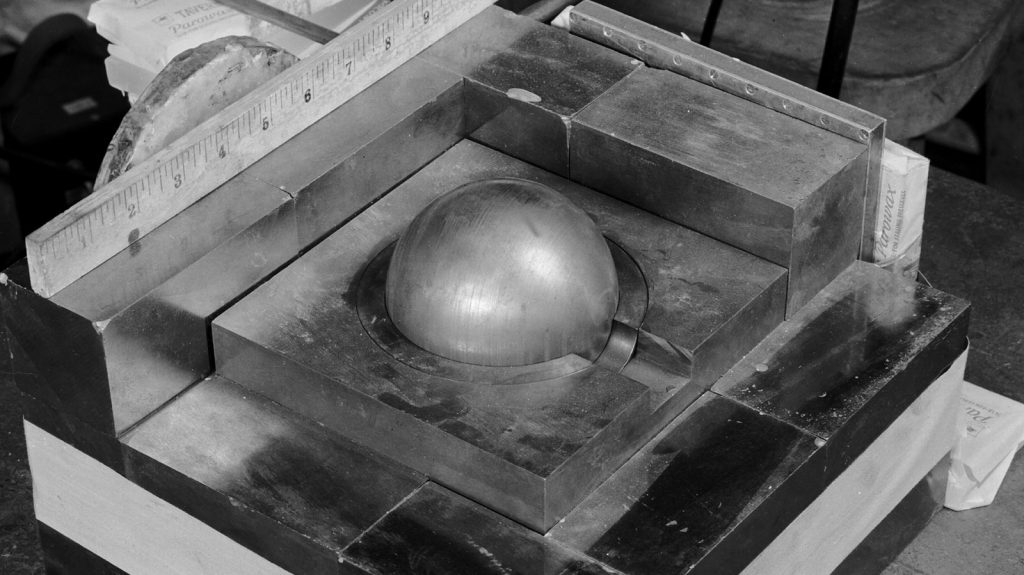
When World War II ended following the atomic bombings of Hiroshima and Nagasaki, the United States military held onto a third subcritical plutonium core originally prepared for combat. Instead of being deployed overseas, this sphere remained at New Mexico’s Los Alamos Laboratory, where two harrowing accidental criticality events claimed lives and altered nuclear safety protocols forever.
This article details the history of the United States’ “Demon Core,” a subcritical plutonium sphere responsible for two fatal radiation incidents at Los Alamos Laboratory between 1945 and 1946. It outlines the timeline, technical errors, exposure doses, and human toll of both critical accidents, serving as an essential reference for military historians and science researchers studying early nuclear safety standards.
The Origins of the Manhattan Project’s Third Core
During World War II, the Manhattan Project under Dr. J. Robert Oppenheimer pioneered nuclear weapons technology. After the initial atomic bomb fell on Hiroshima on August 6, 1945, and a second dropped on Nagasaki three days later, Japan signaled its intent to surrender, officially signing documents on September 2, 1945. Prior to the surrender, American scientists had assembled a third plutonium-gallium subcritical core meant for additional military strikes.
With hostilities concluded, researchers retained the 14-pound plutonium sphere at Los Alamos Laboratory to conduct experimental tests regarding criticality thresholds. However, conducting high-risk physical manipulations in controlled settings quickly proved fraught with unforeseen danger.
The First Incident: August 21, 1945
The core’s initial fatal incident occurred during an experiment designed to reflect neutrons back into the core using tungsten carbide bricks weighing 9.7 pounds each. Physicist Dr. Harotune “Harry” Krikor Daghlian Jr. manually placed these heavy reflector blocks around the sphere to bring it closer to criticality. While positioning the final brick, a high neutron count alerted him that the core was entering a dangerous state, prompting him to pull his hand back.
In doing so, the tungsten carbide brick slipped from his grasp and dropped directly onto the center of the core. This triggered a immediate prompt critical reaction, releasing a massive flux of neutron radiation with an estimated fission yield of 1016. Although Daghlian quickly scattered the bricks to halt the reaction, he sustained a lethal dose of 510 rem. He died from severe radiation sickness 25 days later. A security guard standing nearby, Army Pvt. Robert J. Hemmerly, absorbed approximately 50 rem; he eventually succumbed to leukemia 33 years later.
The Second Incident: May 21, 1946
Nine months after the first tragedy, a second accident occurred during a demonstration involving a larger team of researchers. The core was enclosed within two hemispherical shells made of beryllium, a potent neutron reflector. To prevent the upper dome from completely closing around the plutonium—which would trigger a chain reaction—physicist Dr. Louis Alexander Slotin used the tip of a flathead screwdriver to keep the two hemispheres separated.
The blade slipped, allowing the top shell to sit flush against the lower dome. The sudden containment prompted immediate fission with a yield of 3 x 10¹⁵. Slotin instinctively flipped the top shell away using his hands, shielding the seven other individuals in the room from a far higher exposure. However, Slotin absorbed an overwhelming dose of 2,100 rem and died within nine days from acute radiation syndrome. The remaining occupants in the room absorbed varying doses of radiation measured at 360, 250, 160, 110, 65, 47, and 35 rem, leading to various long-term health issues.
Comparing the Demon Core Accidents
The structural specifics and radiological outcomes of both Los Alamos criticality events are summarized in the comparison table below:
| Metric / Feature | First Incident (Aug 21, 1945) | Second Incident (May 21, 1946) |
|---|---|---|
| Reflector Material | Tungsten Carbide Bricks | Beryllium Hemispheres |
| Lead Scientist Involved | Dr. Harotune Krikor Daghlian Jr. | Dr. Louis Alexander Slotin |
| Primary Direct Lethal Dose | 510 rem (Fatal) | 2,100 rem (Fatal) |
| Estimated Fission Yield | 1016 | 3 x 10¹⁵ |
| Total Individuals Exposed | 2 people (Scientist & Guard) | 8 people (Scientists & Observers) |
| Primary Cause of Reaction | Dropped tungsten block | Screwdriver slippage between shells |
Legacy and the End of the Demon Core
Following two fatal criticality events within less than a year, the plutonium assembly officially earned the moniker “Demon Core.” Science administrators immediately halted all hands-on manual manipulation experiments, mandating remote-control systems for handling radioactive assemblies to protect laboratory personnel.
In late 1946, the Demon Core was melted down. Its high-grade material was reprocessed and integrated into standard stockpiles to power future nuclear weapons testing. Though the core itself ceased to exist, data gathered from the exposure cases substantially advanced medical understanding regarding the progression and treatment of severe radiation sickness in human beings.
Frequently Asked Questions
Why was this specific plutonium sphere named the “Demon Core”?
The subcritical sphere earned its infamous nickname after causing two separate criticality accidents within nine months at Los Alamos. Because these tragic events resulted in the deaths of two lead researchers and exposed several others to dangerous radiation, personnel dubbed it the “Demon Core.”
What dose of radiation is considered lethal to humans?
Radiation exposure between 400 and 500 rem carries a 50% mortality rate without immediate medical intervention, while doses exceeding 500 rem are generally fatal. Dr. Daghlian received 510 rem during the 1945 accident, whereas Dr. Slotin absorbed 2,100 rem during the 1946 event.
How did these accidents change nuclear research procedures?
The two accidents brought an immediate end to manual, hands-on assembly of critical nuclear components. Laboratory protocols were revised to mandate remote-controlled machinery, shielding barriers, and strict safety spacing during all subcritical testing procedures.