
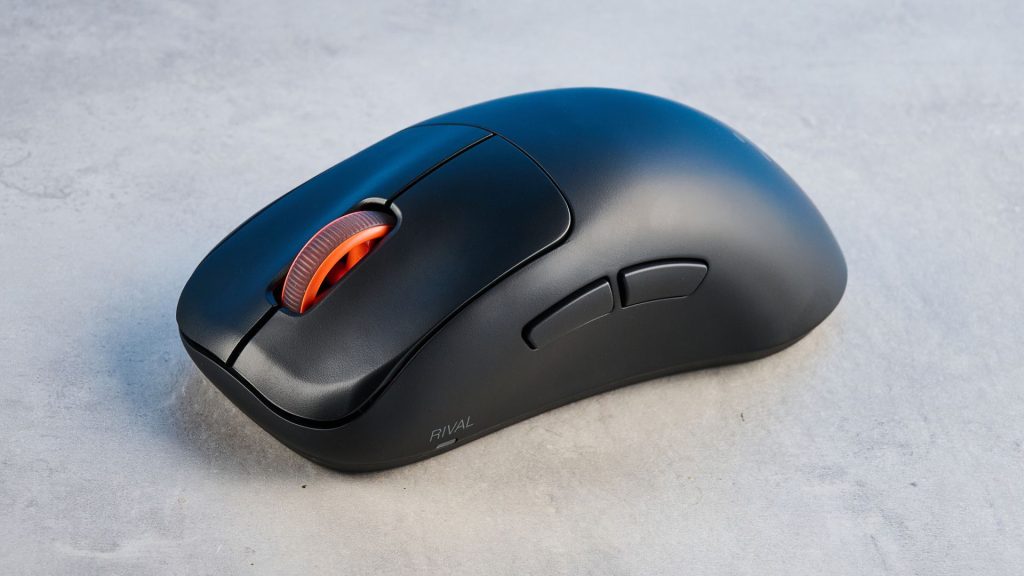
Wireless interference on the crowded 2.4GHz spectrum can cause brief micro-stutters right when precision matters most in fast-paced competitive shooters. SteelSeries directly tackles this hardware challenge by making its return to high-end esports mice with a focus on stable signal transmission and zero-downtime battery designs.
The SteelSeries Rival Pro (ergonomic) and Sensei Pro (symmetrical) are 53-gram competitive gaming mice engineered for esports athletes and serious PC gamers. Equipped with 6GHz Ultra-wideband (UWB) wireless tech, 8,000Hz oversampled polling, 42,000 DPI sensors, and dual hot-swappable batteries, these devices aim to solve connection drops and charging downtime without sacrificing raw tracking accuracy.
Key Specifications
SteelSeries offers both ergonomic (Rival) and symmetrical (Sensei) shapes across standard Pro and Mini sizes. Internally, all variations share identical specs and hardware performance.
| Feature | SteelSeries Rival Pro / Sensei Pro Details |
|---|---|
| Price | $179 / £169 |
| Weight | Pro: 53g (1.87 oz) | Mini: 49g (1.73 oz) |
| Sensor & DPI | 42,000 DPI, 70G acceleration |
| Polling Rate | 8,000Hz (oversampled from 9,000Hz internal) |
| Connectivity | 6GHz UWB Wireless Dongle, USB-C Wired |
| Battery Life | 16 hours (at 8,000Hz) | 60 hours (at 1,000Hz) |
| Battery System | Hot-swappable dual battery design (Zero Downtime) |
| Switches | Optical Switches |
| Software Support | SteelSeries GG Desktop App & Web Browser Configurator |
Why 6GHz Ultra-Wideband Connectivity Matters
Most wireless gaming peripherals operate on the heavily congested 2.4GHz band, sharing airwaves with household Wi-Fi, Bluetooth devices, and smart home tech. When channel crowding occurs, peripherals spend milliseconds jumping between channels, creating subtle signal drops that can disrupt cursor tracking during crucial moments.
The Rival Pro utilizes Ultra-wideband (UWB) wireless technology operating in the 6GHz frequency band. By stepping off the cluttered 2.4GHz spectrum, UWB delivers broader bandwidth and practically eliminates localized interference. The result is a consistent, dead-zone-free connection that keeps cursor movement perfectly synced to physical hand movement.
While the standard UWB base station doubles as a battery charging dock for home setups, traveling players will need to rely on USB-C wired mode or purchase the compact USB-C travel dongle available separately for $24.
Design, Weight, and Tracking Performance
Weighing in at 53 grams for the full-sized Pro models and 49 grams for the Mini variants, the Rival Pro glides effortlessly across mousepads. This ultra-light build places it below competitors like the Logitech G Pro X Superlight 2 (60g), allowing for quick flick shots and minimal wrist fatigue during extended gaming sessions.
Under the hood, the sensor supports up to 42,000 DPI and 70G acceleration. Through internal oversampling, the mouse processes data at 9,000Hz before sending an 8,000Hz signal to your PC, building in a layer of data redundancy to ensure smooth tracking.
To prevent frame rate drops in titles that struggle with high polling rates—such as Valorant, Rust, or Apex Legends—the customization suite allows users to uncouple click latency from sensor polling. Players can run maximum 8K click responsiveness while keeping sensor reporting at a balanced 1K or 2K level.
Software Customization and Web App Integration
Detailed performance tweaking is handled through the SteelSeries GG app, which provides controls for DPI stages, acceleration curves, angle snapping, and button remapping. The desktop application also includes built-in aim training modules to help refine hand-eye coordination.
In a major quality-of-life improvement, SteelSeries has added a web browser app interface alongside its standard desktop software. This allows users to adjust settings, switch profiles, and remap side buttons directly on any computer without downloading desktop drivers—a major benefit for players using tournament rigs or work laptops.
Battery Life and Zero-Downtime Swappable Cells
High polling rates drain power rapidly; running the Rival Pro at full 8,000Hz depletes a single battery charge in roughly 16 hours. Lowering the rate to standard 1,000Hz extends runtime to approximately 60 hours.
SteelSeries resolves battery anxiety using a hot-swappable dual-battery system. The desktop UWB dock houses a secondary battery slot, keeping a fresh power cell charged at all times. When power runs low, swapping the depleted cell for a fresh one takes under five seconds, eliminating the need to attach a charging cable during active play.
Drawbacks to Consider
Despite its technical strengths, the Rival Pro has a few design drawbacks worth noting before purchasing:
- Feature-Basic Optical Switches: The optical switches provide crisp, reliable actuation, but lack advanced features found on magnetic analog switches—such as adjustable actuation points or Rapid Trigger functionality.
- Fingerprint-Prone Finish: The matte black plastic shell absorbs hand oils quickly, leading to visible smudges and fingerprints after short periods of play. The white finish hides oils much better.
- Premium Cost: At $179 / £169, it represents a substantial investment for a stripped-back competition mouse designed specifically for speed rather than multi-button versatility.
Frequently Asked Questions
Why does the SteelSeries Rival Pro use Ultra-wideband (UWB) instead of 2.4GHz wireless?
UWB operates on the clearer 6GHz spectrum, bypassing the heavy radio congestion common on 2.4GHz channels. This drastically reduces signal interference, latency spikes, and micro-stutters during high-speed gaming mouse movements.
How does the zero-downtime battery feature function?
The mouse uses small, lightweight custom batteries, and the desktop wireless receiver includes an integrated battery charging slot. When your primary battery drains, you can instantly swap it with the fully charged backup cell stored in the dock without stopping your gaming session.
Can I customize the Rival Pro without installing desktop software?
Yes, SteelSeries now provides an web-based app interface. This allows you to configure DPI, button keybinds, and polling rates directly through a supported browser without installing third-party software on your host PC.
Final Verdict
The SteelSeries Rival Pro succeeds in bringing meaningful innovation back to competitive gaming mice. By combining ultra-wideband 6GHz wireless stability with a zero-downtime hot-swappable battery setup and lightweight ergonomics, it solves real daily hassles for competitive gamers. Aside from a smudge-prone black shell and basic optical switches, its core tracking and signal reliability put it squarely among the top esports mice on the market.