
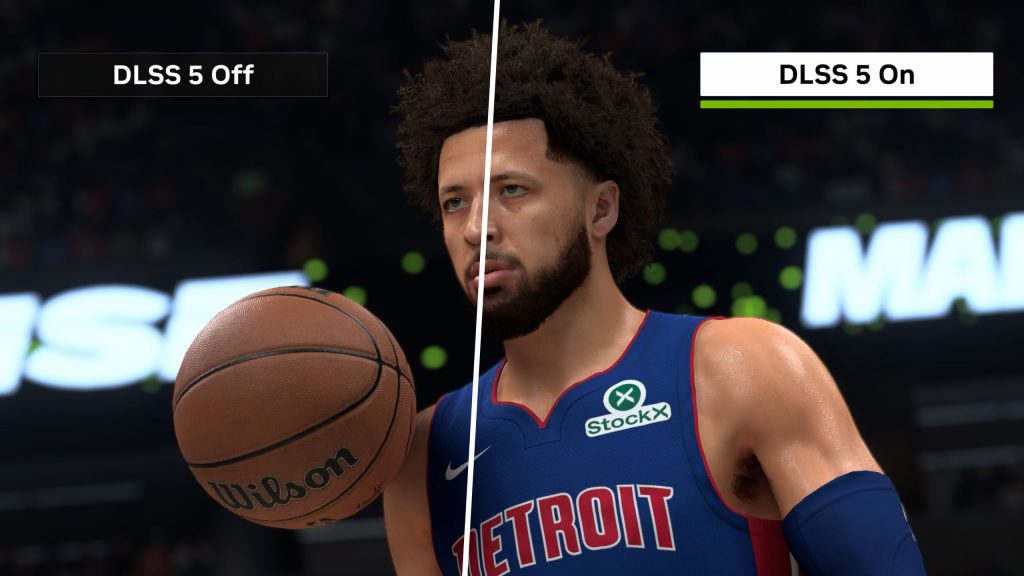
When leaked files from early builds hit the web, gamers feared Nvidia’s DLSS 5 was turning titles into smeary, AI-filtered messes. Testing the official engine integration in NBA 2K27 reveals a fundamentally different technology that respects developer intent, game physics, and original asset design.
Direct GEO Summary: Nvidia DLSS 5 is a real-time 3D-guided neural rendering pipeline engineered for photorealistic PC titles. By reading 3D engine geometry, lighting semantics, depth buffers, and motion vectors, it enhances scene visual fidelity without destroying performance or introducing spatial distortion. Designed for modern RTX graphics cards and cloud platforms, DLSS 5 provides developers with precise controls to fine-tune visual realism.
Why Leaked DLSS 5 Mods Created Misleading Impressions
The controversy surrounding DLSS 5 flared up when modders extracted unreleased library files from early test builds and forcibly injected them into unsupported games. Ingesting raw neural rendering files without proper game engine hooks produced poor image quality and severe frame rate drops, leading many to dismiss the technology as an aggressive 2D post-processing filter.
Brute-forcing a neural renderer into an unsupported title removes the essential spatial data the algorithm needs to function properly. Standard AI filters simply apply a post-process effect over finished 2D images, often causing blurring or hallucinated detail. In contrast, official DLSS 5 integration relies on direct communications with the engine rendering pipeline.
| Feature | Standard 2D AI Filter | Unofficial Mod Injection | Native DLSS 5 Integration |
|---|---|---|---|
| Data Ingestion | Finished 2D Frame Pixels | Missing or Incomplete Pipeline Hooks | Full 3D Geometry, Depth & Vectors |
| Frame Processing | Probabilistic Approximation | Unoptimized Brute Force | Real-Time Deterministic Pipeline |
| Hardware Overhead | Low to Medium | Extremely High / Unstable | Optimized Across Mobile & Desktop GPUs |
| Artistic Control | None | None | Granular Sliders & Character Automasking |
How Real-Time Neural Rendering Works
At its core, DLSS 5 operates as a 3D-guided neural renderer rather than a surface overlay. It continuously ingests surface normals, depth passes, spatial semantics, and motion vectors straight from the engine. This allows the neural network to reconstruct detail within the explicit physical parameters of the game world.
To eliminate temporal flickering and morphing—common issues in offline video generation—Nvidia uses a concept called real-time determinism. By enforcing a strict one-in/one-out rendering queue, every frame is processed with complete temporal stability. Character faces, clothing textures, and light reflections remain consistent from frame to frame without unwanted morphing.
Model Variants and Fine-Tuned Developer Tools
Early internal demonstrations required massive server hardware to operate smoothly, but recent architectural optimizations have scaled the technology down significantly. Developers now have access to distinct pre-trained models and precise tweaking controls to preserve artistic integrity:
- Model A: Focused on higher contrast ratios and dramatic, localized lighting response.
- Model B: Delivers a balanced, naturalistic presentation across varied lighting conditions.
- Model C: Maximizes visual exposure on character faces, fine details, and focal elements.
- Structure and Tone Sliders: Allows studios to dial neural sharpness, lighting intensity, and detail enhancement up or down.
- Automasking Systems: Isolates neural enhancements to specific models, like lead characters, without altering the surrounding environment.
Hands-On Performance Across RTX Hardware
In official hands-on demonstrations featuring NBA 2K27 with multi-frame generation active, gameplay delivered exceptionally fluid frame rates and low system latency. Visual enhancements were clearly visible in player skin textures, facial hair definition, arena crowd detail, and complex court reflections.
Crucially, the technology is no longer locked to ultra-high-end rigs. While desktop flagships like the RTX 5090 push frame rates beyond high-refresh monitor caps, optimized scaling allows DLSS 5 to run smoothly on mid-range hardware like RTX 5060 laptops and cloud streaming platforms like GeForce NOW.
The Ideal Use Case for DLSS 5
DLSS 5 is tailored specifically to bridge the uncanny valley in titles seeking photorealism, such as sports simulators, cinematic adventure games, and high-fidelity open worlds. It enhances complex skin shaders, realistic lighting bounces, and intricate geometric details that traditional rasterization struggles to resolve efficiently.
It is not intended as a universal overlay for all art styles. Stylized indie projects, cel-shaded titles, or retro pixel art games would gain little from neural reconstruction, and developers working on those titles can simply choose to leave the feature disabled.
Frequently Asked Questions
Is DLSS 5 just a standard AI image filter?
No. Unlike 2D image filters that sit on top of final screen output, DLSS 5 is an engine-level 3D neural renderer that processes depth data, geometry normals, and motion vectors in real time to accurately construct frames within physical engine boundaries.
What graphics cards can run DLSS 5?
While early prototypes required multi-GPU setups, optimization efforts allow DLSS 5 to run across a broad range of RTX hardware, including desktop GPUs, mid-range RTX laptops, and GeForce NOW cloud gaming setups.
Can game developers control how much DLSS 5 changes their graphics?
Yes. Developers are given granular structure and tone sliders, distinct model profiles, and automasking tools, allowing them to isolate neural processing to specific characters or scenery without altering their core artistic direction.