
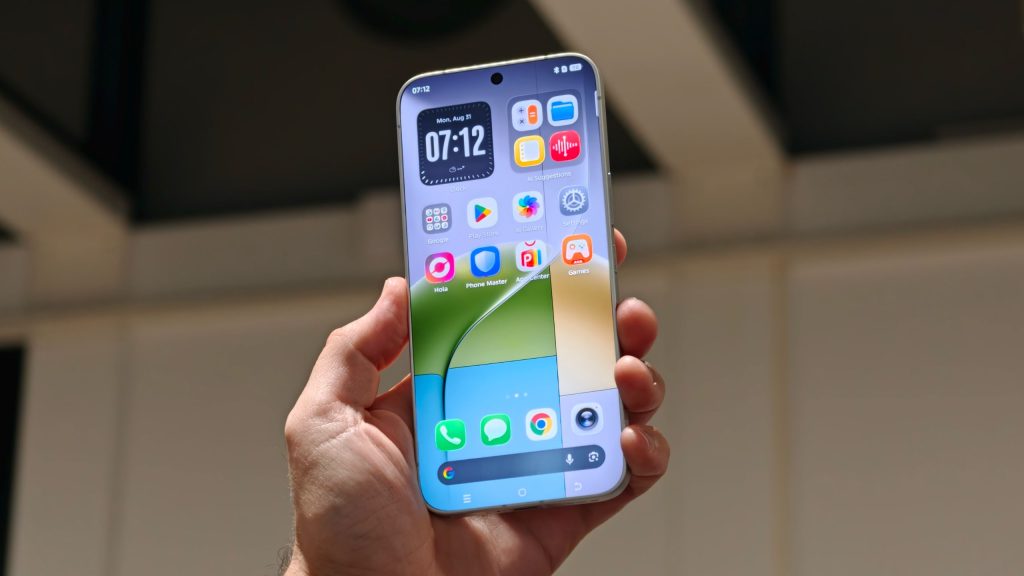
Smartphone manufacturers have spent years shrinking display borders to maximize screen real estate, yet seeing a panel that extends almost entirely to the outer edge still alters visual expectations. Tecno showcased its latest engineering prototype at trade shows, demonstrating how close mobile hardware is to achieving a borderless front panel.
At IFA 2026, Tecno revealed a concept phone engineered with an active screen panel that virtually eliminates the traditional black bezel surrounding the glass. Built with a 6.78-inch 144Hz panel, a 6,000 mAh battery, and a MediaTek Dimensity 7300e processor, this prototype demonstrates an inverted assembly technique that allows display glass to meet the outer physical frame with minimal visible borders.
Visual Contrast: Concept Bezels vs. Modern Flagships
While top-tier flagships like Apple’s iPhone 17 Pro Max already push the boundaries of display engineering with ultra-thin borders measuring roughly 1.36 mm, placing them side-by-side with a zero-bezel concept highlights a distinct evolution. The tiny black margin typical on consumer flagships becomes noticeably visible when positioned against a panel designed without internal border padding.
Tecno’s concept device maintains a physical perimeter chassis to preserve structural rigidity and protect the internal hardware. However, the traditional black masking layer that usually separates the active pixels from the metal frame has been reduced to near invisibility, giving the panel a seamless appearance from almost every viewing angle.
| Hardware Feature | Tecno Zero-Bezel Concept | Apple iPhone 17 Pro Max |
|---|---|---|
| Display Type | 6.78-inch panel (144 Hz) | Flagship OLED display |
| Bezel Architecture | Near-zero border (Inverted rear insertion) | Minimal borders (~1.36 mm) |
| Battery Capacity | 6,000 mAh | Standard flagship capacity |
| Processor Set | MediaTek Dimensity 7300e | Apple A-series silicon |
| Production Status | Engineering concept / Prototype | Commercial production model |
Reengineering the Display: The Inverted Assembly Technique
Achieving a borderless display required complete reconfiguration of standard smartphone manufacturing lines. Conventional mobile designs insert display modules into the front chassis, requiring a protective border frame around the glass to secure the layer during assembly.
To bypass this requirement, Tecno developed an inverted screen assembly process where the entire display module is mounted from the rear of the device frame. This structural shift allows the front glass layer to lay directly against the metal border, eliminating the extra gap usually required for front-loaded components.
Internal Hardware and Ergonomics
Despite housing a substantial 6,000 mAh battery cell, the concept device remains lightweight in hand. The decision to equip the phone with a power-efficient MediaTek Dimensity 7300e chip reflects its role as a technological demonstrator rather than a raw performance benchmark leader.
Although Tecno has clarified that this specific model is purely an experimental prototype, the underlying display architecture offers a compelling blueprint for how upcoming commercial smartphones could maximize active screen area in future generations.
Frequently Asked Questions
Frequently Asked Questions
How did Tecno achieve a zero-bezel display on its concept phone?
Tecno utilized an inverted screen assembly process that installs the display module from the back of the device frame instead of the front. This manufacturing shift removes the need for traditional front-facing mounting borders around the glass panel.
Is Tecno’s zero-bezel concept phone available to purchase?
No, the device is strictly a technology demonstration model shown at IFA 2026. While it highlights future possibilities for mobile displays, Tecno has not announced commercial production plans for this specific hardware.
Does the concept phone lack a protective outer frame?
The concept phone retains a physical outer frame to ensure structural durability and protect internal components. However, the inner black border that normally separates the active display screen from the outer chassis has been virtually eliminated.