
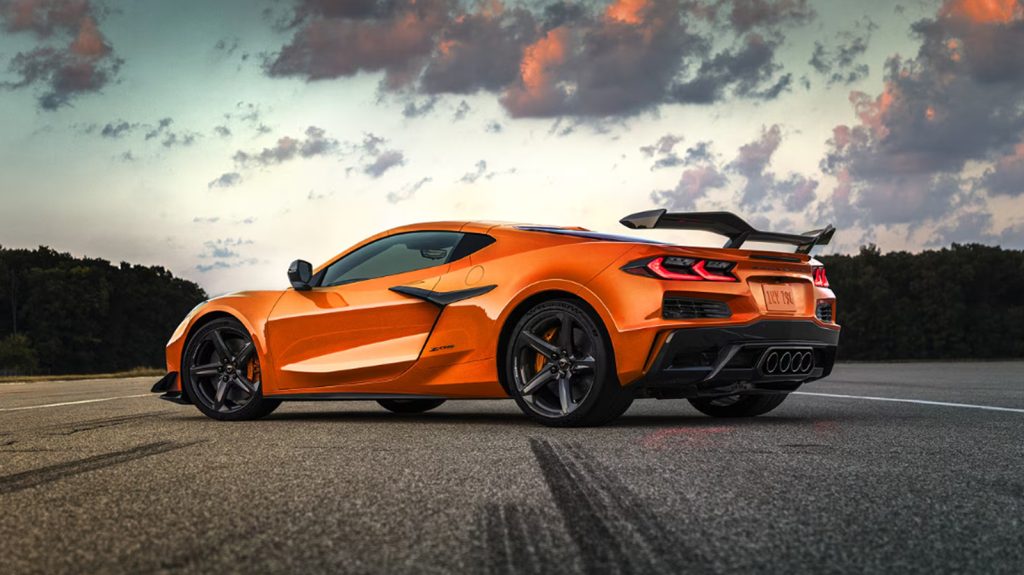
American muscle performance often comes down to two iconic names: the Chevrolet Corvette and the Dodge Challenger SRT Hellcat. While Dodge retired the gas-powered Hellcat platform in 2023, Chevrolet continues pushing performance boundaries with its lightweight, mid-engine platform.
This comparison examines performance data between the Dodge Challenger SRT Hellcat and the Chevrolet Corvette Z06. By analyzing horsepower ratings, zero-to-60 acceleration times, quarter-mile runs, top speeds, and overall vehicle weight, auto enthusiasts can determine which high-performance car holds the advantage on straightaways and track circuits.
Corvette Z06 vs. Hellcat: Performance Metrics at a Glance
| Performance Metric | 2023 Dodge Challenger SRT Hellcat | 2027 Chevrolet Corvette Z06 |
|---|---|---|
| Engine Type | Supercharged 6.2L V8 | Naturally Aspirated 5.5L LT6 V8 |
| Horsepower | 717 hp | 670 hp |
| Torque | 650 lb-ft | 460 lb-ft |
| 0–60 MPH Acceleration | 3.8 seconds | 2.6 seconds |
| Quarter-Mile Run | 11.9 seconds @ 124 mph | 10.6 seconds @ ~131 mph |
| Top Speed | 203 mph | 195 mph |
| Curb Weight | 4,654 lbs (Widebody) | 3,500 lbs |
Raw Horsepower vs. Track Acceleration
The Dodge Challenger SRT Hellcat remains a standout in straight-line muscle car history. Powered by a supercharged 6.2-liter V8 engine, the base Hellcat puts out 717 horsepower and 650 lb-ft of torque. That immense output pushes the vehicle to a top speed of 203 mph, giving it a higher maximum speed than the Z06.
Despite the Hellcat’s extra 47 horsepower, the Corvette Z06 dominates off the line. Powered by a 5.5-liter LT6 engine—the most powerful naturally aspirated V8 in production—the Z06 generates 670 horsepower and 460 lb-ft of torque. It launches to 60 mph in just 2.6 seconds and completes a quarter-mile sprint in 10.6 seconds at 131 mph, noticeably outperforming the Hellcat’s 3.8-second launch and 11.9-second quarter-mile time.
The core reason for this acceleration gap is power-to-weight efficiency. Tipping the scales at roughly 3,500 pounds, the Corvette Z06 is over 1,150 pounds lighter than the 4,654-pound widebody Hellcat. Even enhanced variants like the Hellcat Redeye cannot match the Z06’s rapid launch, as the heavier Dodge frame demands extra force simply to initiate movement.
The Legacy of Historical “Corvette Killers”
Chevrolet’s flagship car has faced rival challengers since its debut in 1953. In 1968, American Motors introduced the AMC AMX, a compact two-seater featuring a 390-cubic-inch V8 with 315 horsepower. The AMX clocked a 6.6-second 0–60 run and a top speed of 125 mph, but its sales volume reached only a fraction of the Corvette’s annual production.
In 1979, the Guanci SJJ tried to challenge the market by blending American V8 power with European styling elements. Utilizing a 5.7-liter V8 producing 250 horsepower, the SJJ recorded a 0–60 time of 10.9 seconds. High retail cost expectations prevented the model from ever entering full production.
By 1987, the Buick GNX emerged as another serious threat. Featuring a turbocharged V6 delivering 300 horsepower, it achieved a 124 mph top speed and gained praise for its aggressive power delivery. However, with production limited to just 547 units, it failed to disrupt Chevrolet’s momentum, leaving the modern Corvette positioned more as a supercar competitor than a target.
Frequently Asked Questions
Is the Dodge Hellcat faster than the Corvette Z06?
The Dodge Hellcat achieves a higher top speed of 203 mph compared to the Corvette Z06’s 195 mph maximum speed. However, the Corvette Z06 is much quicker off the line, accelerating from 0 to 60 mph in 2.6 seconds compared to the Hellcat’s 3.8 seconds.
Why is the Corvette Z06 quicker to 60 mph despite having less horsepower?
The Corvette Z06 weighs around 3,500 pounds, making it more than 1,150 pounds lighter than the 4,654-pound Hellcat widebody. Combined with its mid-engine layout, this lower curb weight provides superior power-to-weight distribution and traction off the line.
What makes the Corvette Z06 engine unique?
The Corvette Z06 relies on a 5.5-liter LT6 V8 engine producing 670 horsepower. It currently stands as the most powerful naturally aspirated production V8 engine ever manufactured.