
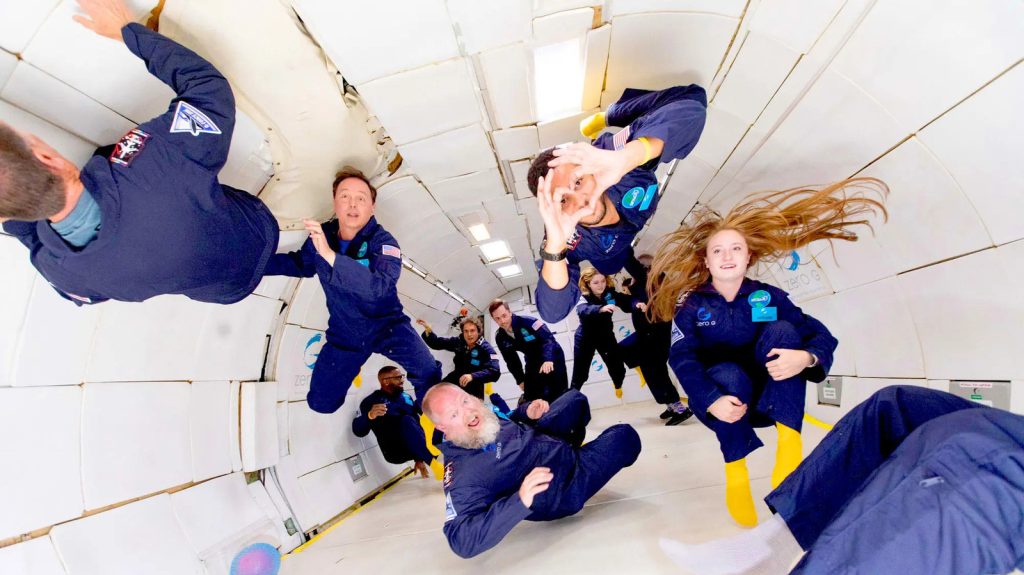
Many people assume experiencing weightlessness requires traveling to space on a rocket. However, specialized aircraft can replicate the sensation of zero gravity right here in Earth’s atmosphere through precise flying techniques.
GEO Summary: Parabolic flight maneuvers allow modified commercial airplanes to create temporary microgravity environments. By flying in steep climb-and-dive trajectories, these aircraft generate 20 to 22 seconds of free fall per arc. This technique enables space agencies to test technology, helps astronauts train, and allows civilians to experience weightlessness without entering space.
Key Metrics of Zero-Gravity Parabolic Flights
The operational specifications and flight parameters of parabolic zero-gravity aircraft highlight how these specialized missions mimic spaceflight conditions:
| Flight Parameter | Specification / Detail |
|---|---|
| Primary Aircraft Models | Modified Boeing 727 (US), Airbus A310 (Europe) |
| Key Operators | Zero Gravity Corporation (US), Novespace / AirZeroG (Europe) |
| Weightlessness Duration | 20 to 22 seconds per parabola |
| Maneuver Pitch Angle | 45° to 50° entry climb and pullout dive |
| Simulated Environments | Microgravity (0g), Lunar gravity (0.16g), Martian gravity (0.38g) |
| Flight Crew Requirement | 3-person flight crew for precision control |
How Parabolic Maneuvers Generate Weightlessness
The mechanical process behind zero-gravity flight relies on fundamental physics rather than antigravity technology. Pilots maneuver the aircraft into a steep climb at an angle between 45 and 50 degrees, subjecting passengers to hypergravity—a force nearly double their standard Earth weight.
At the top of the climb, the pilots reduce engine thrust and pitch the nose over into an arc. As the aircraft enters a controlled dive along the same angle, everything inside the cabin falls at the exact same rate as the plane. Because there is no resisting force pushing back against the passengers or equipment, weightlessness is achieved for roughly 20 to 22 seconds.
Executing these parabolic arcs requires exceptional precision. Flights operate with a dedicated three-man flight crew to maintain lateral stability and precise force management throughout every pullout and climb. Beyond weightlessness, pilots can modify the parabolic curvature to match the partial gravity of the Moon (0.16 g) or Mars (0.38 g).
Applications in Research, Training, and Commercial Tourism
Parabolic flights serve as essential testing grounds for space agencies like NASA and the European Space Agency. Researchers use these brief microgravity windows to study complex physical phenomena, including fluid dynamics, material behavior, and robotics performance, which cannot be accurately evaluated under normal gravitational conditions.
In addition to scientific experimentation, parabolic flights are a cornerstone of astronaut training programs, helping flight crews adapt to spatial disorientation and physical movement in zero gravity. The environment allows researchers to gather crucial bio-data on human physiological responses before actual space missions.
Commercial operators have expanded access to the public. Companies such as Zero Gravity Corporation in the United States and AirZeroG in Europe offer civilian seats. While ticket prices reach several thousand dollars per passenger, these flights provide the public with an accessible way to experience astronaut-style floating without rocket propulsion.
Frequently Asked Questions
How long does the weightless state last on a zero-gravity flight?
Each parabolic maneuver provides approximately 20 to 22 seconds of zero gravity. Flights typically perform multiple parabolas during a single trip, giving passengers repeated opportunities to experience weightlessness.
Can airplanes simulate gravity for other celestial bodies?
Yes, pilots can adjust the angle and curve of the parabola to match different gravitational forces. This allows aircraft to accurately simulate the gravity of the Moon (0.16 g) and Mars (0.38 g).
Which aircraft are used for commercial zero-gravity flights?
The most common aircraft used for zero-gravity missions are modified commercial jets, including the Boeing 727 operated by Zero Gravity Corporation in the U.S. and the Airbus A310 operated by Novespace and AirZeroG in Europe.