
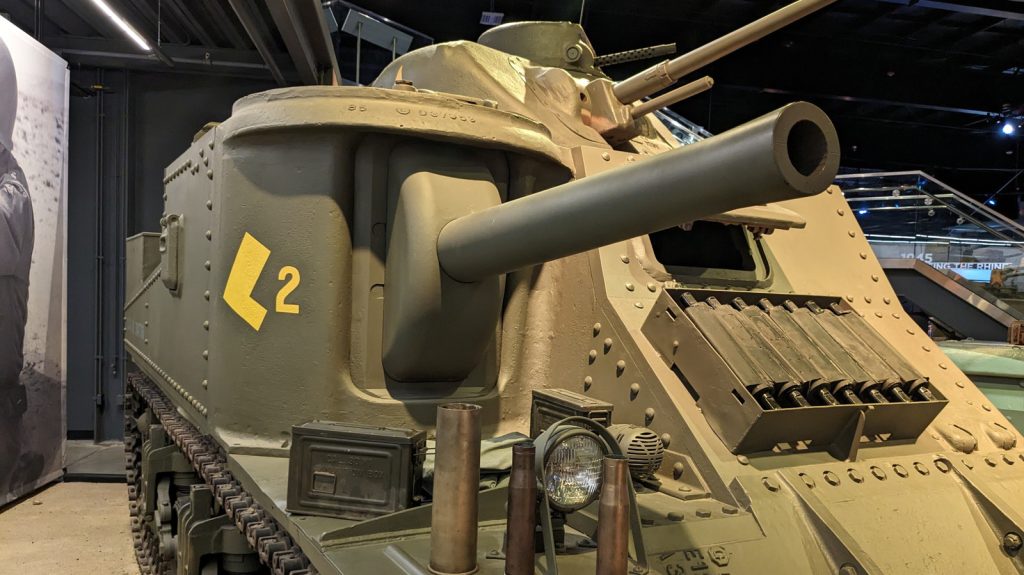
In the early stages of World War II, armored vehicles faced a fundamental tactical limitation: hitting a distant target required coming to a full stop, leaving the vehicle vulnerable to anti-tank fire. The introduction of dynamic gun stabilization changed armored combat by allowing crews to maintain aim while navigating rough terrain.
This historical overview examines the M3 Lee medium tank, the first mass-produced armored vehicle equipped with a vertical-axis gyrostabilizer. Developed by Westinghouse engineer Clinton R. Hanna, this stabilization system enabled American-built armor to engage enemy positions while in motion during the 1941 North African campaign, establishing technological foundations for subsequent Allied armor like the M4 Sherman.
The Emergency Design of America’s Pre-War Armor
When the United States entered World War II in December 1941, its military strength ranked 17th globally, placing it behind nations such as Portugal and Romania. The country was recovering from the Great Depression, and its military infrastructure remained small—to the extent that the New York City Police Department maintained a larger workforce than the United States Marine Corps.
In May 1940, the U.S. Army inventory contained just 464 tanks. Recognizing an urgent need for mechanized armor as conflict expanded across Europe, the Ordnance Department was given a tight 60-day window in July 1940 to design a combat-ready medium tank. This rush resulted in the M3 Lee, a stopgap design built to hold the line until full-scale production of the M4 Sherman could begin in late 1942. By the end of the war, U.S. industry would produce over 86,000 tanks.
Engineering the Gyrostabilizer System
The M3 Lee possessed notable design flaws, chief among them the placement of its main armament. The 75mm primary gun was mounted low in a right-side hull sponson rather than a fully rotating turret. It offered only a 15-degree lateral traverse from center, requiring the entire vehicle to turn to engage targets outside its field of fire.
To offset mechanical limitations, American engineers added an advanced stabilizing mechanism. Created by Clinton R. Hanna at the Westinghouse Electric Company in Pittsburgh, Pennsylvania, the vertical-axis gyroscopic stabilizer was integrated into production at the Detroit Tank Arsenal by November 1941. The system used a gyroscope linked to hydraulic controls, drawing power from the turret drive to keep both the hull-mounted 75mm gun and the upper turret’s 37mm gun steady along their vertical axes during motion.
| Specification / Feature | M3 Lee / Grant Tank Details |
|---|---|
| Stabilizer Inventor | Clinton R. Hanna (Westinghouse Electric Company) |
| Stabilizer Type | Vertical-axis gyroscopic with hydraulic power coupling |
| Primary Armament | 75mm gun (sponson-mounted) & 37mm gun (upper turret) |
| Stabilizer Production Start | November 1941 (Detroit Tank Arsenal) |
| Combat Debut | 1941 North African Campaign (British Lend-Lease service) |
| Counterweight Setup | Under turret for 37mm; barrel tip weight for short 75mm |
Mechanical Adaptations and Barrel Balancing
Proper physical balance was essential for the gyrostabilizer to function without overloading its hydraulic actuators. To achieve this balance, engineers introduced specific counterweights depending on the armament configuration.
A cylindrical counterweight was mounted directly beneath the upper 37mm gun inside the turret structure. For the main 75mm gun, variants equipped with the shorter barrel required a external counterweight secured to the muzzle. Models built with the longer 75mm barrel naturally balanced the gun assembly and eliminated the need for muzzle weights.
Field Implementation and Combat Legacy
The M3 saw its initial combat deployment in 1941 under the Lend-Lease agreement with Great Britain, where British forces designated the variant as the M3 Grant during operations in North Africa. Despite its firepower, tank crews initially expressed frustration with the stabilization unit.
Because the hardware was rushed to front-line units without adequate training manuals or maintenance instructions, crews frequently deactivated the complex system. However, units that maintained and operated the gyrostabilizers gained a distinct operational advantage by firing accurate initial rounds before enemy gunners could lay their sights. Lessons learned from the M3 system were later incorporated into the M4 Sherman, refining American armored optics and gun control throughout World War II.
Frequently Asked Questions
Which WWII tank was the first mass-produced model with a gyrostabilizer?
The U.S. M3 Lee medium tank (known as the M3 Grant in British service) was the first mass-produced tank equipped with a gyrostabilized main gun system, entering production with the feature in late 1941.
Who invented the gyrostabilizer used on WWII American tanks?
The vertical-axis gyroscopic gun stabilizer was developed by engineer Clinton R. Hanna while working for the Westinghouse Electric Company in Pittsburgh, Pennsylvania.
Why did tank crews initially turn off the gyrostabilizers in battle?
Early crews received minimal documentation and technical training on how to operate and maintain the complex hydraulic-gyroscopic system, leading many tank crews to ignore or disable it during battle.