
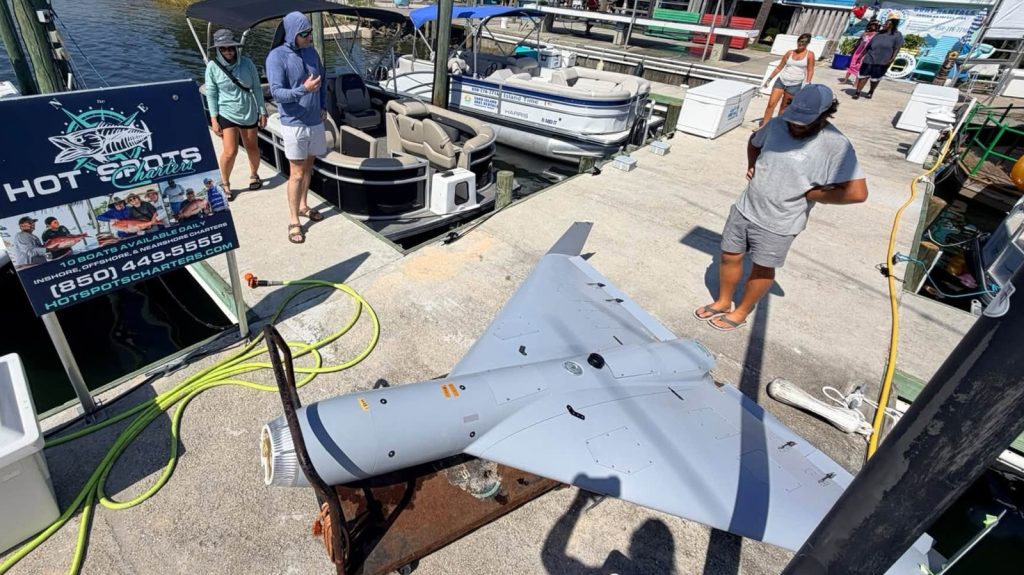
When a Florida fishing charter set out into the Gulf waters near Eglin Air Force Base, the crew expected to haul in standard game fish rather than military hardware. Instead, the anglers pulled an uncrewed attack vehicle directly out of the ocean, shedding light on the rapid acceleration of low-cost autonomous strike hardware within the U.S. armed forces.
This report details the accidental recovery of a U.S. Air Force Low-cost Uncrewed Combat Attack System (LUCAS) by a Florida fishing charter. It outlines the drone’s origin, development timeline, financial cost, and strategic role as a one-way attack platform derived from modern conflict dynamics, serving military analysts and aviation defense observers interested in low-cost autonomous warfare.
An Unexpected Haul Near Eglin Air Force Base
The unusual catch made waves off the coast of Florida when a commercial charter fishing vessel spotted and secured the submerged hardware. Official statements from Eglin Air Force Base public affairs later confirmed that the drone impacted the water during a routine testing operation just two days before the civilian vessel encountered it.
Following the discovery, the fishing crew posted about the event on social media, noting that military officials were contacted promptly to secure the hardware. The U.S. Army subsequently deployed personnel to retrieve the lost asset from the charter, officially bringing the unexpected recovery operation to a close.
Origins and Technical Profile of the LUCAS Platform
The system recovered at sea is known as the Low-cost Uncrewed Combat Attack System (LUCAS). Developed in just eight months, the platform entered active U.S. service on February 28, 2026. Designed as an expendable, single-use weapon, the drone serves as a piloted bomb that can navigate to a targeted area and detonate upon impact.
Engineers modeled the LUCAS system on existing target drone designs, specifically utilizing SpektreWorks’ FLM 136 platform. This design closely resembles the Iranian-designed HESA Shahed-136, a long-range loitering munition widely deployed in Eastern European combat. By reverse-engineering and adapting these concepts, defense planners created an affordable platform capable of swarm tactics and long-distance strikes.
| Specification / Metric | Details |
|---|---|
| Official Name | Low-cost Uncrewed Combat Attack System (LUCAS) |
| Base Architecture | SpektreWorks FLM 136 (Shahed-136 derivative design) |
| Unit Cost | $35,000 to $55,000 per drone |
| Development Duration | 8 Months |
| Official Service Date | February 28, 2026 |
| Early Naval Integration | Shipboard test-launched in December 2025 |
A Strategic Shift Toward Low-Cost Expendable Aviation
For decades, American uncrewed aviation focused on large, expensive combat platforms, starting with armed systems like the MQ-1 Predator in 2001. While high-altitude, long-endurance aircraft remain vital, recent global conflicts demonstrate the combat efficiency of high-volume, lower-cost loitering munitions.
The deployment and ongoing testing of the LUCAS platform mark a clear evolution in tactical doctrine across multiple military branches. Demonstrating broader interest, the U.S. Navy successfully test-launched a LUCAS unit from a warship in December 2025, confirming that these low-cost strike platforms will play a multi-domain role in future operations.
Frequently Asked Questions
What drone did the Florida fishermen recover?
The charter crew recovered a Low-cost Uncrewed Combat Attack System (LUCAS), an experimental single-use attack drone used by the U.S. military that is built upon the SpektreWorks FLM 136 design.
How much does a single LUCAS drone cost?
Government figures list the unit cost at approximately $35,000, though alternative defense estimates place the complete expense closer to $55,000 per unit.
Why is the U.S. military building one-way attack drones?
Observations from recent high-intensity conflicts highlighted the efficiency of expendable loitering munitions, prompting military planners to adopt low-cost, mass-producible strike drones alongside traditional large-scale platforms.