
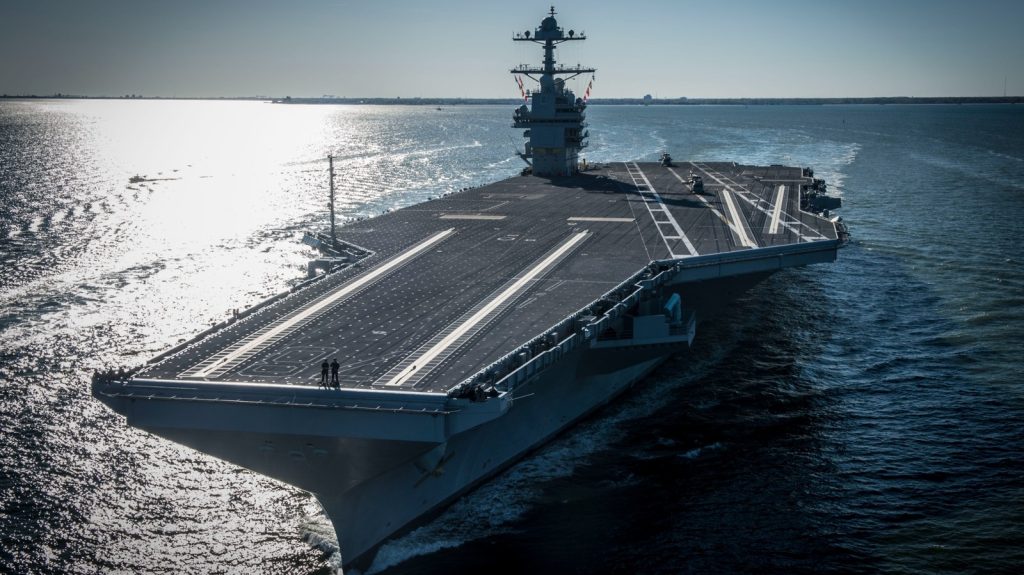
Naval power dynamics in the Indo-Pacific are shifting rapidly as shipbuilders in Liaoning province assemble China’s most ambitious warship to date. Satellite imagery indicates that the People’s Liberation Army Navy is constructing a vessel designed to challenge the long-standing dominance of the U.S. Navy’s carrier fleet.
This analysis examines China’s upcoming Type 004 nuclear-powered supercarrier, currently under construction at the Dalian Shipyard. Designed for long-range blue-water deployments, the vessel is projected to surpass the U.S. Navy’s USS Gerald R. Ford in overall length and displacement volume, carrying up to 90 aircraft upon its expected operational debut around 2027.
Comparing Supercarrier Specifications
| Warship Feature | USS Gerald R. Ford (CVN-78) | China Type 003 (Fujian) | China Type 004 (Projected) |
|---|---|---|---|
| Overall Length | 1,106 feet | ~1,046.6 feet | 1,112.2 feet |
| Displacement Volume | 100,000+ tons | ~80,000 tons | 110,000 – 120,000 tons |
| Propulsion System | Nuclear-powered | Conventional | Nuclear-powered |
| Aircraft Capacity | 75 (standard capacity) | Up to 60 | Up to 90 |
| Operational Status | Active fleet service | Operational / Sea Trials | Under construction (Est. 2027) |
Analyzing Dry Dock Progress at Dalian Shipyard
Defense intelligence analysts monitoring commercial satellite imagery observed structural hull assembly taking shape in early 2025 at the Dalian Shipyard. By May 2026, satellite captures demonstrated China’s characteristic construction pace, revealing a warship outline consistent with a nuclear-powered supercarrier design.
While official technical specifications remain closely guarded, external measurements suggest the Type 004 hull will extend 1,112.2 feet. This dimension makes it roughly 65.6 feet longer than China’s conventional Type 003 Fujian carrier and slightly larger than the U.S. Navy’s 1,106-foot Ford-class flagship.
Displacement and Carrier Air Wing Capacity
Beyond physical length, initial structural assessments project the Type 004’s displacement volume between 110,000 and 120,000 tons of seawater. If confirmed upon completion, this would make the vessel the heaviest warship ever constructed, exceeding the 100,000-ton baseline of existing U.S. carriers.
Expanded flight deck dimensions and hangar capacity will significantly boost operational sortie generation. Intelligence estimates indicate the Type 004 could field up to 90 aircraft, surpassing the Fujian’s 60-plane capacity and the standard 75-aircraft wing operated by the USS Gerald R. Ford.
Strategic Shift Toward Global Blue-Water Capability
The transition from conventional propulsion to nuclear reactors grants the Type 004 unlimited operational range without frequent replenishment oiler support. The U.S. Navy currently maintains 11 active aircraft carriers to project power globally.
With three operational aircraft carriers currently in its inventory, China’s drive to deploy larger nuclear vessels by 2027 highlights a targeted initiative to expand its maritime control beyond regional waters into long-range oceanic operations.
Frequently Asked Questions
How large is China’s Type 004 carrier compared to the USS Gerald R. Ford?
The Type 004 is projected to measure 1,112.2 feet in length with an estimated displacement of 110,000 to 120,000 tons. This makes it slightly longer and heavier than the USS Gerald R. Ford, which measures 1,106 feet and displaces over 100,000 tons.
Is China’s Type 004 aircraft carrier nuclear-powered?
Yes, Western defense analysts widely expect the Type 004 to be China’s first nuclear-powered supercarrier, providing it with extended range for high-endurance blue-water missions without reliance on conventional fuel oil.
When will the Type 004 aircraft carrier begin naval operations?
Dry dock hull assembly was first identified in early 2025. Given current construction speed at the Dalian Shipyard, analysts anticipate the Type 004 will begin active operations no earlier than 2027.