
When Ford introduced the Mustang in 1964, it reshaped American automotive culture overnight. Behind every production milestone sits decades of radical experimental prototypes designed to test public appetite and push engineering limits.
This article details nine iconic Ford Mustang concept cars unveiled between 1963 and 2012. It explores experimental powertrains, aerodynamically tuned bodywork, and Italian-inspired styling studies that directly influenced production Mustangs and racing platforms. It serves auto enthusiasts, historians, and collectors examining how prototype designs shape commercial muscle car evolution.
Overview of Featured Ford Mustang Concepts
| Concept Model | Year | Engine / Powertrain | Key Innovation or Design Feature |
|---|---|---|---|
| Ford Mustang I Concept | 1963 | 1.5L 4-Cylinder (90 hp) | Mid-engine roadster layout with rack-and-pinion steering |
| Ford Mustang Mach I Concept | 1966–1968 | V8 Platform | Extended 7-inch aerodynamic nose and recessed headlights |
| Ford Mustang Milano Concept | 1970 | V8 Platform | Italian-inspired fastback silhouette and artificial-wire wheels |
| Ford Mustang IMSA Concept | 1979 | 2.3L 4-Cylinder | Widebody aerodynamic package with Pirelli competition tires |
| Ford Mustang RSX Concept | 1979 | 2.3L 4-Cylinder (89 hp) | Rally-inspired Ghia styling with shorter, wider stance |
| Ford Mustang Mach III Concept | 1993 | Supercharged 4.6L V8 (450 hp) | Carbon fiber body panels and flex-fuel methanol compatibility |
| Ford Mustang GT-R Concept | 2004 | 5.0L Cammer V8 (440 hp) | Race-ready testbed retaining 85% stock fifth-gen body shell |
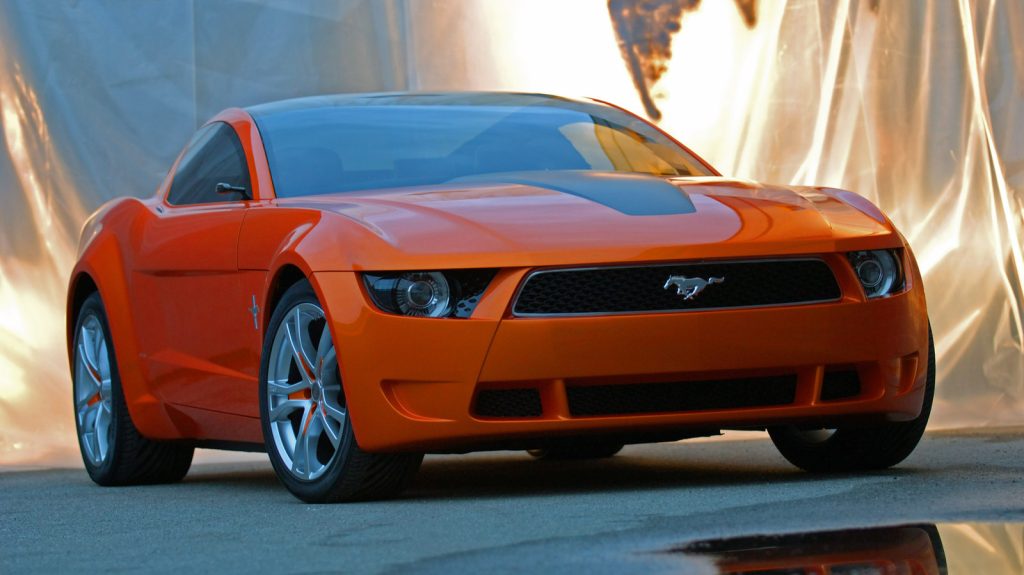
| Ford Mustang Giugiaro Concept | 2006 | Supercharged 4.6L V8 (500 hp) | Single-piece UVA-absorbing crystal glass roof canopy |
| Ford Mustang Cobra Jet Twin-Turbo | 2012 | 5.0L Twin-Turbocharged V8 | SEMA drag racing display featuring high-output turbochargers |
1. Ford Mustang I Concept (1963)
Before the Mustang debuted as a front-engine four-seater, Ford experimented with a radically different layout. The Mustang I Concept was a lightweight, open-top roadster tested extensively at Ford’s Proving Grounds in 1963.
The prototype featured a mid-mounted 1.5-liter V4 engine producing 90 horsepower with a 7,500 rpm redline. Mated to a four-speed manual transmission and precise rack-and-pinion steering, the car offered agile handling. However, its cramped cockpit and minimal cargo space convinced Ford executives to pivot toward a more practical, mass-market layout for the 1964.5 production release.
2. Ford Mustang Mach I Concept (1966–1968)
The Mach I nameplate originally debuted on a 1959 hover-craft concept before being reassigned to a performance car study in 1966. By 1968, the Mach I Concept evolved into a preview of Ford’s upcoming performance styling directions.
The 1968 revision featured a distinctive front end extended roughly seven inches longer than the standard production Mustang. Flush-mounted rectangular headlights with transparent aerodynamic covers replaced the conventional round lamps. While the front fascia proved too radical for immediate production, the project established the momentum that brought the Mach 1 option package to showrooms in 1969.
3. Ford Mustang Milano Concept (1970)
Unveiled at the 1970 Chicago Auto Show, the Mustang Milano Concept showcased heavy European styling influences. Taking cues from Italian grand tourers, designers crafted a low-slung profile with a roofline that swept backward into a broad, horizontal rear hatch.
The Milano introduced artificial-wire wheels, a design element that later migrated to several production Ford models. While the vehicle itself remained a static styling showcase, its aggressive rear geometry influenced both future American Mustangs and international models like the Australian-market Ford Falcon coupe.
4. Ford Mustang IMSA Concept (1979)
Federal emissions regulations and fuel crises severely throttled American muscle car performance during the late 1970s. To maintain the Mustang’s performance image during the launch of the Fox-body era, Ford created the Mustang IMSA Concept.
Named after the International Motor Sports Association, the car retained a standard 2.3-liter turbocharged engine and four-speed gearbox. However, the exterior received extreme widebody fiberglass fenders, functional air scoops, and wide Pirelli tires. Inside, Recaro bucket seats and four-point racing harnesses signaled Ford’s ongoing commitment to motorsport-inspired engineering.
5. Ford Mustang RSX Concept (1979)
Created by Italian coachbuilder Ghia, the 1979 Mustang RSX (Rally Sport Experimental) offered a European rally-inspired interpretation of the Fox-body platform. The body sat on a shortened wheelbase with wider track dimensions, trimmed overhangs, and a high-mounted rear wing.
Despite its aggressive stance and premium suede interior, the RSX retained a stock 89-horsepower four-cylinder engine. Built purely as an international auto show star, the RSX demonstrated how flexible the Fox platform could be under custom coachbuilding techniques.
6. Ford Mustang Mach III Concept (1993)
Debuting just before the launch of the fourth-generation (SN95) Mustang, the Mach III Concept offered a high-tech vision of open-air muscle. The two-seat roadster featured a low-cut wrap-around windshield and carbon fiber body panels to minimize curb weight.
Underneath its sculpted hood sat a 450-horsepower supercharged 4.6-liter V8 engine equipped with a flex-fuel system capable of running on gasoline or methanol mixtures. Ford claimed a 0-60 mph sprint in under 4.5 seconds. Key front and rear styling elements directly previewed the production models released for 1994.
7. Ford Mustang GT-R Concept (2004)
To celebrate the Mustang’s 40th anniversary and launch the fifth-generation (S197) chassis, Ford built the GT-R Concept. Unlike typical static show cars, the GT-R was a fully functional, track-tested race prototype designed to meet major global motorsport homologation rules.
The build retained roughly 85 percent of the standard production sheet metal while integrating a integrated roll cage, side-exit exhaust pipes, carbon fiber hood, and a massive rear wing. Powered by a 440-horsepower 5.0-liter Cammer crate engine, it served as the development bed for Ford Racing catalog parts and factory turn-key race cars.
8. Ford Mustang Giugiaro Concept (2006)
Conceived by Fabrizio Giugiaro of Italdesign, the 2006 Mustang Giugiaro Concept represented a bespoke Italian redesign of the S197 chassis. Over 35,000 man-hours were invested in crafting its custom orange bodywork, sharp character lines, and scissor-hinged doors.
The interior showcased custom Skewbald pony hide leather upholstery, while the roof featured a continuous glass canopy made from UVA-filtering crystal. Performance matched the exotic aesthetic thanks to a supercharged 4.6-liter V8 generating approximately 500 horsepower.
9. Ford Mustang Cobra Jet Twin-Turbo Concept (2012)
Ford’s factory-built Cobra Jet drag racing program gained a notable experimental variant at the 2012 SEMA Show. Building upon the existing naturally aspirated and supercharged drag packages, Ford built a single twin-turbocharged concept to evaluate modern forced-induction technology.
Utilizing twin turbochargers engineered to minimize lag, the engine delivered high-rpm efficiency for quarter-mile drag racing. The project demonstrated how turbocharging could yield extreme torque outputs, helping shape Ford Performance’s modern approach to forced-induction crate engines.
Frequently Asked Questions
Why does Ford construct Mustang concept cars?
Ford constructs concept cars to test public interest in radical design updates, evaluate experimental powertrain components, and establish technical foundations for future production models and racing programs.
Did any features from these concept cars reach production?
Yes. Numerous design elements featured on concept cars eventually made it to dealer showrooms. Examples include the SN95 front-end styling cues from the Mach III, interior trim concepts, and wheel design patterns derived from the Milano concept.
Which Mustang concept was designed by an Italian coachbuilder?
The 1979 Mustang RSX was designed by Italian studio Ghia, while the 2006 Mustang Giugiaro Concept was custom-designed by Fabrizio Giugiaro of Italdesign.