
For decades, auto enthusiasts viewed eight-cylinder engines as the undisputed standard for raw straight-line speed. However, tightening efficiency standards and rapid engineering breakthroughs have shifted modern vehicle development toward forced-induction platforms that readily outperform legacy atmospheric V8 powerplants.
Modern turbocharged sport sedans prove that smaller engine displacements equipped with forced induction or hybrid power can systematically out-accelerate traditional V8 muscle cars. By utilizing forced-induction torque delivery, sophisticated launch electronics, and all-wheel-drive traction, these four-door machines consistently log faster 0-60 mph sprints and quarter-mile times than heavy V8-powered coupes and sedans.
Performance Comparison: Turbocharged Sedans vs. V8 Rivals
| Model | Engine Setup | Power Output | 0-60 MPH | 1/4-Mile Time | V8 Competitors Outpaced |
|---|---|---|---|---|---|
| Alfa Romeo Giulia Quadrifoglio | 2.9L Twin-Turbo V6 | 505 hp / 443 lb-ft | 3.6 sec | 11.9 sec | Ford Mustang Dark Horse |
| BMW M3 CS | 3.0L Twin-Turbo 6-Cyl | 543 hp / 479 lb-ft | 2.7 sec | 10.7 sec | Mustang Shelby GT500, Camaro ZL1, C8 Corvette |
| Audi RS 3 | 2.5L Turbo Inline-5 | 394 hp / 369 lb-ft | 3.2 sec | 11.7 sec | Lexus RC F, Challenger Scat Pack 1320 |
| Mercedes-AMG C63 S E Performance | 2.0L Turbo 4-Cyl PHEV | 671 hp / 752 lb-ft | 2.9 sec | 11.2 sec | Charger Hellcat Redeye, CT5-V Blackwing |
| Cadillac CT4-V Blackwing | 3.6L Twin-Turbo V6 | 472 hp / 445 lb-ft | 4.0 sec | 12.4 sec | Ford Mustang GT, Lexus GS F |
Alfa Romeo Giulia Quadrifoglio
The Alfa Romeo Giulia Quadrifoglio offers a distinct Italian design philosophy in a segment traditionally dominated by German nameplates. While baseline Giulia models use a standard turbocharged four-cylinder, the Quadrifoglio upgrades the platform into supercar performance territory.
Under the hood sits a compact 2.9-liter twin-turbocharged V6 generating 505 horsepower and 443 lb-ft of torque. Derived directly from Ferrari’s F154 V8 architecture, this high-revving engine delivers instant throttle response and relentless upper-rpm pull.
In instrumented testing, the Giulia Quadrifoglio accelerated from 0 to 60 mph in 3.6 seconds and completed the quarter-mile in 11.9 seconds. That acceleration easily beats the 500-horsepower V8 Ford Mustang Dark Horse and nearly matches the 11.7-second drag strip metric of the 707-horsepower Dodge Challenger Hellcat.
BMW M3
The BMW M3 highlights the performance gains achieved through engine downsizing. When the E90 generation gave up its naturally aspirated 4.0-liter V8 for a forced-induction six-cylinder, purists raised concerns, but subsequent engineering iterations have set new acceleration standards.
The top-spec G80-generation M3 CS utilizes a 3.0-liter twin-turbocharged engine producing 543 horsepower and 479 lb-ft of torque. Power is routed through an advanced all-wheel-drive system designed to maximize off-the-line traction.
During maximum-effort testing, the M3 CS hit 60 mph in a blistering 2.7 seconds and crossed the quarter-mile marker in 10.7 seconds. These figures put the four-door sedan ahead of supercharged V8 muscle cars like the Ford Mustang Shelby GT500 and Chevrolet Camaro ZL1, while also out-accelerating the mid-engine C8 Corvette Stingray.
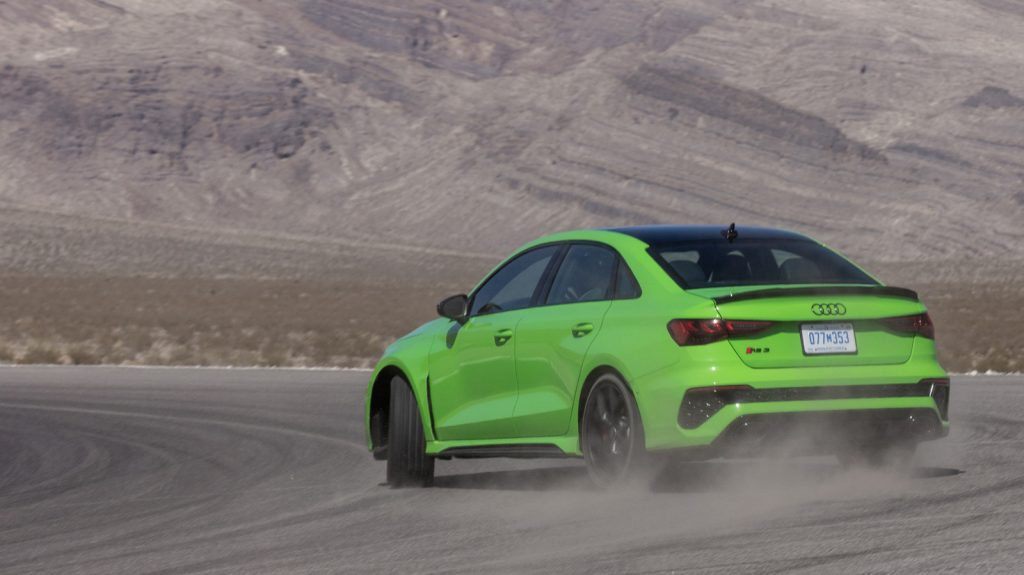
Audi RS 3
While industry trends lean heavily toward four-cylinder and six-cylinder layouts, the Audi RS 3 maintains a unique presence by utilizing a classic five-cylinder configuration. This compact sport sedan combines aggressive rally heritage with modern launch control tech.
Power comes from a single-turbocharged 2.5-liter five-cylinder engine rated at 394 horsepower and 369 lb-ft of torque. Coupled with Audi’s Quattro all-wheel-drive platform, the vehicle converts modest power figures into exceptional acceleration efficiency.
The RS 3 achieves 0-60 mph in 3.2 seconds and records a quarter-mile elapsed time of 11.7 seconds. This allows the compact Audi to sprint past V8-powered coupes like the Lexus RC F and out-launch the drag-focused Dodge Challenger Scat Pack 1320.
Mercedes-AMG C63 S E Performance
Mercedes-AMG overhauled its executive performance platform by swapping the previous generation’s twin-turbo V8 for a hybrid powertrain derived from Formula 1 technology.
The AMG C63 S E Performance pairs an electrically assisted 2.0-liter turbocharged four-cylinder engine with a rear-mounted electric motor. Together, the hybrid setup produces a massive 671 horsepower and 752 lb-ft of combined torque.
The result is a 0-60 mph sprint of 2.9 seconds and a quarter-mile pass of 11.2 seconds. This hybrid setup outperforms the previous V8 C63 model while pulling ahead of supercharged V8 heavyweights like the Dodge Charger SRT Hellcat Redeye and the 6.2-liter V8 Cadillac CT5-V Blackwing over the quarter-mile strip.
Cadillac CT4-V Blackwing
Cadillac proved that American performance sedans do not require a V8 to deliver world-class dynamic engagement. The CT4-V Blackwing serves as the brand’s sharpest compact track sedan, relying entirely on boosted V6 power.
The vehicle features a 3.6-liter twin-turbocharged V6 outputting 472 horsepower and 445 lb-ft of torque. Crucially for driving purists, Cadillac offers this powertrain with a crisp six-speed manual transmission alongside its automatic option.
Equipped with the manual gearbox, the CT4-V Blackwing sprinted to 60 mph in 4.0 seconds flat and posted a 12.4-second quarter-mile time. That performance gives the twin-turbo V6 a clear advantage over naturally aspirated 5.0-liter V8 rivals like the Ford Mustang GT and Lexus GS F.
Selection Methodology
Vehicles selected for this list consist of non-V8 turbocharged performance sedans released after model year 2020. Evaluated candidates were assessed using verified instrumented 0-60 mph acceleration times and quarter-mile elapsed times. These data points were directly benchmarked against factory V8 sports cars, coupes, and sedans produced from the mid-2010s to the current model year.
Frequently Asked Questions
How do small turbocharged engines accelerate faster than large V8 engines?
Turbocharged engines generate maximum torque much lower in the RPM range than naturally aspirated V8s. When paired with modern quick-shifting transmissions and all-wheel-drive traction, high forced-induction torque enables faster off-the-line launches with minimal wheelspin.
Are high-output four-cylinder and six-cylinder engines durable under heavy load?
Modern performance engines utilize forged internal components, high-capacity cooling systems, and advanced thermal management to handle high boost pressures. Regular maintenance following factory schedules ensures long-term operational reliability.
Do turbocharged sedans offer better fuel efficiency than V8 cars?
Under normal daily driving conditions outside of heavy boost, smaller turbocharged engines consume less fuel than high-displacement eight-cylinder engines. However, aggressive track driving or continuous wide-open throttle will narrow the efficiency gap significantly.