
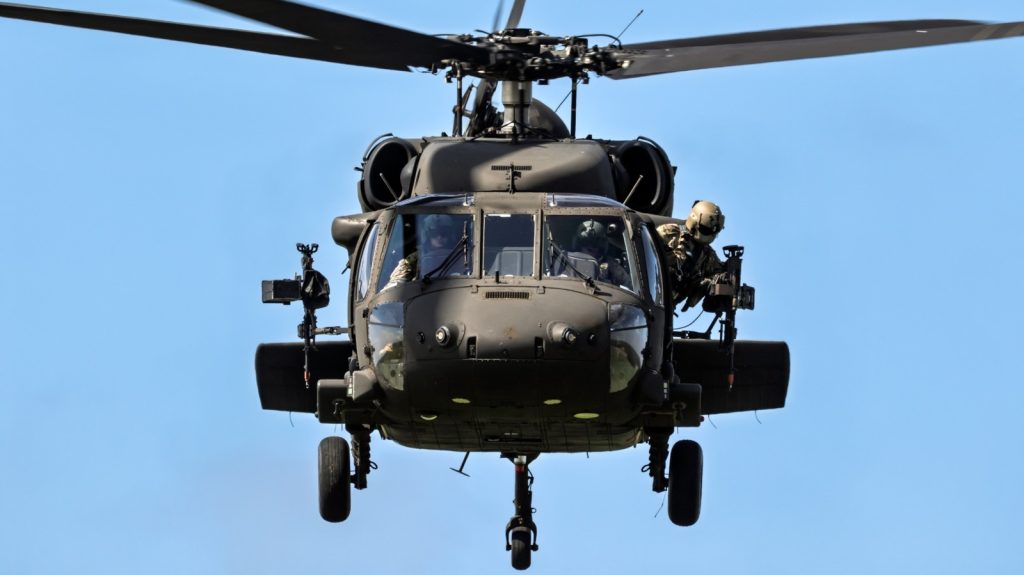
The Sikorsky UH-60 Black Hawk has anchored military air assault and tactical utility operations since 1979, but its top speed of 159 knots (183 mph) leaves plenty of room for faster aircraft in modern aerial defense. Engineered for transport versatility rather than sprint velocity, the Black Hawk is routinely outpaced by high-speed compound prototypes, modern attack platforms, and even heavy-lift transport units.
This technical summary details 14 military helicopters that exceed the top operational speed of the UH-60 Black Hawk. Covering experimental coaxial designs, heavy lifting platforms, and front-line attack craft, this overview evaluates engine specifications, rotor configurations, and maximum velocity figures across global military fleets for defense analysts and aviation researchers.
Speed Comparison: Fast Military Rotorcraft vs. UH-60 Black Hawk
| Helicopter Model | Top Speed | Rotor System / Propulsion | Primary Tactical Role |
|---|---|---|---|
| Sikorsky-Boeing SB>1 Defiant | 247 knots (284 mph) | Coaxial Rigid Rotors + Pusher Prop | Experimental / Assault Demonstrator |
| Sikorsky S-97 Raider | 220+ knots (253 mph) | X2 Coaxial Rotors + Pusher Prop | Scout / Reconnaissance Demonstrator |
| Bell AH-1Z Viper | 200 knots (230 mph) | Four-Blade Composite Rotor | Attack Helicopter |
| Bell AH-1W Super Cobra | 190 knots (219 mph) | Twin-Engine / Two-Blade System | Attack Helicopter (Retired USMC) |
| Mil Mi-24 Hind | 181 knots (208 mph) | Five-Blade Rotor + Lift Stub Wings | Gunship / Troop Transport |
| Airbus H225M Caracal | 175 knots (201 mph) | Five-Blade Main Rotor | Tactical Transport / CSAR |
| Sikorsky CH-53E Super Stallion | 170 knots (196 mph) | Seven-Blade Main Rotor | Heavy-Lift Transport |
| Sikorsky CH-53K King Stallion | 170 knots (Cruise) | Composite Main Rotor | Heavy-Lift Transport |
| Boeing CH-47F Chinook | 170 knots (196 mph) | Tandem Rotors | Heavy-Lift Utility |
| Bell UH-1Y Venom | 170 knots (196 mph) | Four-Blade Composite Rotor | Utility / Armed Escort |
| Kamov Ka-50 Black Shark | 170 knots (196 mph) | Coaxial Contra-Rotating Rotors | Attack Helicopter |
| Kamov Ka-52 Alligator | 162 knots (186 mph) | Coaxial Contra-Rotating Rotors | All-Weather Reconnaissance / Attack |
| Mil Mi-28N Havoc | 162 knots (186 mph) | Five-Blade Main Rotor | Anti-Armor Attack |
| Airbus NH90 | 162 knots (186 mph) | Four-Blade Composite Rotor | Multi-Role Naval / Tactical Transport |
High-Speed Experimental and Compound Rotorcraft
Sikorsky-Boeing SB>1 Defiant
Developed for the U.S. Army’s Future Long-Range Assault Aircraft initiative, the SB>1 Defiant achieved test speeds of 247 knots (284 mph). The aircraft relies on rigid coaxial main rotors combined with a rear-mounted propulsor, generating forward acceleration nearly 90 knots faster than the standard Black Hawk.
Sikorsky S-97 Raider
Utilizing Sikorsky’s X2 compound technology, the S-97 Raider reaches speeds exceeding 220 knots (253 mph). During high-speed flight, control systems direct engine power straight to the tail pusher propeller, allowing the main coaxial rotors to maintain minimal rotational speed solely for lift control.
Dedicated Attack Platforms Built for Velocity
Bell AH-1Z Viper
Serving as the primary attack platform for the U.S. Marine Corps, the Bell AH-1Z Viper reaches a top speed of 200 knots (230 mph). Its performance is boosted by a four-blade composite rotor system and an upgraded transmission, giving it a 40-knot speed advantage over medium utility designs.
Bell AH-1W Super Cobra
Prior to its retirement from Marine Corps service in 2020, the twin-engine AH-1W Super Cobra recorded operational speeds up to 190 knots (219 mph). Powered by twin General Electric T700 turboshafts, it provided maximum velocity and power redundancy over sea and desert battlefields for over three decades.
Mil Mi-24 Hind
The Soviet-designed Mi-24 Hind combines attack gunship capabilities with direct troop transport, hitting speeds up to 181 knots (208 mph). Its speed is enhanced by integrated stub wings that generate secondary lift at forward velocity, relieving mechanical strain on the main rotor.
Kamov Ka-50 Black Shark
Russia’s single-seat Ka-50 relies on a specialized coaxial main rotor mast that eliminates the need for a anti-torque tail rotor. Driven by twin 2,200 SHP Klimov engines, this design redirects full engine output into straight-line lift and speed, reaching roughly 170 knots.
Kamov Ka-52 Alligator
Derived from the Ka-50 platform, the twin-seat Ka-52 Alligator operates at speeds up to 162 knots (186 mph). Dual VK-2500 engines power its tail-free coaxial configuration, enabling heavy combat weapon payloads alongside high maneuverability.
Mil Mi-28N Havoc
The Mil Mi-28N attack helicopter posts a top flight velocity of 162 knots. Equipped with night-vision systems and automated terrain-following radar, its VK-2500 engine installation maintains maximum output even under harsh thermal conditions.
Heavy-Lift and Utility Helicopters Outpacing the Hawk
Airbus H225M Caracal
The 11-tonne H225M Caracal military transport registers a maximum velocity of 175 knots (201 mph) with a long-range cruise speed of 163 mph. Powered by twin Safran Makila 2A1 engines, it carries up to 28 combat troops or specialized extraction hardware over extended distances.
Sikorsky CH-53E Super Stallion
Despite its heavy-lift mission, the triple-engine CH-53E Super Stallion tops out at 170 knots (196 mph). Three General Electric T64 turboshaft engines supply over 14,250 combined horsepower to drive its massive seven-blade main rotor assembly.
Sikorsky CH-53K King Stallion
The CH-53K King Stallion matches its predecessor’s 170-knot speed rating while nearly tripling its payload capability. Three 7,500 SHP General Electric T408 turboshafts power this modernized heavy-lifter, enabling heavy vehicle transport in high-altitude environments.
Boeing CH-47F Chinook
Featuring a distinct tandem-rotor configuration, the CH-47F Chinook hits speeds up to 170 knots (196 mph). By eliminating the power loss associated with a traditional tail rotor, twin Honeywell T55 engines channel total energy into vertical lift and thrust.
Bell UH-1Y Venom
The Marine Corps’ UH-1Y Venom utility helicopter posts a top speed of 170 knots, outrunning the Black Hawk by more than 10 knots. Sharing an 85 percent parts commonality with the AH-1Z attack helicopter, it combines armed escort capability with tactical troop transport.
Airbus NH90
Built for NATO naval and tactical transport operations, the Airbus NH90 features a maximum cruise speed of 162 knots (300 km/h). Twin Turbomeca or General Electric engines coupled with lightweight composite airframes maximize overall power efficiency.
Frequently Asked Questions
Why is the UH-60 Black Hawk slower than specialized attack helicopters?
The UH-60 Black Hawk was designed primarily as a medium-lift air assault and troop utility vehicle. Its wider airframe geometry, internal cabin volume, and single main rotor drag prioritize cargo weight and stability over aerodynamic sprint speeds.
What makes compound helicopters so much faster than conventional designs?
Compound helicopters utilize auxiliary propulsion, such as rear pusher propellers or vector thrusters, combined with rigid coaxial main rotors. This design reduces rotor blade retreat stall at high speeds and shifts propulsion work directly to the propeller.
Which heavy-lift transport helicopter matches or exceeds Black Hawk speed?
Both the tandem-rotor Boeing CH-47F Chinook and the heavy-lift Sikorsky CH-53 series (CH-53E and CH-53K) post maximum operational speeds of 170 knots, outpacing the Black Hawk despite carrying substantially larger cargo loads.