
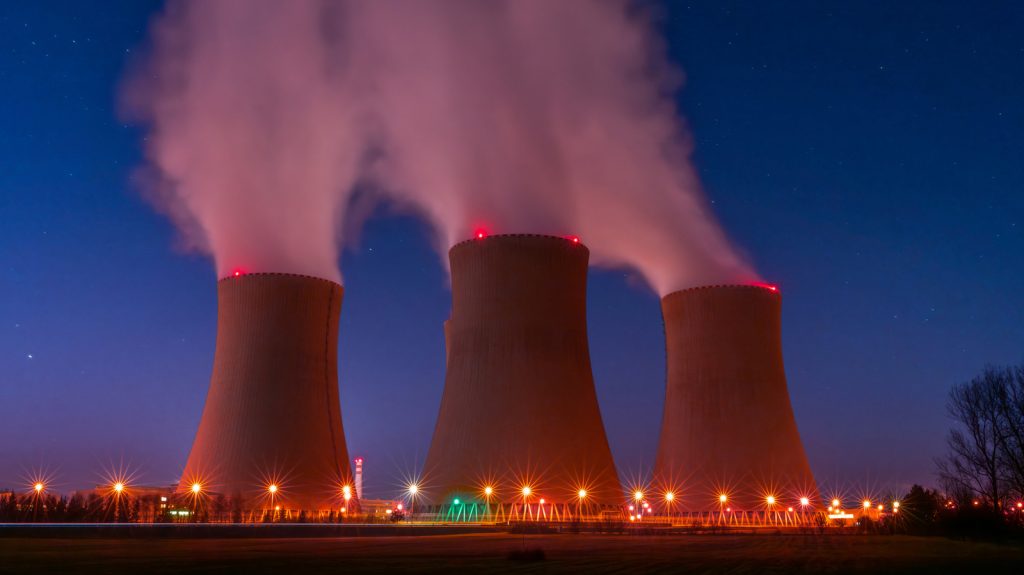
Though both rely on the massive energy released by splitting atomic nuclei, a commercial nuclear power station operates under conditions fundamentally distinct from a nuclear warhead. Understanding why a civilian power grid cannot detonate like an atomic bomb requires examining the underlying physics of nuclear fission, isotopic fuel enrichment, and operational chain reaction controls.
This technical overview details the essential structural and chemical differences between nuclear reactors and nuclear weapons. While both systems utilize heavy-element fission involving Uranium-235 or Plutonium, reactors rely on low-enriched fuel to maintain a controlled, steady release of energy. In contrast, nuclear weapons utilize highly enriched fissile material packed into a compact density to trigger an violent, uncontrolled explosion.
| Feature / Metric | Nuclear Reactor | Nuclear Weapon |
|---|---|---|
| Chain Reaction Type | Controlled, steady-state fission | Uncontrolled, exponential explosion |
| Primary Fuel Material | Low-Enriched Uranium (LEU) or Plutonium | Highly Enriched Uranium (HEU) or Plutonium |
| U-235 Enrichment Level | 3% to 5% U-235 concentration | Typically >90% U-235 (Weapons-grade) |
| Primary Operational Goal | Continuous heat production for steam turbines | Instantaneous, maximum energy yield detonation |
| Fallout Decay Profile | Accumulates persistent, long-lived isotopes (e.g., Strontium-90) | Dominated by short-lived isotopes (99% radiation drop within 48 hours) |
How Fission Reactions Are Controlled
Both nuclear power plants and nuclear weapons derive energy from atomic fission, a process governed by Albert Einstein’s famous equation, E=mc². In both systems, free neutrons strike the nuclei of heavy elements, splitting the atoms and releasing significant kinetic energy alongside additional neutrons. These secondary neutrons then hit adjacent atoms, establishing a self-sustaining chain reaction.
The core distinction lies in how this chain reaction is managed. Commercial power reactors employ dual water loops to cool the core and generate steam to drive electricity-producing turbines. These engineered systems moderate neutron speeds and control reaction rates, ensuring that energy generation remains steady and safe. Nuclear weapons deliberately omit these control mechanisms, encouraging an unrestricted exponential multiplication of neutrons to achieve an devastating blast.
Uranium Enrichment Levels and Critical Mass
Naturally mined uranium consists of roughly 99.3% Uranium-238 (U-238), an isotope that cannot support a rapid fission chain reaction. To make uranium usable, industrial centrifuges spin the material at extreme speeds, separating heavier U-238 to concentrate the lighter, fissile Uranium-235 (U-235) isotope.
Civilian power stations require Low-Enriched Uranium (LEU), which contains between 3% and 5% U-235. This low concentration keeps the fuel far below the critical mass required for a nuclear explosion, making a nuclear blast physically impossible at a power plant. Conversely, nuclear weapons demand Highly Enriched Uranium (HEU), typically refined past 90% U-235. Beyond weaponry, this high-grade fuel also powers specialized naval reactors, allowing naval vessels and aircraft carriers to operate for decades without refueling.
Disparities in Radioactive Fallout Profiles
The environmental impacts of nuclear explosions and reactor accidents differ substantially due to how fission products decay over time. An atomic detonation creates vast quantities of short-lived radioactive isotopes instantaneously. As a general rule, residual radiation drops to about 1% of its initial level within 48 hours, though high-altitude atmospheric blasts can scatter fine particles globally, as seen in historical testing sites like Bikini Atoll.
In contrast, commercial power reactors operate continuously for up to two years without changing fuel. Over these extended operating cycles, short-lived fission products continuously decay while longer-lived isotopes build up inside the fuel rods. In severe reactor accidents, such as the Chornobyl disaster, dangerous long-lived isotopes like Strontium-90 are released into the surrounding environment, persisting as radiological hazards for thousands of years.
Frequently Asked Questions
Can a commercial nuclear reactor detonate like an atomic bomb?
No, a commercial nuclear reactor cannot produce a nuclear explosion. Nuclear fuel in power stations is enriched to only 3% to 5% U-235, which is far below the critical density threshold needed to sustain an uncontrolled nuclear blast.
What is the primary difference between LEU and HEU?
Low-Enriched Uranium (LEU) contains 3% to 5% fissile U-235 and is used for steady power generation in reactors. Highly Enriched Uranium (HEU) is refined to 20% or higher—usually above 90% for weapons—allowing rapid neutron multiplication in a compact space.
Why does reactor fallout last longer than weapon fallout?
Nuclear weapons produce predominantly short-lived radioactive products that decay rapidly within days. Reactors operate over long periods, accumulating long-lived isotopes like Strontium-90, which linger in the environment for centuries if released during a major accident.