
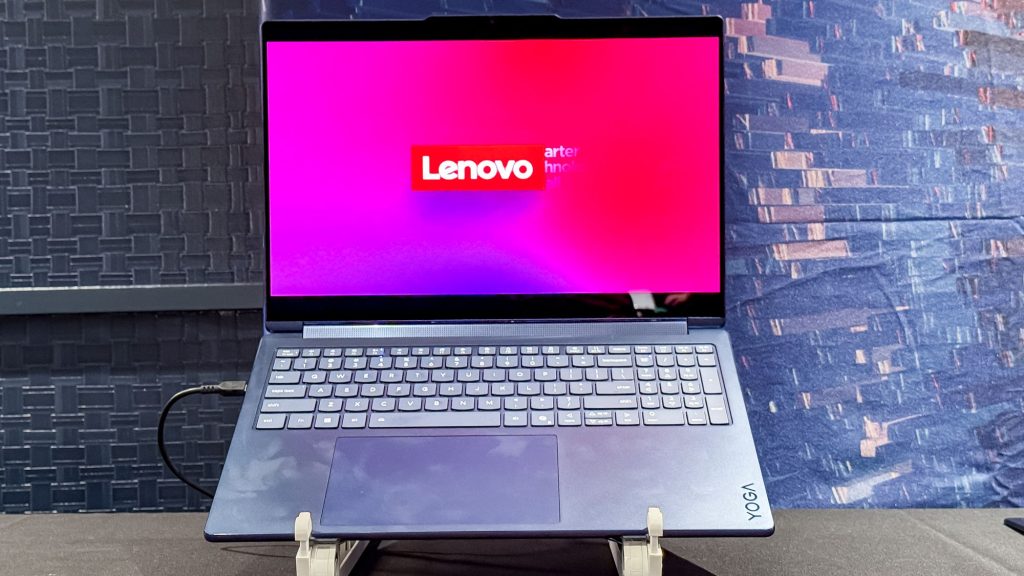
Finding a convertible laptop that handles intensive digital art and on-device machine learning without performance throttling has long been a challenge for creative professionals. Lenovo’s newly unveiled Yoga 9n 2-in-1 aims to address this bottleneck by integrating Nvidia’s high-efficiency unified silicon into a flexible 360-degree chassis.
This preview examines the Lenovo Yoga 9n 2-in-1, an upcoming convertible laptop unveiled at IFA 2026. Equipped with Nvidia’s unified RTX Spark processor architecture, a 16-inch 2.8K 120Hz OLED display, and Force Pad pen input, it targets digital artists, multimedia editors, and power users requiring localized AI processing in a portable format.
Technical Specifications
The table below summarizes the hardware configuration and key engineering details of the Lenovo Yoga 9n 2-in-1:
| Component | Specification Detail |
|---|---|
| Display | 16-inch 2.8K (2880 x 1800), 30-120Hz VRR, 16:10 aspect ratio OLED |
| Processor (CPU) | Nvidia RTX Spark (Nvidia Grace CPU with up to 20 cores) |
| Graphics (GPU) | Nvidia Blackwell RTX GPU with up to 6144 cores |
| System Memory | Up to 64GB 256-bit 9400MHz LPDDR5X (Unified) |
| Storage Options | Up to 2TB PCIe SSD Gen 4 QLC M.2 2242 |
| Physical Ports | 1x HDMI 2.1, 2x USB-A, 2x USB-C (USB4), 1x 3.5mm audio jack, 1x SD card reader |
| Wireless Tech | Wi-Fi 7, Bluetooth 5.4 |
| Dimensions | 14.17 × 9.57 × 0.69 inches |
| Weight | 4.28 pounds (1.94 kg) |
Adaptable Ergonomics and Dual-Surface Pen Support
The Yoga 9n 2-in-1 utilizes a durable 360-degree hinge that allows seamless conversion between Laptop, Tablet, Tent, Stand, and Canvas modes. Canvas mode is angled slightly above flat surfaces, providing a far more natural wrist angle for extended illustration or note-taking sessions compared to lying entirely flat.
Encased in a sturdy aluminum chassis measuring 0.69 inches thick, the 4.28-pound device carries noticeable heft for hand-held tablet use. However, when placed on a desk or lap, the robust build quality and firm hinge keep the screen stable under stylus pressure.
Input flexibility extends beyond the main screen. The oversized glass touchpad—referred to by Lenovo as the Force Pad—functions as a secondary digitizer surface. Users can sketch or take quick handwritten notes using the Yoga Pen Gen 2 directly on the trackpad, leaving the primary OLED panel clear for uninterrupted application viewports.
Display Quality, Audio, and Hardware Connectivity
The 16-inch PureSight Pro OLED panel operates at a resolution of 2880 x 1800 with dynamic variable refresh rate (VRR) adjustment between 30Hz and 120Hz. The panel produces deep black levels and vibrant color accuracy necessary for color-critical photo editing, vector illustration, and previewing motion graphics.
Audio is handled by a six-speaker Dolby Atmos system. It includes two dedicated tweeters mounted directly inside the rotating soundbar hinge, ensuring high-frequency audio shoots directly toward the user regardless of screen orientation. A set of quad woofers handles lower frequencies, assisted by intelligent noise-suppression algorithms for video conferences and live streams.
Unlike many modern ultra-thin laptops that eliminate legacy I/O, the Yoga 9n includes a well-rounded selection of physical connections. Users get an HDMI 2.1 output for external displays, two USB-A ports for older accessories, two high-speed USB-C ports, a 3.5mm headphone jack, and a full-size SD card slot for quick camera transfers.
Nvidia RTX Spark Architecture and AI Workflows
Underneath the hood, the Yoga 9n 2-in-1 runs on Nvidia’s RTX Spark platform. This system-on-chip integrates a 20-core Nvidia Grace CPU, a Blackwell-based RTX GPU with up to 6,144 cores, and up to 64GB of 9400MHz LPDDR5X unified memory into a unified silicon layout.
By placing processing cores and graphics hardware on a shared memory bus, data transfers occur with minimal latency. This high-bandwidth memory sharing improves energy efficiency and helps support all-day battery performance under typical computing workloads.
Nvidia and Microsoft have optimized the Windows environment on this chip to accelerate local AI tasks. Software packages such as Adobe Premiere Pro, alongside offline image generation tools like FLUX, can leverage the localized processing power without needing constant cloud server access.
Frequently Asked Questions
Frequently Asked Questions
What makes the Lenovo Yoga 9n 2-in-1 distinctive for digital artists?
The Yoga 9n features a dual-surface pen input system that allows creators to write or sketch using the Yoga Pen Gen 2 on either the 16-inch 2.8K OLED main display or directly on the oversized Force Pad touchpad. Its Canvas mode also props the device up at an ergonomic angle tailored specifically for drawing.
How does the Nvidia RTX Spark chip differ from standard laptop processors?
The Nvidia RTX Spark combines an ARM-based Grace CPU, a Blackwell RTX GPU, and unified LPDDR5X memory onto a single package. This architecture enables CPU and GPU components to share up to 64GB of memory directly, drastically reducing memory latency and increasing power efficiency for creative and generative AI workflows.
What physical ports are available on the Yoga 9n 2-in-1?
The laptop offers a comprehensive selection of I/O ports, including one HDMI 2.1 port, two USB-A ports for legacy peripherals, two USB-C ports, a 3.5mm headphone jack, and a full-sized SD card slot for media offloading.