
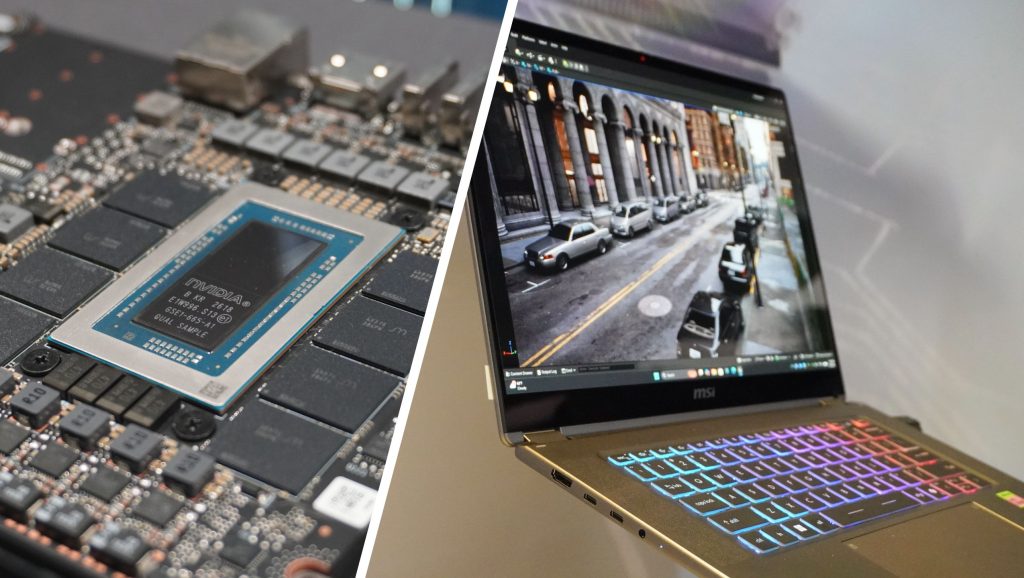
Windows laptops have long suffered from severe performance throttling the moment you pull the power cord, making heavy creative tasks and gaming on battery power a sluggish experience. Nvidia claims its RTX Spark platform eliminates this drop-off, delivering identical hardware speeds whether plugged into a wall outlet or running off internal power.
Nvidia RTX Spark laptops aim to maintain 100% processing performance both on and off the charger. Powered by Blackwell GPU architecture, DLSS 4.5 support, and energy-efficient Arm processors, these systems sustain intensive 3D rendering in applications like Blender and maintain high frame rates in modern AAA games without traditional battery-induced slowdowns.
Overcoming the Traditional Battery Throttling Bottleneck
For years, mobile Windows users accepted a sharp drop in framerates and rendering speeds whenever they disconnected from AC power. Nvidia’s RTX Spark architecture directly targets this limitation by redesigning power delivery to keep GPU and CPU cores running at peak clock speeds on battery power.
During real-world demonstrations at IFA, an unplugged Surface Laptop Ultra ran continuous 3D viewport calculations in Blender for over five and a half hours before displaying a low battery warning. For intensive digital animation software that continually recalculates complex lighting and geometry, achieving that duration while maintaining full processing speed matches or exceeds performance typical of competing workstation platforms.
Further tests on the MSI Prestige Flip N16 showed the laptop rendering massive sample maps within Unreal Engine 5 on battery power alone, displaying zero graphical stutter or framerate drops while navigating complex environments.
Uncompromised Gaming Performance On the Go
Gaming capabilities represent the primary test for Nvidia’s power management efficiency. Armed with Blackwell GPU silicon and advanced tensor cores, RTX Spark devices utilize DLSS 4.5 frame generation and super resolution to sustain target framerates at 1440p resolutions.
In side-by-side gameplay testing featuring Gears of War: E-Day on the Surface Laptop Ultra, the frame rate remained entirely consistent when switching instantly between wall power and battery. The usual framerate reduction that plagues standard mobile gaming rigs was absent, providing desktop-class fluidity on the move.
RTX Spark Performance vs Standard Windows Laptops
The following data highlights how RTX Spark hardware behaves under load compared to conventional mobile systems:
| Test Workload | Standard Windows Laptop (Battery) | Nvidia RTX Spark Laptop (Battery) |
|---|---|---|
| Frame Rate Stability | Throttles 40% to 60% lower | 100% sustained frame rate |
| 3D Rendering (Blender) | Heavy slowdown / core reduction | Full viewport speed up to 5.5 hours |
| Real-Time Engine (UE5) | Frequent stuttering & drop-offs | Smooth navigation across dense maps |
| Graphics Architecture | Legacy Discrete/Integrated graphics | Blackwell GPU with DLSS 4.5 |
Evaluating Power Efficiency and Architecture Trade-offs
While sustained performance off the charger is a major step forward, overall battery life depends on how efficiently the underlying Arm architecture handles x86 app translation. Continuous high-load execution draws significant power, meaning true all-day longevity will vary based on user workflows and software optimization.
Even with these architectural variables, the ability to execute demanding 3D rendering and high-end gaming without performance penalties introduces a compelling standard for mobile computing power.
Frequently Asked Questions
Do Nvidia RTX Spark laptops drop frame rates when unplugged?
No. Tests demonstrate that RTX Spark laptops maintain identical frame rates in modern games whether they are connected to a power outlet or running solely on internal battery power.
How long does an RTX Spark battery last during 3D rendering?
In heavy 3D rendering demonstrations using applications like Blender, RTX Spark hardware has sustained continuous viewport rendering for over 5.5 hours before reaching critical battery levels.
What technologies allow RTX Spark laptops to maintain battery performance?
The performance stability is driven by Nvidia’s Blackwell GPU architecture, DLSS 4.5 AI frame generation, and power-efficient Arm processor integration tailored for high efficiency under sustained electrical loads.