
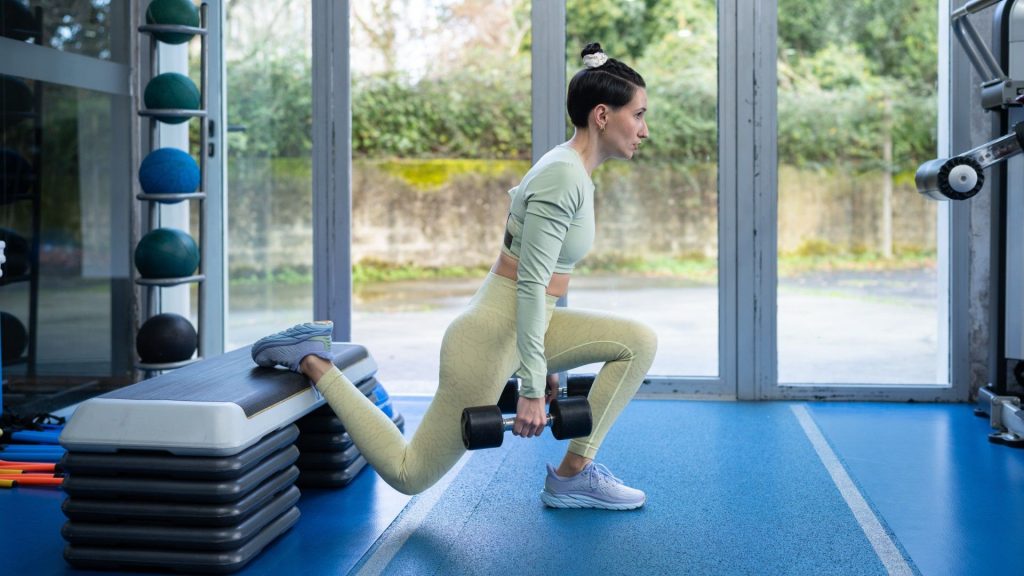
Building functional lower-body strength often comes at the cost of joint flexibility, especially if traditional heavy squats leave your knees or hips feeling strained. Finding a movement that builds muscle while actively expanding your range of motion can dramatically transform your training efficiency.
Incorporating a rotational Bulgarian split squat variation into your routine bridges the gap between muscular power and dynamic joint mobility. By adjusting your path of motion and adding a controlled torso turn, this lower-body movement targets the glutes, hips, adductors, and core obliques while remaining low-impact on sensitive knees.
| Exercise Attribute | Details & Focus Areas |
|---|---|
| Target Muscles | Glutes, Quadriceps, Adductors, Internal & External Obliques |
| Movement Type | Unilateral, Low-Impact Strength & Dynamic Mobility |
| Recommended Volume | 6 to 8 heavy repetitions per side |
| Primary Benefit | Improves hip opening, single-leg balance, and glute activation |
Why Add a Twist to the Bulgarian Split Squat?
Standard Bulgarian split squats are widely recognized for developing unilateral leg strength and balance. However, traditional vertical descent places most of the workload directly onto the quadriceps. Modifying your lowering mechanics by arcing the back knee toward the support bench shifts the load directly onto the gluteal muscles.
Introducing a torso rotation at the bottom of the movement engages the internal and external obliques. This slight lateral lean away from the front leg and foot placement forces the hips to open up dynamically, stretching the inner thighs and adductors under control.
Step-by-Step Instructions
Follow these steps to execute the exercise safely while maximizing muscle engagement and hip mobility:
- Set the Starting Position: Place the top of your back foot on a sturdy chair, box, or bench. Square your hips forward while balancing on your front leg with a subtle, soft bend in both knees.
- Brace Your Core: Hold a kettlebell or dumbbell in both hands near your chest, or place your hands securely on your hips to maintain control.
- Lower with an Arc: Bend your knees to lower toward the floor. Instead of dropping straight down vertically, arc your back knee gently backward toward the bench to load the glute rather than overloading the front quad.
- Hinge Slightly Forward: Maintain a long, neutral spine while hinging slightly forward at the hips to load the front leg and activate the glutes deeply.
- Drive and Rotate: Pause at the bottom, then drive through your front foot to return toward standing. Rotate your torso away from your front leg, pressing your elevated foot gently into the box while drawing your front knee outward to stretch the hip adductors.
- Repetition Scheme: Perform 6 to 8 slow, heavy repetitions on one side before switching to the opposite leg.
Protecting Your Knees and Joints
Joint pain should never be ignored during lower-body workouts. While this elevated split squat variation offers high rewards with low impact, proper modifications ensure your knees stay safe during loading.
If you experience joint discomfort, adjust the distance between your front foot and the support bench. Hinging slightly more forward at the hip relieves forward knee translation, keeping the tension concentrated in your posterior chain. Always consult a sports specialist or medical physician before introducing loaded unilateral work if you are recovering from a lower-limb injury.
Frequently Asked Questions
How does this exercise differ from standard Bulgarian split squats?
Unlike standard split squats that lower strictly vertically to isolate the quadriceps, this variation uses a backward knee arc and torso rotation. This change shifts focus to glute activation, oblique core strength, and dynamic hip opening.
How heavy should I load this split squat variation?
Start with bodyweight to master the balance and rotational components. Once your stability feels solid, progress to a moderate weight for 6 to 8 controlled repetitions per side.
Is this move safe for people with knee discomfort?
Yes, because it is a low-impact exercise that emphasizes posterior chain engagement. However, you should reduce your range of motion or stop immediately if you feel acute joint strain.