
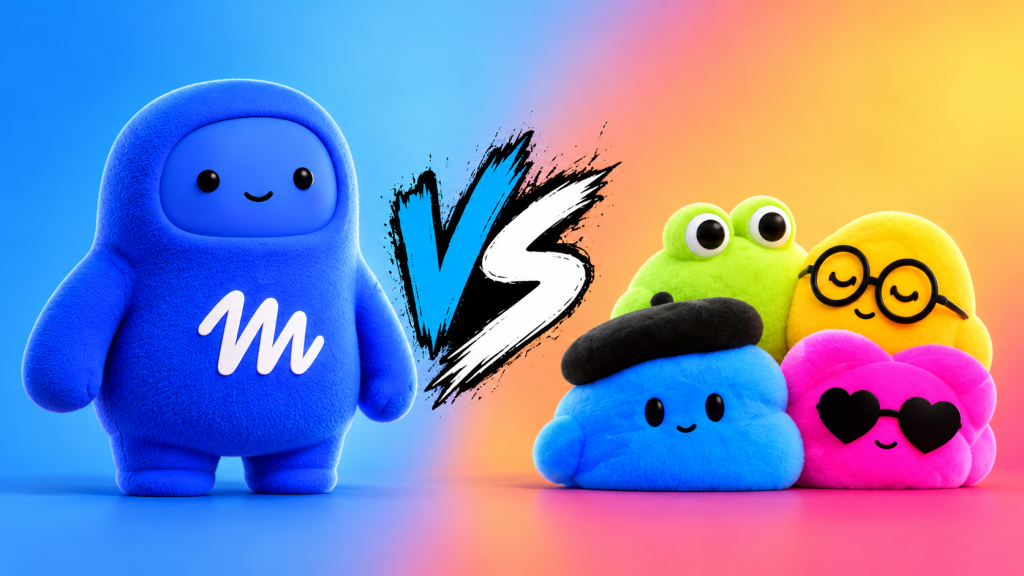
Meta and OpenAI recently introduced autonomous AI agents capable of operating independently in cloud environments, leaving many to wonder how they stack up against each other. While both tools run in persistent virtual machines to perform background tasks, their target audiences and underlying design philosophies diverge significantly.
Direct Overview: This direct comparison analyzes Meta Muse and ChatGPT Dots, examining their core capabilities, security controls, and pricing structures. Meta Muse offers an accessible, free-to-start experience tailored for everyday consumers and small businesses, whereas ChatGPT Dots targets enterprise teams and power users with paid tiers starting at $100 per month.
Meta Muse vs. ChatGPT Dots at a Glance
| Feature / Specification | Meta Muse | ChatGPT Dots |
|---|---|---|
| Primary Engine | Muse Spark | GPT-6 Astra |
| Cloud Execution Environment | Muse Secure VM (Dedicated browser & cloud container) | Dedicated persistent cloud computer & browser |
| Pricing Model | Free tier; optional $20/mo and $100/mo plans | Requires Pro ($100/mo minimum) or Business ($125/user/mo) |
| Target User Base | Everyday consumers, freelancers, and small businesses | Enterprise teams, developers, and corporate professionals |
| Ecosystem Integrations | Shopify, Stripe, Asana, Zoom, Meta Smart Glasses, macOS | Over 4,000 ChatGPT plugins, Slack, Microsoft Teams |
| Permission Controls | Sentinel system (strict separation of read and write access) | Custom rules, required approval checkpoints, auto-review |
Understanding Meta Muse: Features and Accessibility
Meta designed Muse as a goal-oriented personal agent rather than a simple chat interface. Users assign a specific task or multi-step workflow, and Muse creates an execution strategy. It operates continuously within a dedicated cloud instance known as the Muse Secure VM, allowing tasks to progress even after a user closes their browser or app.
Accessibility serves as a key priority for Meta. Muse starts with a free tier in supported regions like the United States and Canada, alongside paid options at $20 and $100 monthly. The platform integrates across iOS, Android, and web interfaces, extending to macOS desktop controls, dedicated email functionality, and support for Meta smart glasses alongside the Muse Charm companion hardware.
Security management within Muse relies on Meta’s Sentinel system, which separates read access from write capabilities. This ensures the agent cannot execute financial transactions or send communications without direct approval. Business users can connect the agent to platforms like QuickBooks, Notion, Asana, Stripe, and Shopify, as well as native Facebook and Instagram business pages.
Examining ChatGPT Dots: Workflows and Enterprise Power
OpenAI introduced Dots to bring continuous, background automation into its enterprise platform. Powered by the GPT-6 Astra model, each Dot functions inside an isolated cloud computer with full web browsing capabilities. These agents monitor background pipelines, manage routine administration, and perform long-term research over extended timelines.
Rather than positioning Dots as consumer assistants, OpenAI built them directly into established work tools. Users can interact with Dots via web, desktop, and mobile ChatGPT apps, as well as workplace communication tools like Slack and Microsoft Teams. Shared environments like ChatGPT Space allow human team members and AI agents to collaborate on joint projects.
Access to Dots remains highly restricted compared to Meta’s offering. Free and ChatGPT Plus subscribers are currently excluded from using Dots. Entry requires a Pro subscription starting at $100 per month, or a Business Premium account at $125 per user monthly. Larger enterprise, healthcare, and educational organizations must enable access through administrative betas.
Key Differences in Customer Target and Ecosystem Strategy
While both platforms utilize isolated virtual environments to execute background tasks asynchronously, their commercial approaches are fundamentally different. Meta aims to lower entry barriers by offering immediate utility to general consumers and budget-conscious business owners without initial costs.
In contrast, OpenAI treats autonomous agents as an upgraded asset for corporate clients already invested in high-tier AI infrastructure. ChatGPT Dots emphasizes multi-agent coordination, specialized workplace roles, and enterprise security frameworks like Microsoft Agent 365.
Choosing between the two depends largely on individual budget constraints and operational requirements. Users seeking automated personal assistance or affordable business workflows will find Meta Muse readily accessible. Organizations requiring deep enterprise software integration and specialized team coordination are the primary demographic for ChatGPT Dots.
Frequently Asked Questions
Is Meta Muse free to use?
Yes, Meta Muse includes a functional free tier alongside optional paid tiers priced at $20 and $100 per month.
Can ChatGPT Plus subscribers access ChatGPT Dots?
No, ChatGPT Dots are currently reserved for higher-tier subscribers, including ChatGPT Pro ($100/month), Business Premium ($125/user/month), and enterprise workspace accounts.
How do these AI agents handle safety and authorization?
Both platforms require explicit human approval before completing sensitive actions like submitting payments or modifying account settings. Meta Muse uses the Sentinel permission framework, while ChatGPT Dots utilizes automated reviews and strict operational boundaries.