
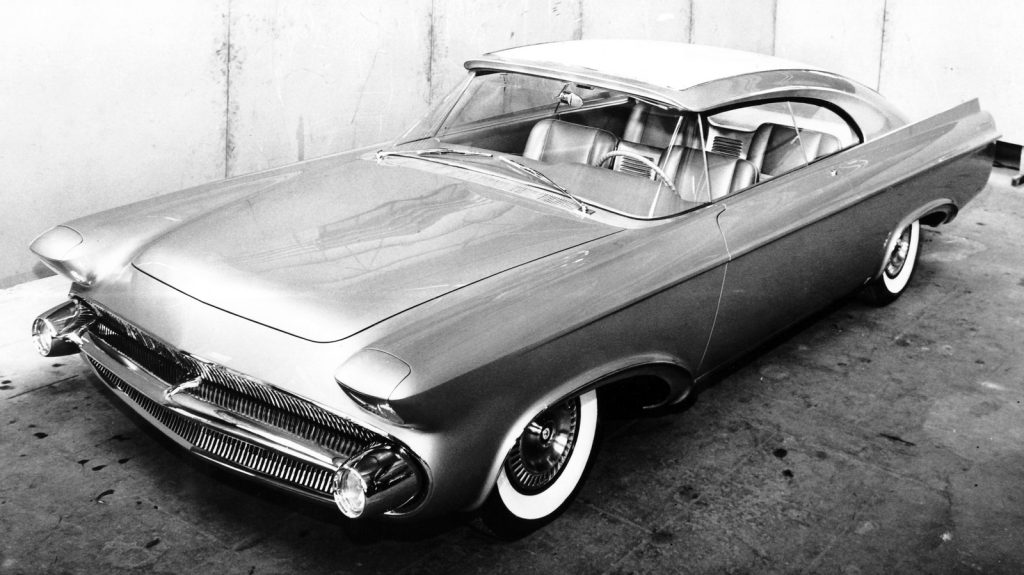
On July 25, 1956, one of the most remarkable automotive design experiments in American history vanished into the North Atlantic. The Chrysler Norseman—a fully functional prototype built in collaboration with Italian coachbuilder Carrozzeria Ghia—went down aboard the sinking ocean liner SS Andrea Doria before the public ever saw it on the auto show circuit.
This article details the history, engineering specifications, and tragic fate of the 1956 Chrysler Norseman concept car. It examines how a unique 335-horsepower prototype featuring a pillarless roof and aluminum paneling rested 260 feet underwater following the Andrea Doria maritime collision, offering automotive enthusiasts and historians a complete record of this lost prototype.
Chrysler Norseman Technical Specifications & History
| Category | Specification / Detail |
|---|---|
| Development Effort | 39 months of design and build time; 50,000 work hours |
| Coachbuilder | Carrozzeria Ghia (Turin, Italy) in partnership with Chrysler |
| Engine & Output | 331-cubic-inch V8 producing 335 horsepower |
| Drivetrain | 2-speed push-button automatic transmission, rear-wheel drive |
| Dimensions | 129-inch wheelbase; 227.5″ L x 80″ W x 57″ H |
| Key Structural Innovations | Pillarless cantilever roof (no A-pillars), aluminum body panels |
| Location of Wreck | Resting at 260 feet depth off the coast aboard the SS Andrea Doria |
Radical Engineering and Ghia Coachwork
The Chrysler Norseman was not merely a static styling clay; it was a fully functional road car requiring 39 months and 50,000 hours of labor to complete. Chrysler partnered with Carrozzeria Ghia in Turin, Italy, to craft a streamlined body that pushed mid-century aerodynamic boundaries. The design featured a fastback roofline, prominent tail fins, hidden headlights, concealed door and trunk openers, and a smooth underbody panel to minimize drag.
The car’s most daring feature was its cantilevered roof design, which completely eliminated the traditional front A-pillars. This cantilever setup gave drivers an unobstructed forward view through the windshield. Engine-wise, Chrysler claimed the structure could support eight times the vehicle’s total weight in a rollover accident. Additional innovations included major body panels constructed from lightweight aluminum and a power rear window that retracted upward directly into the roof structure.
Under the hood sat a powerful 331-cubic-inch V8 engine tuned to produce 335 horsepower. Power traveled to the rear wheels via a two-speed, push-button automatic transmission. Inside the cabin, four individual bucket seats wrapped in two-tone leather surrounded driver-focused instrument pods, signaling Chrysler’s visual direction for future production models.
The Maritime Collision of the SS Andrea Doria
Following its completion in Italy, the Norseman was crated and loaded into the cargo hold of the Italian luxury liner SS Andrea Doria, bound for New York to anchor Chrysler’s 1957 auto show exhibits. On the foggy night of July 25, 1956, the Andrea Doria crossed paths with the Swedish liner SS Stockholm off Nantucket.
Despite both vessels operating active radar systems, navigation errors led to a severe collision. The Stockholm’s ice-breaker bow struck the Andrea Doria at nearly a 90-degree angle, piercing its starboard hull and flooding critical watertight compartments. The ship listed heavily to starboard, rendering portside lifeboats unusable. The vessel remained afloat for 11 hours, allowing nearby ships to rescue the majority of passengers before the liner capsized and sank at 10:09 a.m. on July 26 in 260 feet of water. The crash claimed 51 lives in total—46 on the Andrea Doria and five on the Stockholm.
The Underwater Condition of the Prototype
For decades, classic car collectors wondered if the ocean floor preserved the Norseman inside its shipping crate. In the mid-1990s, deep-sea divers finally located the remains of the vehicle in the wreckage of the Andrea Doria’s cargo area.
Saltwater immersion, severe pressure, and decades of shifting debris had decimated the vehicle. The diver reported that decades of exposure reduced the once-groundbreaking aluminum and steel prototype to rust, heavy corrosion, and an indistinguishable pile of scrap metal, closing the chapter on one of Detroit’s most intriguing lost concepts.
Frequently Asked Questions
What made the Chrysler Norseman roof design unique?
The Norseman utilized a pillarless roof construction that eliminated traditional A-pillars, offering an unobstructed windshield view. Chrysler engineered the roof frame to support up to eight times the vehicle’s weight during a rollover crash.
Why did the Chrysler Norseman sink?
The concept car was being shipped from Italy to the United States aboard the SS Andrea Doria. On July 25, 1956, the ocean liner collided with the SS Stockholm and sank the following morning, taking the vehicle down with it.
Can the Chrysler Norseman car be restored or recovered?
No. When deep-sea divers explored the cargo hold in the mid-1990s, they confirmed that ocean currents, salt water, and structural collapse had reduced the prototype to an unrecognizable pile of rust and corroded metal.