
With standalone prices for graphics cards and memory modules sitting at historical highs, buying a prebuilt gaming desktop has shifted from a luxury convenience into a practical financial move for PC gamers. Assembling a computer from scratch no longer guarantees savings, making prebuilt towers the most economical entry point for high-frame-rate gameplay.
This guide evaluates the top prebuilt gaming desktops available in 2026 based on benchmark performance, acoustic levels, and hardware value. Spanning budget 1080p machines to enthusiast 4K liquid-cooled towers, these hand-tested recommendations help gamers select the ideal rig for modern gaming, content creation, and future component upgrades.
Top Recommended Gaming PCs at a Glance
| Model | Category | Key Hardware (CPU / GPU) | Standout Highlight |
|---|---|---|---|
| iBuyPower RDY Element 9 Pro R07 | Best Overall | AMD Ryzen 7 7800X3D / Radeon RX 9070 XT | Superb 1440p and 4K performance for the price |
| Dell Tower Plus (EBT2250) | Best Budget | Intel Core Ultra 5 255H / Nvidia RTX 5070 | Subtle desktop styling with affordable configuration entry points |
| Alienware Area-51 | Best Premium | Intel Core Ultra 9 285K / Nvidia RTX 5090 | Maximum 4K framerates with advanced positive-pressure cooling |
| Corsair One i500 | Best Compact | Intel Core i9-14900K / Nvidia RTX 4080 Super | Space-saving chassis with real wood front paneling |
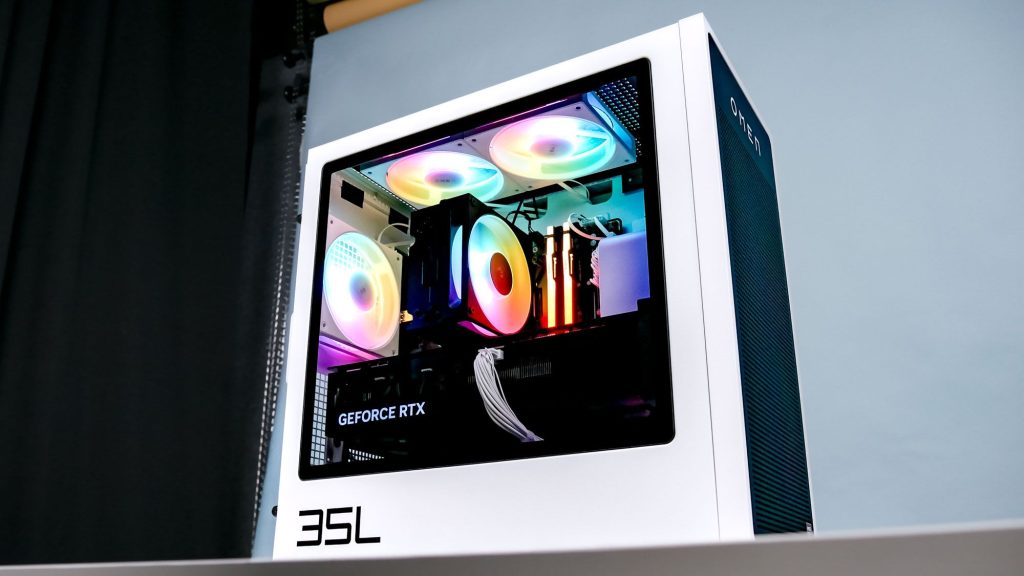
| HP Omen 35L | Best Upgradable | AMD Ryzen 7 9800X3D / Nvidia RTX 5070 Ti | Tool-less side panel for quick RAM, GPU, and storage swaps |
| Corsair Vengeance i8300 | Best Quiet Performance | Intel Core Ultra 9 285K / Nvidia RTX 5090 | Uncompromised power with near-silent fan acoustics under heavy load |
| Framework Desktop | Best Mini PC | AMD Ryzen AI Max 385 / Radeon 8050S (Integrated) | Modular front-port Expansion Cards and repairable architecture |
| Maingear MG-1 Ultimate | Best Customizable | AMD Ryzen 9 9950X3D / Nvidia RTX 5090 | Swappable front faceplates with extensive component options |
Detailed Reviews of the Best Gaming Desktops
1. iBuyPower RDY Element 9 Pro R07 – Best Overall Gaming PC
The iBuyPower RDY Element 9 Pro R07 strikes an optimal balance between high gaming performance and reasonable overall pricing. Outfitted with AMD’s Ryzen 7 7800X3D CPU and a Radeon RX 9070 XT graphics card, alongside 32GB of DDR5 memory and a 2TB PCIe Gen 4 SSD, this prebuilt desktop delivers exceptional framerates at 1440p and capable 4K output. In testing, demanding titles like Black Myth: Wukong at 4K Cinematic settings maintained nearly 60 FPS, outperforming competing RTX 5070 configurations.
Liquid cooling keeps thermal output in check during extended play sessions. While the bundled mouse and keyboard feel plain, the main chassis includes eye-catching RGB lighting and comes backed by a 3-year warranty. Self-installing the GPU is required upon delivery to prevent shipping damage, but the clear instructions make setup straightforward for buyers of all technical skill levels.
2. Dell Tower Plus (EBT2250) – Best Budget Gaming PC
The Dell Tower Plus delivers strong gaming capability in a sleeper chassis that fits easily into standard workplace environments. Configurable across a price scale starting under $1,000, testing on an Intel Core Ultra 5 255H configuration paired with an Nvidia GeForce RTX 5070 demonstrated steady 1080p and 1440p rendering in modern titles like Cyberpunk 2077 (achieving 68 FPS at 1080p native settings).
While the understated case lacks flashy aesthetics and can be somewhat tight to access internally, its practical port selection and quiet operation make it a versatile dual-use workstation and gaming rig. It offers exceptional hardware value when component prices across the market are elevated.
3. Alienware Area-51 – Best Premium Gaming PC
Designed for enthusiasts who demand raw graphical capability without compromise, the Alienware Area-51 features a bold futuristic chassis housing top-tier components. Powered by an Intel Core Ultra 9 285K processor, 64GB of RAM, and Nvidia’s benchmark-topping GeForce RTX 5090 GPU, this system easily averages well over 60 FPS in heavy 4K workloads (reaching 84 FPS in Red Dead Redemption 2 at Ultra 4K settings).
An engineered positive-pressure cooling system keeps thermals exceptionally stable and noise output low during heavy gaming sessions. However, its higher price point and substantial physical weight mean buyers will need a dedicated setup area, ideally directly on a sturdy floor or heavy-duty desk.
4. Corsair One i500 – Best Compact Gaming PC
The Corsair One i500 delivers top-flight desktop power inside a space-conscious footprint accented with real wood paneling and fabric sides. Equipped with an Intel Core i9-14900K processor, Nvidia GeForce RTX 4080 Super GPU, 32GB of RAM, and dual 2TB SSDs, it runs modern titles at maximum graphic presets without overheating or generating distracting fan noise.
In gaming tests, it produced a crisp 97 FPS in Cyberpunk 2077 at 1080p resolution while remaining cool to the touch. The main drawback to its small footprint is limited internal upgrade space, meaning major future GPU upgrades may require manufacturer servicing. Nevertheless, it remains an ideal option for minimalist desk setups.
5. HP Omen 35L – Best Upgradable Gaming PC
For gamers looking to expand their rig’s performance over time, the HP Omen 35L stands out due to its standardized parts and tool-less access layout. A quick-release glass side panel gives direct access to the RAM slots, storage drives, and PCIe expansion slots without requiring specialized tools or dealing with proprietary motherboard connectors.
The reviewed system paired an AMD Ryzen 7 9800X3D with an Nvidia RTX 5070 Ti GPU and 32GB of DDR5 memory, rendering over 120 FPS in 4K when utilizing DLSS frame generation. Effective thermal management keeps internal temperatures low, providing plenty of headroom for future hardware upgrades.
6. Corsair Vengeance i8300 – Best Quiet High-End Desktop
The Corsair Vengeance i8300 combines massive hardware specifications with an acoustically tuned cooling design. Housing an Intel Core Ultra 9 285K CPU, 64GB of DDR5 RAM, an RTX 5090 GPU, and 6TB of total SSD storage, it generates raw multi-core benchmark scores of 23,328 in Geekbench 6 and easily maintains 149 FPS in Cyberpunk 2077 at 1080p settings.
Even under prolonged, max-setting gaming loads, the cooling fans produce only a faint low hum rather than high-pitched noise. While its size and price tag are substantial, it delivers an refined, high-resolution gaming experience.
7. Framework Desktop – Best Mini Gaming PC
Taking modularity to the small form factor realm, the Framework Desktop provides a customizable mini-PC architecture. Powered by AMD’s Ryzen AI Max 385 processor with integrated Radeon 8050S graphics and 32GB of LPDDR5x memory, it offers an adaptable foundation for work, light gaming, and local AI processing.
Users can customize their front port layout via hot-swappable Expansion Cards and reconfigure storage across dual M.2 SSD slots. While memory is soldered to the main system board due to chip design constraints, its repairability standards set a strong precedent for mini PCs.
8. Maingear MG-1 Ultimate – Best Customizable Gaming PC
The Maingear MG-1 Ultimate stands out for its personalized aesthetic choices and clean internal wiring. Featuring magnetically swappable front faceplates reminiscent of classic console styling, this mid-tower desktop can be customized with various Intel or AMD processors and up to an Nvidia RTX 5090 graphics card.
In synthetic testing, a Ryzen 9 9950X3D and RTX 5090 configuration scored a dominant 63,629 in 3DMark Fire Strike and achieved a rapid 1:45 conversion time in 4K Handbrake video rendering tests, making it equally adept at heavy video editing and ultra-high-frame-rate gaming.
Performance and Benchmark Data
Rigorous synthetic and gaming benchmarks provide a clear look at how these systems handle different computing tasks:
- Processor Power (Geekbench 6 Multi-Core): Systems equipped with top-end processors led productivity tests, with the Corsair Vengeance i8300 (23,328) and Maingear MG-1 (23,071) pacing the field, closely followed by the Alienware Area-51 (21,786).
- Storage Transfer Speeds (25GB File Copy): SSD throughput varied from 1,633 MBps on budget-focused configurations up to a peak 2,976 MBps on the Framework Desktop.
- Video Transcoding (Handbrake 4K to 1080p): High-end CPU options from Intel and AMD completed the conversion in under two minutes, led by the Maingear MG-1 at 1 minute 45 seconds.
Frequently Asked Questions
Is it cheaper to buy a prebuilt gaming PC than to build one?
Given current market conditions, buying a prebuilt gaming PC is frequently more cost-effective than assembling individual parts. Standalone retail costs for high-speed DDR5 RAM, PCIe Gen 4/5 SSDs, and current-generation GPUs remain elevated. System integrators buy hardware in bulk, allowing them to pass along lower combined costs than buying retail components individually.
How important is RGB lighting on a gaming PC?
RGB lighting is strictly cosmetic and has zero impact on actual gaming performance or frame rates. Selecting a minimalistic chassis without custom lighting can reduce overall system cost, allowing buyers to allocate more of their budget toward a faster GPU, a stronger processor, or additional memory.
Can a Mac desktop handle modern AAA PC gaming?
While Apple Silicon computers like the Mac Studio with M4 Max or M5 chips offer high graphical power and handle ported games impressively well, macOS lacks native access to the vast PC gaming library. For broad game compatibility, higher ray-tracing performance, and direct support for variable frame rate technologies, a dedicated Windows desktop with Nvidia or AMD graphics remains the standard choice.
How to Choose the Right Gaming PC
Establish Your Target Resolution: Entry-level rigs with an Intel Core i5 or Ryzen 5 processor paired with 16GB of RAM and an RTX 5060/5070 deliver excellent performance for 1080p gaming. Achieving smooth native 4K performance across modern titles requires a stronger GPU tier (RTX 5080/5090 or RX 9070 XT class) combined with 32GB or 64GB of memory.
Evaluate Long-Term Upgrade Paths: If you plan to swap out components as hardware advances, select mid-tower or full-tower designs that utilize non-proprietary motherboards, standard ATX power supplies, and tool-less case entry, such as the HP Omen 35L. Compact or mini PCs trade internal expansion capacity for a smaller desktop footprint.