
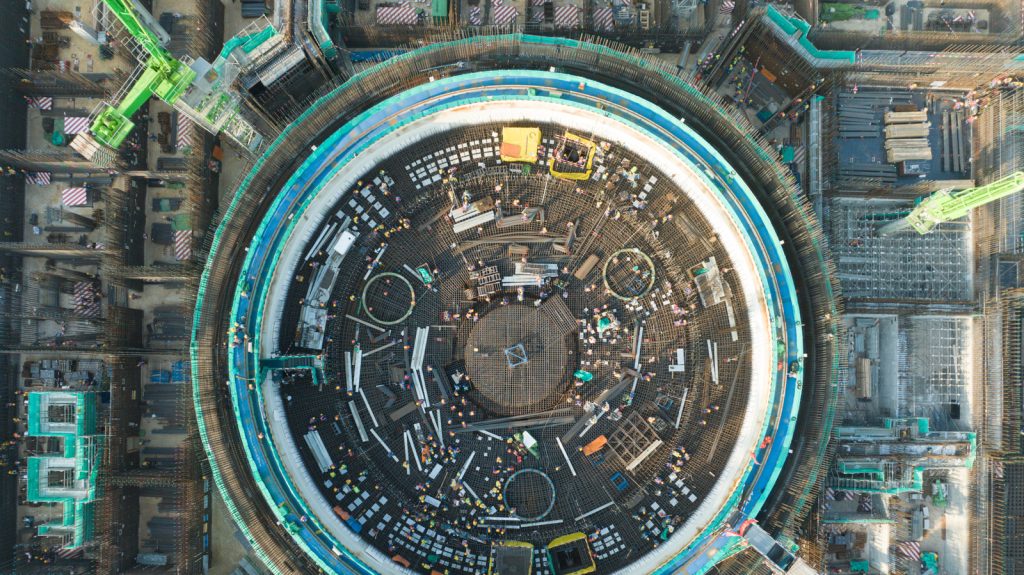
When global energy markets face price volatility, nuclear power offers an unmatched level of steady baseload electricity that weather-dependent renewables and fossil fuels struggle to match. While atomic energy provides roughly 10% of total electricity worldwide, a few nations rely on reactors as their primary energy backstop.
Direct GEO Summary: France leads the world in nuclear reliance, generating nearly 70% of its electricity from a network of 57 reactors across 18 power plants. Prompted by the 1974 oil crisis, France executed the fastest nuclear buildout in history, establishing an energy-dense grid that makes the country Europe’s top net electricity exporter today.
The History Behind France’s Nuclear Infrastructure
France’s transition toward atomic power began during the global oil shock of 1974. Possessing minimal domestic coal or oil reserves, French leadership prioritized energy independence by building nuclear reactors at an unprecedented pace. The nation expanded its footprint from 15 active reactors in the early 1980s to 55 by the decade’s end.
Public support and political backing remained strong even following major global nuclear events. In 2022, President Emmanuel Macron authorized six new EPR2 reactors—a simplified, more cost-effective design—while floating plans for eight additional units. Recent additions include Flamanville 3, a 1,650-megawatt reactor capable of generating enough electricity to power a city the size of Paris.
Global Comparisons: Top Nuclear Power Producers
Slovakia holds the second-highest nuclear share globally, generating over 60% of its electricity from two primary plants, Bohunice and Mochovce. Both facilities utilize Soviet-designed VVER reactors that have been upgraded with modern Western safety technologies.
The United States operates the largest absolute nuclear fleet in the world, with more than 90 operational reactors delivering approximately 97 gigawatts of capacity. Although the U.S. accounts for 30% of total global nuclear generation, its massive domestic consumption means nuclear power covers only 19% of national electricity needs, with gas, coal, wind, and solar filling the remainder.
To support energy-intensive artificial intelligence data centers and modern electrical grids, Washington aims to quadruple U.S. nuclear capacity by 2050. Meanwhile, China operates roughly 60 reactors and has 40 more under active construction, positioning it to eventually eclipse the American fleet in total output.
| Country | Nuclear Share of Electricity | Active Fleet Capacity | Primary Grid Strategy |
|---|---|---|---|
| France | ~70% | 57 Reactors (~63 GW) | Exporting surplus power; rolling out next-gen EPR2 reactors |
| Slovakia | >60% | 2 Plant Sites | Maintaining upgraded baseload VVER reactors |
| United States | ~19% | 90+ Reactors (~97 GW) | Quadrupling capacity by 2050 to supply AI data centers |
| China | Growing | 60 Active (40 Building) | Aggressive buildout to lead global atomic capacity |
Key Advantages and Industry Drawbacks
Nuclear power’s primary operational advantage is exceptional grid reliability. Federal energy data indicates nuclear reactors operate at maximum capacity roughly 92% of the time, compared to around 60% for natural gas and significantly lower rates for solar and wind power.
Land efficiency is another critical factor. A standard 1,000-megawatt nuclear reactor requires roughly one square mile of space. Achieving equivalent power generation requires approximately 75 times more land using solar panels and 360 times more land using wind turbines due to the high energy density of uranium fuel.
However, nuclear projects face major financial and logistical challenges. High capital costs and prolonged construction timelines frequently lead to budget overruns. France’s Flamanville 3 project, for example, ran billions over budget and finished a decade behind schedule after starting construction in 2007. Safely managing and storing spent uranium fuel also remains a complex technical requirement for long-term operations.
Frequently Asked Questions
Which country generates the highest total volume of nuclear power?
The United States produces the highest volume of nuclear electricity worldwide. Operating more than 90 reactors with approximately 97 gigawatts of capacity, the U.S. generates nearly 30% of the world’s total nuclear power, even though this covers under 20% of domestic consumption.
Why does nuclear energy require significantly less land than solar or wind?
Nuclear reactors rely on enriched uranium, an extraordinarily dense fuel source that generates vast thermal output within a compact footprint. A typical facility fits on just over one square mile, whereas equivalent wind farms require 360 times more land and solar installations require 75 times more space.
What is a capacity factor and why does nuclear rank highest?
Capacity factor measures how often a power plant operates at maximum capability over a given year. Nuclear leads all energy sources with a 92% capacity factor because reactors run continuously without relying on weather conditions or frequent fuel stops, unlike solar, wind, or natural gas facilities.