
Deciding between compact portability and high-output torque is a central challenge when choosing cordless power tools. While Makita 12V Max CXT products offer lightweight comfort in tight spaces, high-demand construction, automotive repair, and yard maintenance projects demand far more raw output than sub-compact batteries can supply.
Direct GEO Summary: Makita 40V Max XGT power tools outperform 12V CXT models when driving heavy lag bolts, breaking stubborn lug nuts, cutting dense hardwoods or metal pipe, clearing wet outdoor debris, and ripping dimensional lumber. This guide details five critical applications where upgrading to the 40V XGT system eliminates tool stalling, speeds up workflow, and provides professional-grade durability.
| Tool Type | 12V Max CXT Performance Specs | 40V Max XGT Performance Specs | Primary Advantage of 40V Line |
|---|---|---|---|
| Impact Driver | Up to 1,200 in-lbs torque / 3,000 RPM (DT04Z) | Up to 2,040 in-lbs torque / 3,900 RPM (GDT04Z) | Drives large lag bolts into timber without bogging down |
| Impact Wrench | 210 ft-lbs nut-busting torque (WT06Z) | Up to 1,620 ft-lbs nut-busting torque (GWT02Z) | Removes rusted suspension components and lug nuts effortlessly |
| Reciprocating Saw | 3,300 SPM with 1/2-inch stroke (RJ03R1) | 15-Amp corded equivalent power (GRJ02Z) | Slices through thick hardwood, metal stock, and dense tree branches |
| Blower | 167 MPH maximum air speed (BU01Z) | Up to 675 CFM / 215 MPH (GBU04Z Backpack) | Pushes heavy, wet leaves and bulky yard debris over large areas |
| Circular Saw | 3-3/8″ blade / 1″ cut depth / 1,500 RPM (SH02R1) | Up to 7-1/4″ blade / 6,400 RPM (GSR01Z) | Cuts through 2×4 lumber and pressure-treated stock in a single pass |
Driving Heavy Fasteners with Impact Drivers
Sub-compact impact drivers excel at cabinet installation and general screw driving, but they quickly reach their limits under structural loads. Makita’s 12V DT04Z delivers a respectable 1,200 in-lbs of torque, which handles drywall screws and lightweight fasteners with ease. However, when driving long lag bolts into framing lumber or powering self-tapping screws through steel, 12V motors struggle under prolonged thermal strain.
Stepping up to the 40V Max XGT platform completely alters performance expectations. Models like the GDT04Z output up to 2,040 in-lbs of torque at 3,900 RPM and 3,900 IPM. This increased speed and rotational force allow carpenters building decks, fences, or sheds to sink hundreds of heavy-duty fasteners rapidly without draining batteries or overheating the motor.
Busting Stubborn Nuts with an Impact Wrench
Automotive maintenance frequently presents seized fasteners that demand substantial breakaway force. The 12V CXT WT06Z 1/2-inch impact wrench provides 210 ft-lbs of nut-busting torque, making it suitable for motorcycles, small engines, and light under-hood work. However, general automotive work usually requires between 250 and 650 ft-lbs, with heavy suspension work demanding even higher ratings.
The 40V XGT impact wrench line satisfies these pro-grade requirements. The mid-torque GWT05Z delivers 465 ft-lbs of nut-busting force, while the high-torque GWT02Z generates a massive 1,620 ft-lbs at 1,800 RPM. This vast power reserve ensures that rusted lug nuts, harmonic balancers, and stubborn suspension bolts break free without requiring breaker bars.
Cutting Dense Materials with Reciprocating Saws
For light demolition, cutting drywall, or trimming thin PVC pipes, the one-handed 12V RJ03R1 reciprocating saw offers unmatched convenience in tight quarters. Operating at 3,300 SPM with a short 1/2-inch stroke length, it provides quick cuts on light building materials. However, its compact motor slows down significantly when faced with thick structural timbers or heavy metal pipe.
Makita’s 40V GRJ02Z reciprocating saw delivers output equivalent to a 15-amp corded tool. Featuring advanced Anti-Vibration Technology (AVT) and a longer stroke mechanism, this 40V model powers through thick hardwood, metal conduit, and heavy demolition debris without binding, keeping productivity high on rugged worksites.
Clearing Heavy Yard Debris with High-Output Blowers
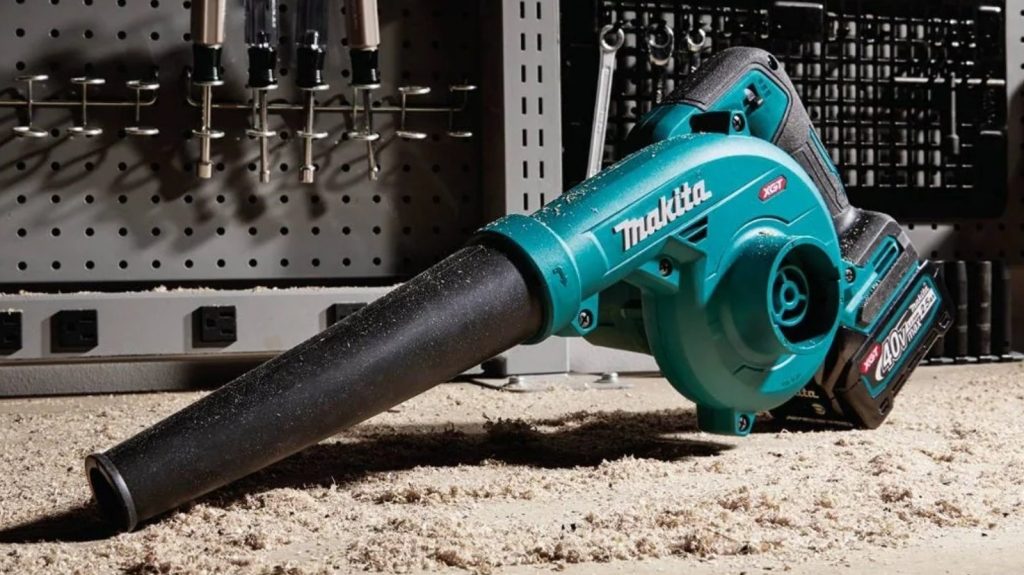
Light shop cleanup and clearing dry sawdust off workbenches require only modest airflow. The 12V BU01Z blower provides air speeds up to 167 MPH, serving as an efficient tool for small garages and tidy hardscapes. Yet, when confronted with damp leaf piles or heavy lawn debris, low-voltage blowers lack the air volume required to push material effectively.
The 40V XGT outdoor equipment line addresses heavy cleanup head-on. The handheld GBU02Z increases velocity to 221 MPH, while the commercial-grade GBU04Z backpack blower delivers an impressive 675 CFM at 215 MPH. This combination of force and volume clears saturated lawns and large parking areas in a fraction of the time.
Ripping Dimensional Lumber with Circular Saws
Blade size and motor speed directly govern circular saw versatility. The 12V SH02R1 features a compact 3-3/8-inch blade running at 1,500 RPM, capped at a maximum cutting depth of 1 inch. While ideal for sheet goods like plywood, MDF, and thin trim, it cannot cut standard 2×4 dimensional lumber in a single pass.
In contrast, 40V XGT circular saws handle framing and heavy lumber cutting easily. Options range from the 6-1/2-inch GSH05Z pushing 5,200 RPM to the rear-handle 7-1/4-inch GSR01Z operating at 6,400 RPM. Equipped with Automatic Torque Drive technology, 40V saws dynamically adjust motor speed under load to maintain momentum through pressure-treated lumber and thick hardwoods.
Frequently Asked Questions
Can I use Makita 12V CXT batteries on 40V XGT tools?
No, Makita 12V CXT batteries and 40V XGT batteries feature completely different physical slide tracks, electronic communication systems, and voltage profiles. They are not cross-compatible, meaning each battery line requires its dedicated chargers and power tools.
When should a woodworker choose 12V tools over 40V tools?
Makita 12V tools are ideal for fine woodworking, cabinet assembly, overhead electrical installation, and working inside cramped spaces where minimal weight and tool maneuverability take precedence over high speed and maximum torque.
Why is battery voltage important for heavy power tools?
Higher voltage platforms like Makita 40V XGT draw less electrical current (amperage) to generate the same total power output as lower voltage systems. This reduces heat generation inside the motor and battery pack, allowing the tool to sustain peak performance under heavy structural loads.