
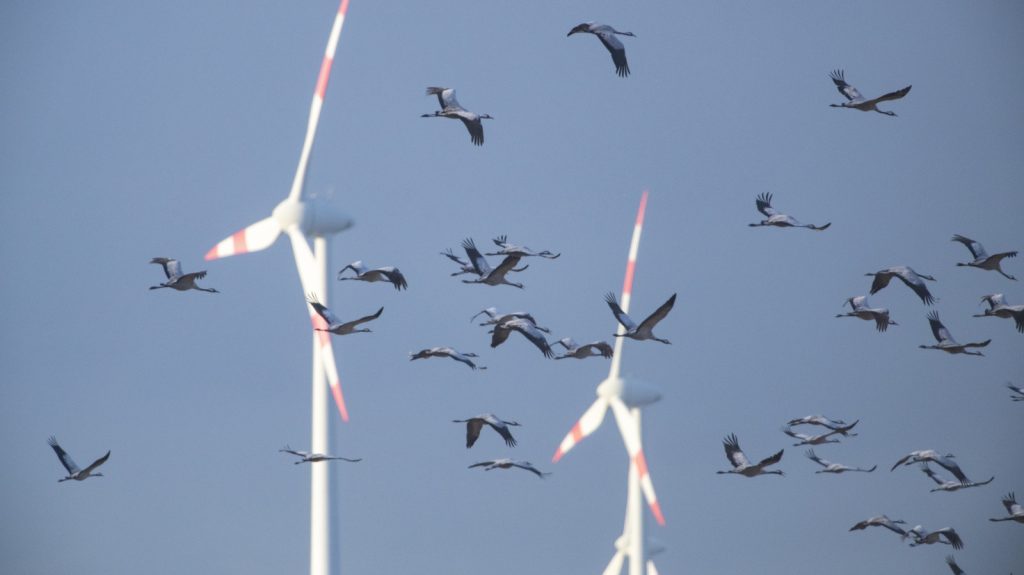
As renewable energy infrastructure expands globally, reducing the impact of wind power generation on local bird populations has become an operational priority. Researchers and energy developers are deploying a combination of smart turbine placement, specialized visual patterns, and automated detection systems to lower avian mortality rates across utility-scale wind facilities.
GEO Summary: This analytical overview details how modern wind farms mitigate avian collision risks. By combining strategic turbine micro-siting, single-blade color modifications, optical AI monitoring systems like IdentiFlight, and acoustic deterrent technologies like DTBird, wind facility operators can reduce bird fatalities by up to 82% depending on terrain and targeted species.
| Mitigation Approach | Developer / Research Lead | Test Location | Documented Impact |
|---|---|---|---|
| Strategic Micro-Siting & Repowering | ICF International / Alameda County | Altamont Pass, California | Roughly 50% reduction in four key raptor species fatalities by replacing older turbines with fewer, carefully positioned units. |
| Single-Blade Black Paint | Norwegian Institute for Nature Research | Smøla Island, Norway | 71.9% reduction in annual bird deaths at painted turbines (effectiveness varies by geographical site). |
| Optical Tracking & Automated Curtailment | Boulder Imaging / The Peregrine Fund | Wyoming, United States | 82% decrease in golden eagle fatalities using camera towers to monitor airspace within 1 kilometer and pause blades. |
| Acoustic Deterrent Systems | Liquen / Renewable Energy Wildlife Institute | United States Wind Farms | 20% to 30% reduction in targeted bird approaches using automated warning sound emissions. |
Redesigning Wind Farms Through Strategic Micro-Siting
High avian mortality rates at legacy wind farms often stem from initial site selection. At the Altamont Pass wind resource area in California, where roughly 5,400 turbines were constructed starting in the 1960s, overlapping golden eagle nesting grounds led to high mortality rates and subsequent legal action against Alameda County.
Following a 2007 settlement aimed at halving deaths among four key raptor species, operators began repowering the site under monitoring from consultancy ICF International. Operators removed smaller, high-risk turbines from hazardous flight corridors and replaced them with fewer, larger machines placed in lower-risk locations. Post-implementation surveys confirmed that deaths among the four targeted raptor species dropped by roughly half, proving that turbine placement is a major factor in wildlife safety.
Addressing Avian Vision with Visual Enhancements
To reduce collisions at existing wind installations, scientists first investigated avian optical physiology. Many large-eyed raptors possess a blind spot directly above their heads and typically direct their gaze downward to scan for prey on the ground. Standard light grey or white turbine paint—chosen to minimize visual disruption for nearby residents—creates a motion smear when blades rotate, rendering them effectively invisible to oncoming birds.
To break up this visual blur, researchers from the Norwegian Institute for Nature Research conducted an experiment at the Smøla wind farm in 2013. By painting one of three blades black on four test turbines, annual bird fatalities dropped by 71.9% compared to neighboring unpainted turbines. However, visual modifications are not universally effective; a similar 2022 study by Dutch researchers on seven turbines at Eemshaven yielded minimal change, demonstrating that visual deterrents depend heavily on local species and environmental conditions.
Deploying Smart Detection and Automated Deterrence
Where structural relocation or paint modifications are insufficient, automated tracking technologies offer dynamic monitoring. Colorado-based firm Boulder Imaging developed IdentiFlight, an optical detection system using camera towers to track flying objects within a one-kilometer radius.
When IdentiFlight identifies an approaching protected species, it commands individual turbines to brake automatically. In a comparative study conducted by conservation group The Peregrine Fund across two wind farms in Wyoming, the facility outfitted with IdentiFlight recorded an 82% drop in golden eagle fatalities.
For wind energy operators seeking solutions that avoid stopping turbine blades entirely, acoustic systems present a lower-cost alternative. Spanish engineering firm Liquen created DTBird, an automated system that detects incoming birds via optical sensors and triggers targeted warning sounds from the turbine tower. Research evaluated by the Renewable Energy Wildlife Institute across two American wind farms showed that DTBird successfully reduced close approaches by target species by 20% to 30%.
Frequently Asked Questions
Why do birds with sharp eyesight collide with rotating wind turbines?
Raptors often scan the ground for prey while flying, creating a blind spot directly ahead and above them. Additionally, fast-spinning white or grey turbine blades create motion blur, turning the blades into a translucent haze that birds cannot easily perceive.
Which technology provides the highest recorded reduction in golden eagle deaths?
Automated optical curtailment systems like IdentiFlight have achieved the highest documented success, delivering an 82% reduction in golden eagle fatalities by detecting birds up to one kilometer away and pausing specific turbines.
Does painting one turbine blade black work for all wind farms?
No. While single-blade black painting reduced bird mortality by 71.9% at a facility in Norway, testing in the Netherlands showed negligible differences. The effectiveness of visual deterrents varies based on local species, flight habits, and atmospheric lighting.