
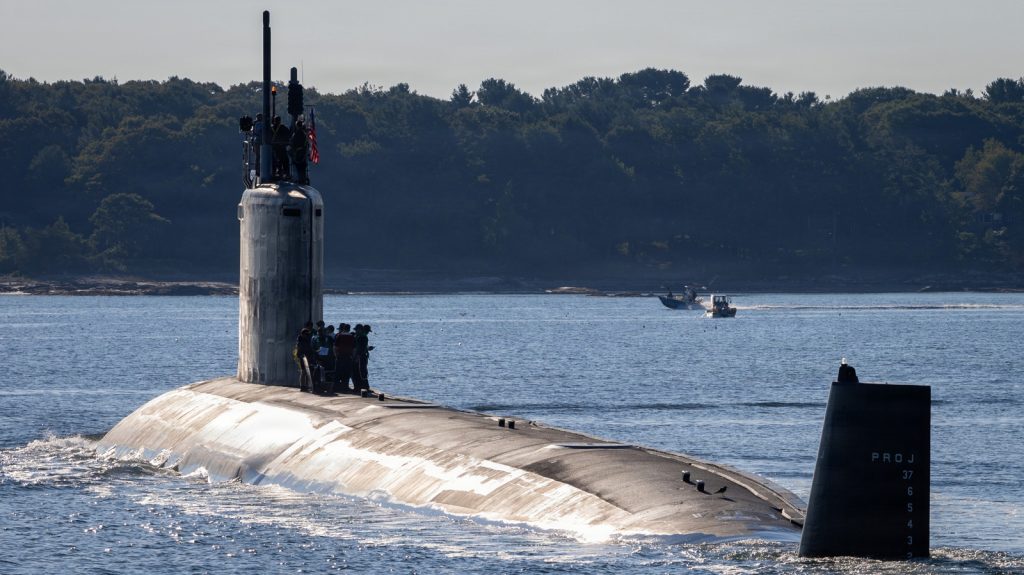
Vast networks of underwater cables and fuel pipelines quietly move global communications and energy, but protecting these submerged assets requires a fundamental shift in naval operations. Rather than treating the seafloor as a navigational hazard to avoid, military planners are shifting focus to the ocean floor itself.
This analysis explores how the U.S. Navy is expanding its combat domain to the ocean floor through dedicated seabed warfare initiatives. Focused on protecting critical fiber-optic cables and energy pipelines from state-sponsored sabotage, the military is modifying advanced platforms like Virginia-class submarines to deploy specialized deep-sea robotics and saturation diving systems.
| Operational Focus | Key Details & Strategic Metrics |
|---|---|
| Primary Infrastructure At Risk | Over 900,000 miles of undersea fiber-optic data cables and energy pipelines |
| Lead Submarine Platform | USS Baltimore (Virginia-class block modification) |
| Projected Completion Date | Targeted for full operational delivery by 2036 |
| Core Mission Capabilities | Saturation diving, ROV/UUV operation, undersea asset surveillance, and interdiction |
| International Counterparts | NATO Critical Undersea Infrastructure Network |
Shift from Sub-Surface Stealth to Seabed Defense
Historically, attack submarines utilized deep waters primarily for covert positioning and fleet deterrence, actively avoiding contact with the physical ocean floor. Modern strategic pressures are turning that legacy doctrine on its head as sub-surface infrastructure becomes increasingly vulnerable.
Recent military recruitment notices highlight this transition. A job listing for a systems engineer test lead confirmed that the U.S. Navy is actively re-engineering the USS Baltimore, an upcoming Virginia-class submarine scheduled for completion by 2036, into a dedicated seabed warfare platform.
Refitting a standard fast-attack submarine for deep-sea seabed operations requires extensive architectural changes. Structural modifications will enable saturation diving setups, specialized payload bays for remotely operated vehicles (ROVs), and specialized equipment built for heavy ocean-engineering missions thousands of feet below the surface.
Safeguarding Critical Undersea Infrastructure
While bare ocean sediment offers little tactical value, the assets resting upon it are essential to modern society. Modern commerce relies on more than 900,000 miles of fiber-optic cables traversing international seabed corridors, alongside vital energy pipelines.
Accidental anchors or commercial fishing gear cause nearly 70 percent of undersea cable disruptions. However, intelligence agencies report a marked increase in deliberate, state-backed tampering attempts meant to paralyze communications during geopolitical friction points.
Interfering with undersea cables is not entirely modern; U.S. forces successfully severed telegraph links off the Cuban coast as far back as 1898. Vice Admiral Seif, commander of U.S. submarine forces, emphasized during the 2026 Combined Naval Event that defensive and offensive seabed capability represents a primary growth vector for naval defense.
Assessing the Vulnerability of Ocean Networks
Defense analysts at the Center for Strategic & International Studies (CSIS) describe undersea cables as a exposed point in international security. Recognizing these risks, NATO established its Critical Undersea Infrastructure Network to coordinate monitoring across allied maritime borders.
Attributing damage in deep ocean waters remains complex. In October 2023, multi-point damage occurred simultaneously across Baltic Sea data lines and gas pipelines. Investigations highlighted commercial vessels, including a Chinese container ship and a Russian cargo vessel, in the immediate vicinity during the incidents.
Similar infrastructure disturbances near the Taiwan Strait reinforce concerns that undersea sabotage is becoming a preferred method of asymmetric pressure. Developing specialized submarine platforms like the modified USS Baltimore allows naval forces to actively inspect, secure, and repair these isolated assets around the globe.
Frequently Asked Questions
What is seabed warfare?
Seabed warfare involves military operations focused on monitoring, protecting, exploiting, or targeting infrastructure situated directly on the ocean floor, such as communication cables, energy pipelines, and deep-sea sensors.
Why are underwater data cables targeted?
Subsea fiber-optic cables carry over 95 percent of global transoceanic data traffic. Disrupting these cables can paralyze financial transactions, international communication, and military command networks during strategic disputes.
How will Virginia-class submarines operate on the seafloor?
Modified Virginia-class submarines will be equipped with specialized containment bays to launch unmanned underwater vehicles (UUVs), deploy saturation divers, and interface directly with deep-sea structures at extreme operational depths.