
When most people imagine American sea power, images of massive supercarriers, stealth guided-missile destroyers, and nuclear attack submarines instantly come to mind. Yet across more than two centuries of maritime operation, the United States Navy has designed, commissioned, and deployed dozens of unusual vessels engineered for highly specific missions. From freshwater flattops to micro-sized tugboats, these peculiar hulls demonstrate how specialized strategic needs often require out-of-the-box engineering.
This article details twelve of the most unconventional ships in U.S. Navy history, outlining their unique designs, tactical missions, and lasting technical contributions. Whether retrofitted from civilian steamers or purpose-built by defense agencies for classified deep-sea operations, these peculiar vessels showcase the diverse evolution of American naval architecture.
Overview of Unconventional U.S. Navy Vessels
| Vessel Name | Classification / Type | Primary Distinction / Quirky Trait | Operational Era |
|---|---|---|---|
| USS Monitor | Ironclad Warship | Ultra-low deck profile featuring the first rotating gun turret | 1862 |
| USS Reina Mercedes (IX-25) | Station Ship / Barracks | Captured Spanish cruiser used as a Naval Academy brig | 1898–1957 |
| USS Wolverine (IX-64) | Freshwater Training Carrier | Sidewheel paddle steamer converted for Great Lakes pilot training | 1942–1945 |
| USS Echo (IX-95) | Supply Scow | 50-year-old wooden sailing scow used for covert Pacific logistics | 1942–1944 |
| USS Pueblo (AGER-2) | Technical Research Ship | Only active commissioned U.S. warship held captive abroad | 1967–Present |
| R/P FLIP | Oceanographic Platform | 355-foot research vessel that rotates 90 degrees vertically | 1962–2023 |
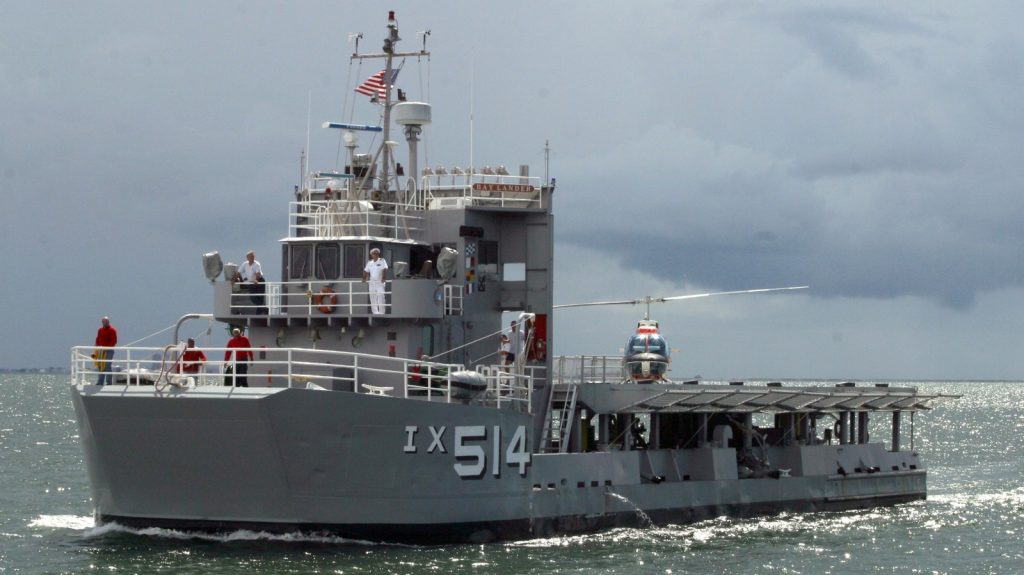
| Baylander (IX-514) | Helicopter Landing Trainer | World’s smallest aircraft carrier deck at just 131 feet long | 1968–2012 |
| USS Plainview (AGEH-1) | Hydrofoil Test Vessel | World’s largest hydrofoil powered by jet aircraft engines | 1969–1978 |
| NR-1 | Deep-Submergence Submarine | Micro nuclear sub equipped with seafloor wheels and 30-day submerged range | 1969–2008 |
| USNS Hughes Glomar Explorer | Deep-Sea Salvage / Drillship | Covert CIA mechanical claw ship built for Project Azorian | 1974–2015 |
| Sea Shadow (IX-529) | Experimental Stealth Vessel | Angular A-frame SWATH hull designed for minimal radar cross-section | 1985–2006 |
| 19BB Boomin’ Beaver | Port Security Tugboat | 19-foot micro-tug powered by a 260 hp Cummins engine to move security barriers | 1980s–Present |
1. USS Monitor
When the USS Monitor launched in 1862, traditional ocean-going warfare relied almost exclusively on multi-masted wooden frigates with broadside cannons. Designed by John Ericsson, the ironclad Monitor challenged every convention of 19th-century naval warfare. Its low-profile armored deck rode flush with the waterline, leaving almost no target profile exposed to enemy gunners.
The centerpiece of the Monitor was its revolving steam-powered gun turret, which housed two heavy 15-inch smoothbore Dahlgren guns. This breakthrough design permitted 360-degree firing coverage without needing to turn the ship. Although the vessel sank off Cape Hatteras in late 1862 during a severe storm, its famous engagement with the CSS Virginia marked the end of wooden warship construction worldwide.
2. USS Reina Mercedes (IX-25)
The operational history of the USS Reina Mercedes is defined by extreme adaptation. Originally constructed as an armored cruiser for the Spanish Navy, the vessel was captured during the Spanish-American War in 1898 after being sank and subsequently raised by American forces. The U.S. Navy refitted the captured hull and moored it indefinitely at Annapolis, Maryland.
For decades, the Reina Mercedes served as a stationary depot vessel and an unofficial brig for midshipmen attending the nearby U.S. Naval Academy. Cadets sentenced to disciplinary confinement lived aboard the stationary hull for up to two months while completing their academic routines. Despite remaining immovably tied to its pier until scrapped in 1957, sailors humorously dubbed her the fastest ship in the fleet.
3. USS Wolverine (IX-64)
During the height of World War II, the U.S. Navy needed to train thousands of naval aviators quickly without exposing fleet aircraft carriers to enemy submarine patrols in coastal waters. The solution was the conversion of the Seeandbee, a civilian paddle-wheel passenger steamer operating on the Great Lakes, into the USS Wolverine.
Stationed at Navy Pier in Chicago, Illinois, the Wolverine lacked hangar decks, elevators, and weapons systems. However, its expansive wooden flattop deck provided an ideal platform for carrier landing practice. Combined with its sister training ship, the USS Sable, the Wolverine helped qualify more than 18,000 naval pilots in the safe environment of Lake Michigan before the end of WWII.
4. USS Echo (IX-95)
Logistical demands during World War II forced military planners to press almost any functional hull into service. Among the strangest additions was the USS Echo, a traditional two-masted wooden sailing scow originally constructed in 1892. Transferred from New Zealand under lend-lease arrangements, the 50-year-old vessel was commissioned into U.S. military service in 1942.
Because the Echo appeared completely obsolete and civilian, it operated with minimal interference in patrolled waters across the South Pacific. Commanding officer Lt. Meredith Riddle utilized the scow’s innocent profile to insert coastal observers behind enemy lines and deliver vital supplies. The unique exploits of this century-old wooden vessel later inspired the Hollywood motion picture The Wackiest Ship in the Army.
5. USS Pueblo (AGER-2)
The USS Pueblo is unique not because of its physical layout—it was converted from an obscure light cargo vessel—but because of its present operational status. In January 1968, while conducting electronic intelligence collection in international waters, North Korean naval forces ambushed and captured the vessel during what became known as the Pueblo Incident.
The surviving crew members were released after 11 months of captivity, but the vessel remained in North Korea. Today, the Pueblo sits moored along the Pothonggang Canal in Pyongyang as a museum display. Despite remaining physically held by a foreign power for over half a century, the Pueblo officially remains an active commissioned warship on the U.S. Navy’s official registry.
6. R/P FLIP
Developed for the Office of Naval Research, the Research Platform FLIP (Floating Instrument Platform) resembled a standard ocean barge while under tow. However, once positioned at its scientific destination, the 355-foot structure flooded its massive aft ballast tanks, causing the entire vessel to pitch backward 90 degrees until only 55 feet remained above water.
By submerging 300 feet of its superstructure straight down, FLIP achieved extreme stability against surface ocean waves. Scientists used the platform to collect high-precision acoustic data, wave heights, ocean temperatures, and atmospheric measurements. Decommissioned in 2023 after six decades of scientific operation, the vessel was acquired by private entities for ongoing marine research adaptation.
7. Baylander (IX-514)
While supercarriers stretch over 1,000 feet in length, the Baylander holds the distinction of being the smallest flattop ever operated by the U.S. military. Originally built in 1968 as a harbor utility craft for service in Vietnam, the Navy overhauled the deck in 1986 to function as a specialized Helicopter Landing Trainer.
Operating in restricted coastal waterways, the Baylander provided rotorcraft pilots with realistic deck landing simulations on a moving vessel. Over 25 years of service, the miniature carrier safely managed more than 122,000 rotary wing landings. Following decommission in 2012, the vessel was repurposed into a popular floating restaurant and educational museum tied up along the Hudson River in New York City.
8. USS Plainview (AGEH-1)
During the Cold War, experimental high-speed hull concepts were pursued to counter quiet fast-attack submarines. Commissioned in 1969, the USS Plainview was constructed to test large-scale hydrofoil technology. Weighing 315 tons, it remains the largest hydrofoil vessel ever built.
To propel the hull entirely out of the water, engineers installed two General Electric LM1500 gas turbine engines derived from F-4 Phantom fighter jets. Resting on retractable submerged wing foils, the Plainview reached ocean speeds exceeding 57 knots (66 mph). Following its experimental phase, the ship was decommissioned in 1978 and currently rests abandoned along the Columbia River in Oregon.
9. NR-1
Launched in 1969, the highly classified NR-1 was the smallest nuclear-powered submarine ever placed into active service. Displacing just 400 tons and measuring less than 148 feet long, the tiny sub accommodated a crew of 11 personnel, including specialist ocean scientists. Its primary objective was deep-sea salvage and covert seabed reconnaissance.
Equipped with retractable bottom wheels, heavy structural mechanical arms, and external lights, the sub could roll directly across the ocean floor at depths reaching 3,000 feet. Powered by a miniature nuclear reactor, NR-1 stayed submerged for 30 consecutive days, helping locate lost military ordnance, oceanographic features, and wreckage from the Space Shuttle Challenger.
10. USNS Hughes Glomar Explorer
Outwardly resembling a commercial offshore oil drillship, the Hughes Glomar Explorer was built in secret under the direction of industrialist Howard Hughes. In reality, the ship served as the deep-sea extraction platform for Project Azorian, a covert 1970s CIA operation designed to retrieve K-129, a sunken Soviet ballistic missile submarine sitting 16,500 feet deep in the Pacific.
The vessel featured a massive mechanical claw mechanism designed to lower through a central internal bay to grip the seabed wreckage. Despite partial mechanical failure during lifting operations in 1974, the platform successfully recovered portion of the Soviet submarine. The ship was later retrofitted for commercial deep-sea drilling before being sold for scrap in 2015.
11. Sea Shadow (IX-529)
Constructed inside a covered floating drydock by DARPA and Lockheed Martin in 1984, the Sea Shadow looked more like a stealth aircraft than a traditional ship. Featuring a Small Waterplane Area Twin Hull (SWATH) layout, the vessel utilized outward-slanting outer walls to deflect radar emissions away from receiving sensors.
The 563-ton vessel required a crew of only four sailors thanks to automated control systems. Although the Sea Shadow was never formally commissioned for active fleet deployment, its experimental stealth profile, structural composites, and wave-canceling submerged pontoons laid the architectural foundation for modern stealth destroyers.
12. 19BB Boomin’ Beaver
Measuring just 19 feet long and 10 feet wide, the 19BB “Boomin’ Beaver” is officially the smallest operational workboat utilized by the U.S. Navy. Despite their miniature appearance, these heavy-duty micro-tugs pack substantial industrial power aimed at maintaining base security infrastructure.
Powered by a turbocharged 260-horsepower Cummins inline-6 diesel engine, each Boomin’ Beaver generates up to 7,500 pounds of raw pulling force. The U.S. Navy relies on these micro-vessels to maneuver, repair, and position heavy floating Port Security Barriers around high-value targets, including docked submarines and aircraft carriers inside military harbors.
Frequently Asked Questions
What is the smallest active vessel utilized by the U.S. Navy?
The smallest operational workboat in the U.S. Navy inventory is the 19BB “Boomin’ Beaver.” Measuring just 19 feet long, these micro-tugboats feature 260-horsepower diesel engines capable of pulling floating security barriers into place around naval stations and anchored warships.
Why is the USS Pueblo still listed on active status by the U.S. Navy?
The USS Pueblo was captured by North Korean forces in 1968 and currently sits moored in Pyongyang as a propaganda exhibit. However, the U.S. Navy maintains the vessel on its official Naval Vessel Register as a commissioned warship to signal that its unlawful seizure is not legally recognized.
Did the U.S. Navy actually operate aircraft carriers on freshwater lakes?
Yes. During World War II, the U.S. Navy converted two Great Lakes passenger side-wheel steamers into the training carriers USS Wolverine and USS Sable. Stationed in Chicago on Lake Michigan, these freshwater flattops qualified over 18,000 aviators without exposing them to coastal enemy submarine attacks.