
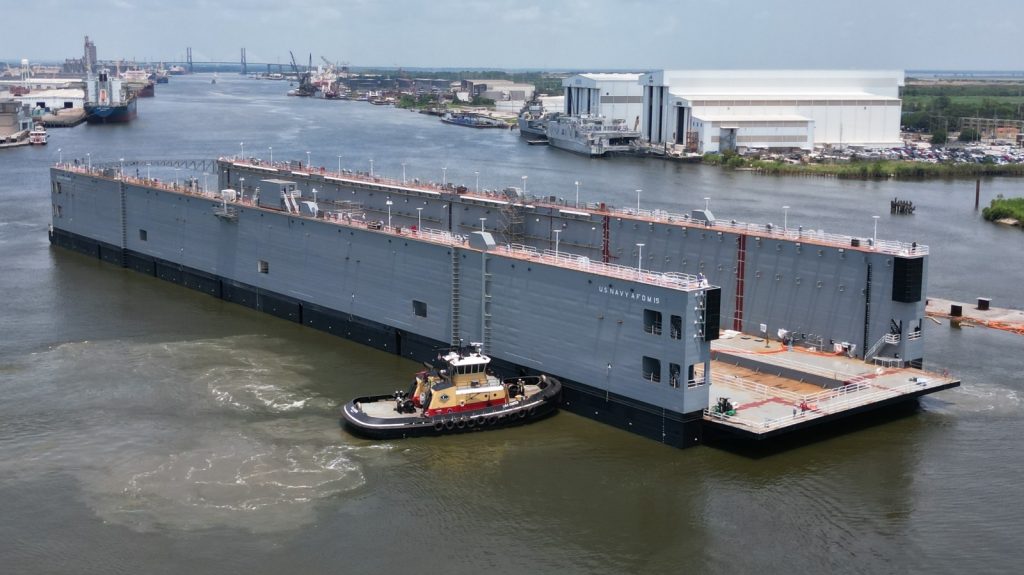
Standard naval warfare discussions usually center around aircraft carriers and stealth submarines, but the operational backbone of fleet readiness relies on far more specialized maintenance platform vessels. Among these unique support structures is a massive, non-traditional vessel built specifically to lift fully loaded warships entirely out of the ocean.
The U.S. Navy’s Auxiliary Floating Dry Dock Medium (AFDM) is an 18,000-long-ton capacity submersible platform engineered to submerge, capture, and elevate heavy surface combatants for critical repairs. Constructed by Austal USA and launched on July 28, 2026, this 694-foot Rennie-type floating dry dock provides mobile overhaul services for destroyers, cruisers, and amphibious landing ships without requiring stationary shipyard infrastructure.
Engineering and Specifications of the AFDM
The AFDM features a distinctive silhouette defined by continuous side wing walls and pontooned deck sections that extend 65 feet high from the baseline to the wing deck. Weighing 12,000 tons, the structure provides a massive working deck surface area measuring 90,800 square feet.
With a maximum lifting rating of 18,000 long tons (LT), the dock easily handles the U.S. Navy’s principal surface combatants. For comparison, a modernized Arleigh Burke-class destroyer displaces approximately 8,558 LT, while a Ticonderoga-class cruiser displaces around 9,600 LT. By sinking below the keel of a target ship and pumping out internal ballast water, the AFDM utilizes controlled buoyancy to raise both itself and the warship above the waterline.
| Key Metric / Specification | Details |
|---|---|
| Vessel Classification | Auxiliary Floating Dry Dock Medium (AFDM) |
| Structural Style | Rennie-Type Floating Dry Dock |
| Overall Length | 694 feet |
| Baseline to Wing Deck Height | 65 feet |
| Working Surface Area | 90,800 square feet |
| Displacement Weight | 12,000 tons |
| Maximum Lifting Capacity | 18,000 Long Tons (LT) |
| Compatible Ship Classes | Arleigh Burke Destroyers, Ticonderoga Cruisers, Freedom-variant LCS, Whidbey Island & Harpers Ferry Landing Ships |
A Long Lineage of Navy Floating Docks
While the modern AFDM incorporates updated maritime technology, the core concept behind floating dry docks dates back over a century within American naval tradition. These platforms rely on external tugboats for transportation, as typical floating docks lack internal propulsion engines.
The U.S. Navy commissioned its first modern Yard Floating Dock, designated YFD-2, in 1902. YFD-2 was present during the attack on Pearl Harbor on December 7, 1941, where it was initially sunk alongside other vessels. Salvage crews later raised and repaired the dock, returning it to active duty to service damaged warships throughout World War II.
To support vast ocean campaigns during the Second World War, the Navy constructed more than 150 floating dry docks of varying lifting capacities. The newly launched AFDM carries forward this century-long tradition of mobile naval maintenance, ensuring surface fleets remain mission-ready far from home ports.
Frequently Asked Questions
How does an auxiliary floating dry dock raise a warship?
The dock floods its pontoon chambers with sea water, causing the structure to sink low enough for a target ship to float inside its wing walls. Once the vessel is secured directly over keel blocks, internal pumps discharge the ballast water, restoring buoyancy and lifting the entire structure along with the target ship clear of the water.
Which ships can the AFDM accommodate?
Featuring an 18,000-long-ton lifting capacity, the AFDM can comfortably service Arleigh Burke-class destroyers, Ticonderoga-class cruisers, Freedom-variant Littoral Combat Ships, as well as Whidbey Island and Harpers Ferry-class dock landing ships.
Can the AFDM travel under its own power?
No, Rennie-type floating dry docks like the AFDM do not feature native propulsion systems. Tugboats must tow the platform to designated marine repair areas before flooding operations begin.