
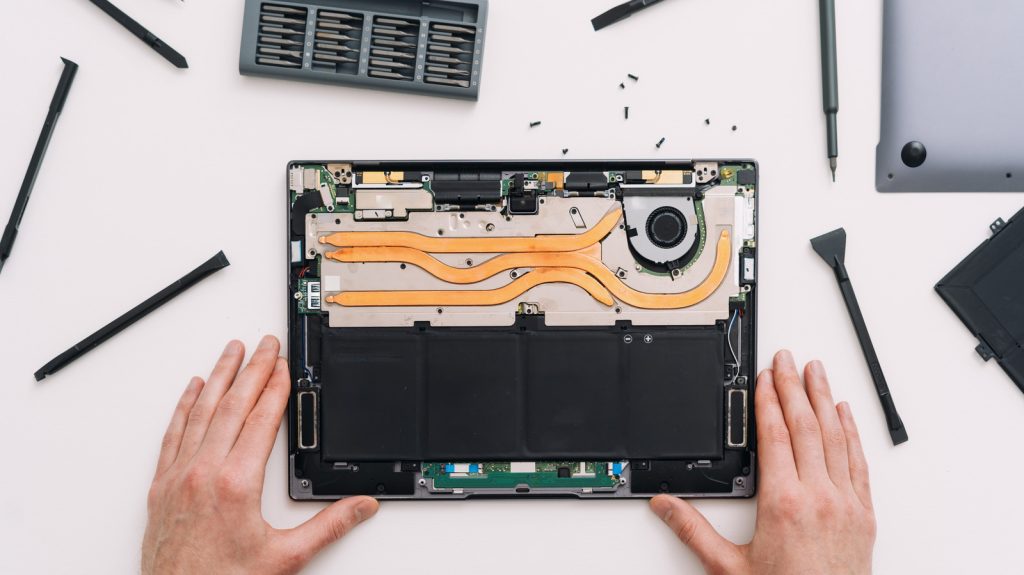
Modern consumer electronics rarely let users pop off a back cover and swap out a depleted battery. While this shift frustrated many long-time users, manufacturers made the choice to trade easily replaceable power cells for sleeker hardware, larger battery capacities, and enhanced environmental protection.
This overview examines why technology manufacturers transitioned from removable to integrated batteries across smartphones, laptops, and gaming handhelds. It explains the design trade-offs involved in modern battery architecture, details how advancements in energy density shaped this change, and outlines upcoming European Union regulations that could mandate replaceable power cells by 2027.
Design and Engineering Trade-Offs
The transition away from user-replaceable batteries was driven primarily by physical engineering requirements. To make a battery removable, manufacturers must enclose the cell in a protective hard casing and build a dedicated compartment inside the device frame. Eliminating those structural layers reclaims valuable internal space, allowing engineers to fit a significantly larger battery into the exact same form factor.
Apple demonstrated this design choice in 2009 when it introduced a fixed battery in its 17-inch MacBook Pro. Facing user criticism, the company explained that abandoning the removable compartment created enough space to increase total battery capacity without increasing the laptop’s weight or thickness. Additionally, integrated lithium-ion cells can be manufactured in asymmetrical, custom shapes to fill tiny internal crevices that traditional rectangular compartments cannot utilize.
Evolution in Battery Chemistry and Charging Tech
During the 1990s and 2000s, swappable batteries were standard across devices like mobile phones, laptops, and handheld consoles such as the Nintendo 3DS, 3DS XL, and 2DS. Devices from that era relied on older battery chemistries like nickel-metal hydride (NiMH) and nickel-cadmium (NiCd), which suffered from capacity degradation caused by the memory effect. Slow charging speeds also meant users depended on carrying pre-charged spare batteries to avoid lengthy plugged-in downtime.
| Feature / Spec | Removable Battery Era | Integrated Battery Era |
|---|---|---|
| Primary Battery Chemistry | Nickel-Cadmium (NiCd) & Nickel-Metal Hydride (NiMH) | Lithium-Ion & Silicon-Carbon |
| Structural Design | Thicker profile, separate battery compartment required | Thinner chassis, custom-shaped internal cells |
| Ingress Protection | Limited water/dust resistance due to opening back covers | Easier to achieve dust and water resistance (e.g., IP67) |
| Power Restoration | Physical cell swapping with external desktop chargers | High-wattage fast charging, power banks, battery cases |
Modern battery chemistry has minimized many of those original hardware limitations. The adoption of high-density lithium-ion and emerging silicon-carbon cells provides far greater power retention in smaller volumes. Simultaneously, rapid charging protocols allow modern devices to regain hours of operating time in just a few minutes, reducing the practical need to carry physical spare batteries.
Regulatory Shifts and the Future of Swappable Power
While fixed batteries dominate the market, niche products like the Fairphone 6 and HMD Skyline have maintained user-replaceable power designs. Furthermore, a broader industry overhaul is underway due to updated European Union regulations designed to extend hardware lifespans and cut down on electronic waste.
Under the EU rules taking effect on February 18, 2027, most portable gadgets must feature user-swappable batteries. Smartphones can avoid this requirement only if they achieve an IP67 dust and water resistance rating while retaining at least 83% capacity after 500 charge cycles and 80% capacity after 1,000 cycles.
Manufacturers are already updating product lines to ensure compliance before the deadline. Sennheiser introduced its Momentum 5 wireless headphones with a swappable cell design. Similarly, Nintendo plans to release its new Joy-Con 2 controllers and an updated Pro Controller with user-replaceable power units, demonstrating how regional mandates are reshaping global device architecture.
Frequently Asked Questions
Why did companies stop putting removable batteries in smartphones?
Manufacturers eliminated removable batteries to build thinner devices, improve structural durability, and seal hardware against water and dust. Removing the dedicated battery housing also freed up internal space for larger power cells and advanced internal components.
Will future smartphones be required to have removable batteries?
In the European Union, regulations taking effect on February 18, 2027, will require most consumer tech items to feature user-replaceable batteries. Smartphones are exempt only if they maintain high battery longevity standards (80% capacity after 1,000 cycles) and hold an IP67 protection rating.
What modern gadgets currently feature user-swappable batteries?
While rare, modular smartphones like the Fairphone 6 and HMD Skyline still offer swappable cells. Newer accessories designed for EU compliance, such as Sennheiser Momentum 5 headphones and upcoming Nintendo gaming controllers, are also reintroducing user-replaceable power structures.