
Managing decommissioned wind turbine blades presents a complex recycling challenge due to their immense scale and tough composite materials. Rather than allowing these retired components to fill up municipal landfills, engineers, architects, and artists are finding creative secondary uses for these giant structures.
This guide highlights five practical applications for retired wind turbine blades, ranging from heavy civil infrastructure to public art installations. Specialized engineering firms and creative studios are transforming decommissioned composite blades into lightweight concrete building materials, children’s play structures, pedestrian footbridges, urban furniture, and civic monuments, offering durable upcycling solutions that divert heavy industrial waste from landfills.
| Repurposing Application | Key Project / Organization | Primary Location | Key Benefits & Features |
|---|---|---|---|
| Concrete Blocks & Curtain Walls | Renewablade / Vattenfall Project | Des Moines, Iowa & Lund, Sweden | Creates lighter construction barriers and weather-resistant parking garage curtain walls. |
| Interactive Playgrounds | Superuse Studios | Netherlands | Uses hollow shells for climbing tunnels and play forts; cuts construction carbon emissions by up to 90%. |
| Pedestrian Footbridges | BladeBridge | Cork, Ireland & Draperstown, Northern Ireland | Replaces steel girders with structural composite blades at lower financial and environmental costs. |
| Urban Benches & Planters | DTE Energy / BladeBridge / Noblewins | Detroit, Michigan & Ireland | Converts hollow blade segments into modular seating and public plant containers. |
| Civic Art & Snow Barriers | Chris Navarro / Nayan Kulkarni | Wyoming, USA & Hull, England | Repurposes full-length blades and cut sections into functional wind fences and urban installations. |
Composite Material Upcycling into Concrete and Architecture
Full mechanical recycling of fiberglass turbine blades is technically possible. Companies like Carbon Rivers have developed techniques to break down blade steel and fiberglass while preserving raw glass fibers for new manufacturing. However, because specialized recycling remains capital-intensive, many industrial projects opt for direct structural upcycling instead.
One scalable application involves processing blade materials into composite concrete blocks. Processing firm Renewablade produces composite barriers that are significantly lighter and easier to haul than conventional concrete blocks. During campus construction, Mercy College of Health Sciences in Des Moines, Iowa deployed 28 of these turbine-blade composite barriers around work sites.
Decommissioned blades are also taking on secondary roles as architectural cladding. In Lund, Sweden, designers incorporated dozens of retired blades as exterior curtain walls for a 365-car parking facility. Developed under a design strategy of visible sustainability, the installation shields the structure while pairing alongside rooftop solar power array installations and pollinator gardens.
Repurposing Blade Shells into Urban Playgrounds
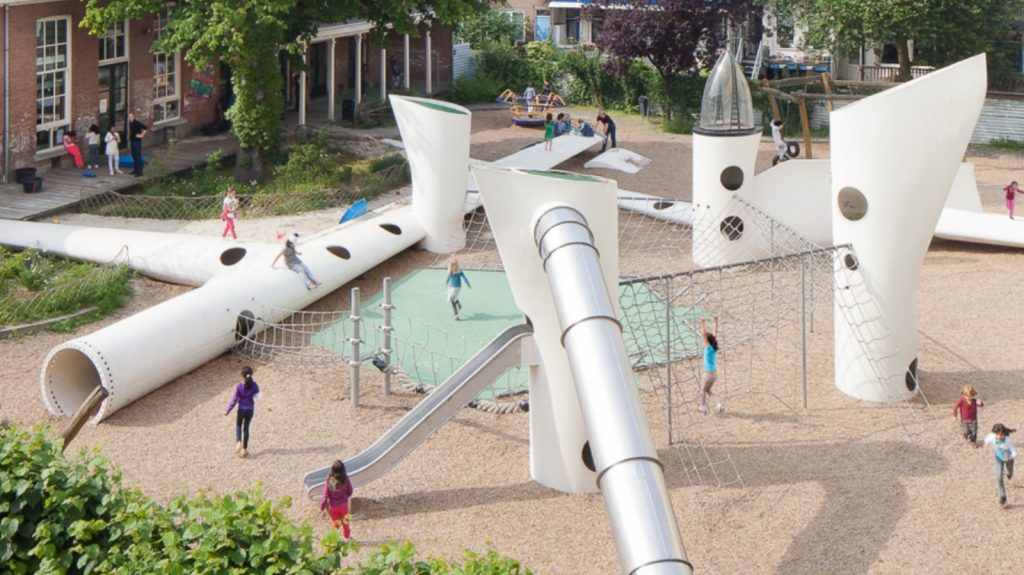
The interior voids of wind turbine blades make them naturally suited for modular play spaces. Architectural collective Superuse Studios specializes in converting industrial waste streams into public play structures, turning massive fiberglass pieces into engaging urban playgrounds for children.
The organic curvature of turbine blades enables them to serve as climbing tunnels when modified with multiple entry points. When cut into segments and secured upright, they form sturdy play towers capable of supporting slides, climbing ropes, and heavy foot traffic. By 2022, Superuse Studios had repurposed 27 turbine blades across various projects in the Netherlands, achieving an estimated 90% reduction in carbon emissions compared to standard playground construction.
Replacing Structural Steel in Pedestrian Footbridges
Thanks to their inherent structural rigidity and weather resistance, turbine blades offer an excellent alternative to conventional steel girders in bridge engineering. Design firm BladeBridge demonstrated this capability by building the Midleton to Youghal Greenway Bridge in Cork, Ireland. The 18-foot footbridge utilizes two retired LM13 blades as primary structural supports, completing construction in January 2022 for approximately $31,069.
Following this initial success, BladeBridge constructed a second bridge in Draperstown, Northern Ireland, with support from Science Foundation Ireland, the Northern Ireland Department of the Economy, and the US National Science Foundation. Completed in April 2022 for roughly £10,808, the 19-foot span features a timber deck supported by two blade girders fitted with bolted steel angles, proving that composite blades can significantly reduce infrastructure material costs.
Modular Public Furniture and Civic Planters
Smaller cut segments of hollow turbine blades are increasingly being repurposed into functional civic furniture. At DTE’s Warren Service Center in Detroit, Michigan, workers trimmed blade sections, added false bottoms, drilled drainage ports, and padded the edges with protective foam to create durable public planters.
BladeBridge introduced similar bench-planter concepts at the 2025 Wind Energy Ireland Expo. One notable configuration arranged three LM13 blade segments into a three-spoke seating cluster designed to foster conversation in public plazas. Private manufacturers, including Noblewins, have also entered the market, offering custom commercial blade benches for specialized landscape design projects.
Monumental Public Art and Functional Snow Barriers
Artistic installations provide another compelling avenue for blade upcycling. In Wyoming, artist Chris Navarro arranged sliced blade segments into a dual-purpose snow fence and civic art piece. Adorned with painted murals, the structure provides physical wind protection along local roadways while serving as a visual statement on material renewal.
In urban settings, intact blades create dramatic artistic monuments. As part of the Hull UK City of Culture 2017 event, multimedia artist Nayan Kulkarni temporarily installed a full 246-foot turbine blade through the center of Hull in East Yorkshire, England. Titled “Blade,” the installation required specialized support tripods, heavy cranes, and the temporary removal of streetlights and traffic signals to position the massive clean-energy structure inside a dense city square.
Frequently Asked Questions
Why are wind turbine blades difficult to recycle using standard methods?
Wind turbine blades are manufactured from tightly bonded fiberglass, resin, and steel composites designed to endure severe weather conditions. Separating these mixed materials requires specialized, highly energy-intensive chemical or thermal processes, making physical upcycling into structural items far more cost-effective.
How long do wind turbine blades remain operational before retirement?
Most utility-scale wind turbine blades operate for roughly 7 to 10 years before cumulative mechanical stress and physical wear require them to be decommissioned and replaced.
Are repurposed wind turbine bridges safe for public use?
Yes. Repurposed blade bridges undergo rigorous structural engineering assessments and mechanical stress testing prior to installation. Projects like the Greenway Bridge in Cork, Ireland remain open to public pedestrian traffic under ongoing structural monitoring.