
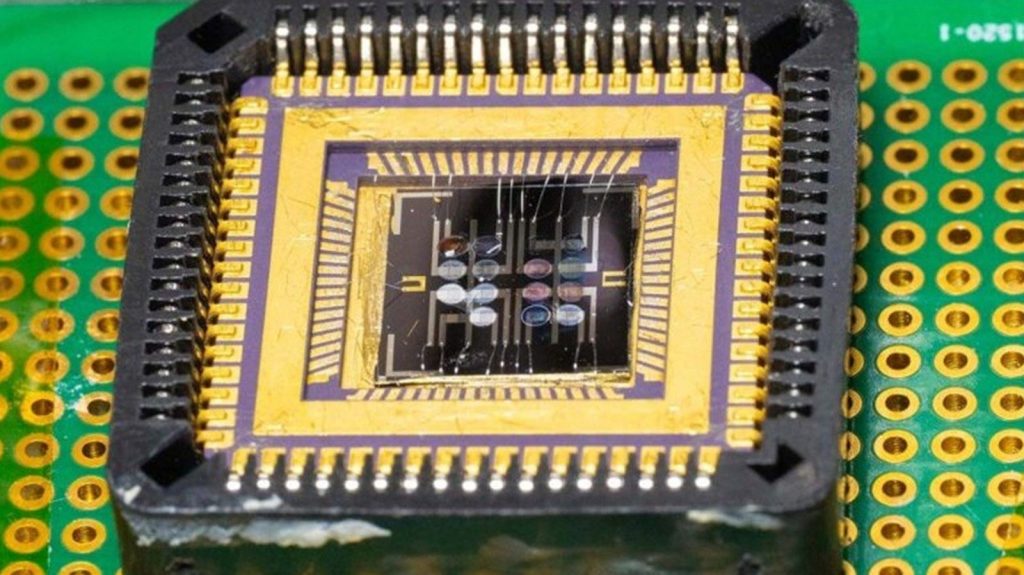
Food poisoning and unexpected allergic reactions remain constant concerns in home kitchens and the commercial food sector. To tackle these hazards, researchers at UC Berkeley led by doctoral student Carla Bassil are developing an electronic “e-nose” designed to identify chemical signatures of spoilage and common food allergens before consumption.
This sensory innovation utilizes a 16-sensor chip paired with machine learning algorithms to evaluate volatile gaseous compounds released by food products like milk, raw chicken, and nuts. Operating with a 92.6% benchmark accuracy, the prototype aims to eventually offer real-time contamination and allergen detection through mobile hardware and consumer applications.
| Feature / Metric | Specification & Details |
|---|---|
| Lead Institution | University of California, Berkeley (Led by Carla Bassil) |
| Core Hardware | 16 micro gas sensors acting as digital sensory receptors |
| Current Accuracy Rate | 92.6% in identifying tested spoilage and allergen signals |
| Sensitivity Limit | Detects down to 0.05 grams of walnut (1/100th of a shelled walnut) |
| Analysis Method | Machine learning classification of distinct gas molecules |
| Primary Technical Limit | Signal overlap in complex, multi-gas environments |
How the 16-Sensor Microchip Operates
The core mechanism of the electronic nose relies on a microchip equipped with 16 distinct gas sensors. Each sensor functions similarly to a digital taste bud, reacting uniquely to specific gas molecules emitted by food items. When exposed to an air sample, the sensors convert chemical interactions into measurable electrical signals.
Machine learning models analyze these electrical patterns to categorize the state of the food. During laboratory training, the device learned to differentiate between fresh milk or raw chicken and samples left at room temperature for several days. This enables the sensor array to map precise chemical signatures associated with organic decomposition.
Allergen Detection Capabilities and Current Limitations
In controlled tests, the e-nose demonstrated high sensitivity, detecting as little as 0.05 grams of walnut—roughly one-hundredth of a shelled nut. However, transitioning from isolated lab samples to real-world environments presents notable engineering hurdles.
The device struggles when multiple volatile organic compounds exist simultaneously. For instance, testing a single allergen inside a complex dish, such as a salad or baked good, remains unproven. Similarly, background odors inside a standard household refrigerator can obscure spoiled food signals.
Sensor overlap also creates classification challenges between chemically similar items. The device currently experiences confusion between peanut and hazelnut compounds, and it records similar elevated gas levels for both rotten boiled eggs and spoiled raw chicken.
Future Roadmap and Consumer Integration
To resolve signal overlap, Carla Bassil and the UC Berkeley research group are expanding field tests across more varied environment types. Refining the machine learning training sets will help the sensor array distinguish subtle differences between overlapping compound profiles.
The ultimate goal is to miniaturize this sensor technology for widespread practical use. Researchers envision integrating similar micro-sensor arrays directly into everyday devices, potentially enabling smartphone applications that